Other (Less Urgent) Things To Do Regarding The Tax Bill (TCJA)

The following is a quick brainstorming list of things to think about doing if/when the TCJA becomes law.  They don’t need to be done before the end of 2017 so I carved them out separately from my previous post.

  1. Update your tax withholding to account for your new level of deductions. Note that IRS guidance on this may be delayed until late Jan / early Feb due to the complexity in calculations.
  2. Payoff HELOC debt if the loss of tax deductibility makes the after-tax interest rate cost prohibitive vs. other options.
  3. Revise estate plan (if necessary) to account for bigger exemption. Consider lifetime gifting plans to take advantage of the bigger exemption if estate tax may be an issue for you in the future.
  4. Increase 529 contributions to account for private K-12 expenses if you know you will incur those expenses.
  5. Keep in mind that alimony will not be deductible to the payer / taxable to the receiver starting with divorces that take place after 12/31/18 (the bill gives one extra year to prepare for this).
  6. If you have any children with financial accounts in their names, review the new “kiddie tax” rules and plan accordingly as their tax system has shifted to follow the trusts and estates rates.
  7. If you have an AMT credit, likely due to the exercise of an Incentive Stock Option, without a corresponding sale in the same year, prepare for that credit to get “released” more quickly (i.e. larger credit each year until fully used).
  8. Note that the floor for deducting medical expenses in 2017 and 2018 only, is changing from 10% to 7.5% (if you’re able to itemize). For some, this may mean tracking their out-of-pocket expenses and providing them to their tax preparer at tax time.  Again, this is retroactive and applies to 2017.
  9. Since unreimbursed employee expenses are no longer deductible, the days of keeping mileage logs to take a tax deduction for use of your vehicle for work as an employee are over (unless required for your employer to reimburse you). In a related note, if you use your car for work as an employee (outside of commuting) and your employer doesn’t pay for that mileage, it’s worth discussing that with them since you are no longer going to be able to deduct the mileage for tax purposes.
  10. If you own a business, client entertainment is no longer deductible. Meals are still 50% deductible.  Keep that in mind when setting up events if the tax treatment matters.
  11. Employers can no longer reimburse employees tax-free for moving expenses. Any moving expense that an employer pays will be considered taxable income.  If you’re signing on with a new employer and they say they’ll pay for moving expenses, ask them to “gross up” those payments such that you are made whole after-tax.  If they refuse, note that they’re really only paying / reimbursing you for 55-80% of the net moving cost.

What To Do (or not do) In 2017 Regarding The Tax Bill (TCJA)

The House and Senate have now passed the tax bill (though the House needs to vote again after some minor amendments in the Senate) and then it will be on its way to the President for signature.  While anything is possible, and the odds of the President signing in January rather than December have increased dramatically, it seems safe to assume that the bill will eventually become law.  There’s not a ton of time left to take action and there aren’t a lot of people who can take any action to take advantage of / avoid the disadvantages of the new tax law.  In this post, I’ll outline what you might be able to do, why you might be able to do it, and (maybe most importantly) why it may not work in certain situations.  These are general rules.  Proceed with caution.  Things can get very complicated and unintended consequences are possible.  The bill has not yet become law and there is some small risk that something prevents it from becoming law which means that actions you take under the assumption that it will become law may backfire.  I tried to keep this list simple, but unfortunately, there’s just no way to do that while providing enough actionable information.  Taxes simply aren’t simple.  Thanks Congress!

Consideration #1

Because: Federal tax rates are falling for every tax bracket in 2018,

Consider: Deferring income to 2018 from 2017 when you have the ability to do so,

Unless: You’re going to have substantially more income in 2018 than 2017 that could push you up to the next tax bracket OR you’re able to deduct state income taxes this year that you won’t be able to deduct next year (see below) and those state income taxes cause more tax savings than deferring the income to a lower federal rate year.

Examples:

  • avoid exercising non-qualified employee stock options in December that could be exercised in January 2018 (all else being equal)
  • contribute more to your 401k in the final payroll of 2017 and less in 2018 (but not less than the match amount),
  • defer some end of year revenue if possible if you’re self-employed or have a side job, or accelerate some expenses that you can take in 2017 instead of 2018 (including equipment purchases that would qualify for Sec 179 immediate expensing). This is especially important if your business would qualify for the 20% deduction on pass-thru income in future years.
  • perform deductible repairs / maintenance on rental properties in 2017 that you were considering doing in 2018.

Consideration #2

Because: Federal tax rates are falling for every tax bracket in 2018,

Consider: Accelerating deductions to 2017 from 2018 when you have the ability to do so since they will have a larger impact in reducing your taxes in 2017,

Unless: You’re going to have substantially more income in 2018 than 2017 that could push you up to the next tax bracket OR those deductions wouldn’t provide as much (or any) benefit in 2017 as they would in a future year due to the Alternative Minimum Tax (AMT) in 2017, or because you can’t itemize in 2017.

Examples (but see below for limitations):

  • Pay any state income tax that you might owe for 2017 via an estimated tax payment before the end of 2017. Note: this won’t work if you’re already “in AMT” for 2017 and you have to reasonably believe that you owe what you pay (can’t just pay an extra amount in 2017 to deduct it Federally and then receive a big state refund in 2018 and take it as income Federally at a lower tax rate).
  • Pay your Jan 1st mortgage payment prior to the end of December 2017 (your mortgage lender should report the interest for that payment on your 2017 1098), though most people do this already.
  • Pay outstanding property tax bills that aren’t due until some time in 2018 before the end of 2017 (this is only relevant in certain jurisdictions that bill in one year but set the bill’s due date in the following year). Note: this won’t work if you’re already “in AMT” for 2017 and you generally can’t prepay future year property tax bills that haven’t been generated yet.
  • Make additional charitable contributions in 2017 that you would have otherwise made in a future year or consider starting a Donor Advised Fund which allows you to make a lump charitable contribution into a fund, take the full deduction this year, and then distribute to charity in future years as you see fit.
  • Take any Miscellaneous Itemized Deductions in 2017 that you would have otherwise taken in a future year (see link for list). Note: this won’t work if you’re already “in AMT” for 2017.

Comment: How do you know that you’re “in AMT” for 2017?  If your income and deductions are similar in 2017 than they were in 2016, you can use your 2016 taxes as a guide.  Check line 45 of your 2016 Form 1040.  If there is a number on it, you’re “in AMT” and assuming the same situation in 2017, you will not benefit from those items above marked as not working if you’re in AMT.  If there’s no number on line 45 it means you likely wouldn’t be in AMT if you didn’t pay additional state income / property taxes or those items that would be considered Misc. Itemized Deductions.  But, if you do make those extra payments, it could push you into AMT.  To determine how much room you have until you hit AMT, check with your tax preparer who should be able to go back to your 2016 return and slowly increase your deductions that aren’t deductible for AMT until you hit AMT.  That will give you an approximate limit to the extra payments you can make in 2017 before hitting AMT.  If your 2017 situation is different from 2016, then the only way to know how much room you have for additional payments in 2017 is to prepare a mock tax return for 2017 which is not an easy task as it means gathering all the information that would be on your tax documents (W-2, 1099s, 1098s, etc.) without actually getting your tax documents in the mail.

Consideration #3

Because: The standard deduction is increasing substantially starting in 2018, fewer and fewer people will be able to itemize, meaning that their deductions won’t provide any benefit above the standard deduction. To estimate whether you’ll be able to itemize or not in 2018, add up the following for 2018 (use your 2016 Schedule A as a guide if your situation is going to be the same:  1) state/local taxes = the sum of Line 5 + Line 6 of your Schedule A, but only $10k as a max, 2) mortgage interest = Line 15 of your Schedule A (but back out any mortgage interest that’s associated with a HELOC, 3) charitable contributions = Line 19 of your Schedule A.  If you are single and the above adds up to less than $12k or if you’re married filing jointly and it adds up to less than $24k,

Consider: Accelerating deductions to 2017 from any future year.

Unless: those deductions wouldn’t provide any benefit in 2017 due to the Alternative Minimum Tax (AMT) in 2017, or because you can’t itemize in 2017.

Examples: Same as Consideration #2

Comment: Same as Consideration #2.

Consideration #4

Because: The deduction for state/local taxes paid is going to be limited to $10k per year (both Single and Married Filing Jointly!), which includes state/local income taxes, sales taxes, and property taxes,

Consider: Accelerating deductions to 2017 from 2018 for state/local income/sales taxes or property taxes,

Unless: those deductions wouldn’t provide any benefit in 2017 due to the Alternative Minimum Tax (AMT) in 2017, or because you can’t itemize in 2017.  Note that if the total of your state/local tax deductions in future years will be less than $10k, the only benefit here is that which is described by #2 above.

Examples (note that none of these work in AMT):

  • Pay any state income tax that you might owe for 2017 via an estimated tax payment before the end of 2017. Note that the tax bill specifically outlaws pre-paying 2018 state income taxes.  They would not be deductible in 2017 and would instead be treated as paid in calendar 2018 so that the system can’t be gamed.
  • Pay outstanding property tax bills that aren’t due until some time in 2018 before the end of 2017 (this is only relevant in certain jurisdictions that bill in one year but set the bill’s due date in the following year). You can only do this if the bill has already been generated.  Also, for those who pay their property taxes through an escrow account, you can still make a payment out-of-pocket.  Your escrow company will eventually make the same payment and it should be refunded back to the escrow account or back to you at that time.  If it goes back to the escrow account, your next escrow reconciliation will pick up the overpayment and refund it back to you.
  • If you live in a state with no income tax and you instead deduct sales taxes, and you’re planning to buy a big ticket item (car, truck, boat) soon, do it before the end of 2017 so you get the additional sales tax deduction in 2017.

Individual Income Tax Provisions of the TCJA – now updated w/ details of the final bill

The Conference Committee has now released their Conference Report which resolves the differences between the bills passed by the House and the Senate.  In a previous post, I noted those differences.  In this post, I’ll note the corresponding provisions in the conference report.  This final bill will need to be passed on both chambers and then signed by the president to become law.  Prediction markets currently give a ~90% chance of this happening prior to the end of 2017, a ~5% chance of it passing in the first half of 2018, and a ~5% chance of it not passing at all.  So this is pretty close to a done deal.

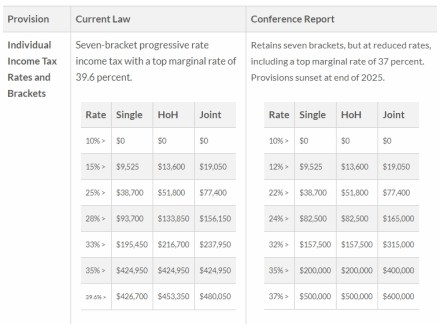
  • Income Tax Rates – lower rates for all, temporarily through 2025, but different from both the House and Senate plans.  See comparison of today’s rates vs. the rates in the final bill below, courtesy of The Tax Foundation.  All rates revert to 2017 law (indexed for inflation) after 2025 unless extended by another Congress.

rates

  • Kiddie Tax – follows the Senate proposal, such that a child’s investment income is taxed with trust and estates rates (higher), vs. being taxed at the parent rate after a threshold.  Reverts to existing law after 2025.
  • Tax Rates for Dividends and Long-Term Capital Gains – remain as they are today.  0% applies if income puts you in the old 0%, 10%, or 15% tax bracket, 15% applies if in the prior 25%, 33%, or 35% bracket, and 20% applies if in the old 39.6% bracket.
  • Capital Gain / Loss Tax-Lot Accounting – the provision to force First In First Out (FIFO) treatment on sales was eliminated.  Current rules which allow LIFO, specific, ID, or FIFO remain in effect.
  • Alternative Minimum Tax (AMT) – follows the Senate proposal.  AMT is not repealed, but the exemptions amounts are increased and the phaseout income at which the exemption begins to be reduced is also increased.  When combined with the SALT limitations and the elimination of miscellaneous itemized deductions subject to the 2% of AGI floor (see below), AMT shouldn’t impact nearly as many taxpayers as it previously did.  Reverts to existing law after 2025.
  • Standard Deduction – increased to $12k single, $24k MFJ.  This increase, when combined with the SALT limitations and the elimination of miscellaneous itemized deductions subject to the 2% of AGI floor (see below) means fewer taxpayers will itemize their deductions.  Reverts to existing law after 2025.
  • Child Tax Credit – credit is increased to $2k per child ($500 for other dependents like parents), and begins to phase out at $200k single, $400k MFJ.  Reverts to existing law after 2025.
  • Adoption Credit / Credit for Plug-In Vehicles / Hope Scholarship Credit / Lifelong Learning Credit – no change to any of these.   Existing law remains in effect.
  • Itemized Deductions Limited – Keep in mind though that with the higher standard deductions, fewer people will need to itemize so loss of some of the below isn’t as bad as it seems.  All of these revert back to existing law after 2025.  These include:
    • State and Local Taxes (SALT) and / or Property Taxes will only be deductible up to a combined max of $10k.  Note that this is the same for Single and MFJ, thereby imposing a marriage penalty via this deduction.  Additionally a provision was added to disallow a 2017 deduction on 2018 state/local income taxes that are prepaid so that taxpayers can’t game the system by prepaying future year’s worth of state taxes in 2017.
    • Mortgage interest deduction would only be allowed on up to $750k of new mortgage debt (vs. $1M today), and there would be no more $100k of HELOC debt interest deduction allowed. Existing mortgages (closing prior to 12/15/2017 or with a binding contract prior to that date) would be grandfathered in the old rules.
    • Casualty loss deduction eliminated (unless specifically authorized by special disaster relief).
    • Medical expense deduction remains, with the AGI threshold reduced from 10% to 7.5% for 2017 and 2018 only (reverts to 10% thereafter).
    • Misc. Itemized Deductions that are subject to the 2% of AGI floor (see IRS Publication 529 for a list of these deductions) are all eliminated.
  • Other deductions / exclusions:
    • Moving expenses deduction eliminated.  Reverts after 2025.
    • Alimony deduction eliminated and alimony would no longer be taxable to the receiver.  Effective starting 2019 and does not revert after 2025.
    • Student loan interest deduction is NOT eliminated.  Existing rules are retained.
    • Tuition and fees deduction is NOT eliminated.  Existing rules are retained.
    • Sec 121 exclusion of gain on the sale of a principal residence is NOT changed.  The 2 of 5 year rule remains in effect with no income caps.
  • Retirement Accounts – generally unchanged except that 401k plan loan repayments get a little easier in the case of a termination. Rather than needing to repay the loan within 90 days of termination or treating the loan as a distribution, borrowers would have the ability to repay the loan to a new retirement plan or IRA by the due date of that year’s tax return (including extensions).
  • 529 College Savings Plans  enhanced to allow up to $10,000/year of tax-free distributions for private / homeschool K-12 expenses.  Edit 12/19/17 – after Senate amendments to conform to Reconciliation rules, the “homeschool” portion of this provision was dropped.  529 withdrawals cannot be used for homeschool expenses.
  • Estate Tax – is not repealed, but the exemption would be doubled (~$11M per person / $22M per couple).
  • ACA Individual Mandate – repeals the “Individual Mandate” (the provision that requires everyone to have health insurance, or pay a penalty on their taxes), by reducing the penalty for not having insurance to $0.
  • Employer Benefit Changes – No change to dependent care FSAs, adoption benefits, tuition reimbursement plans,  reduced / free tuition for employees of educational institutions, pre-tax transportation plans (parking / commuting). free gym memberships.  Tax-free moving expenses reimbursements would no longer be allowed though.   There would also no longer be deductions to the employer for (1) an activity generally considered to be entertainment, amusement or recreation, (2) membership dues with respect to any club organized for business, pleasure, recreation or other social purposes, or (3) a facility or portion thereof used in connection with any of the above items.

Over the next few days, I’ll post my thoughts on what, if anything, we can do before the end of 2017 to take advantage of (or limit the disadvantages of) the new tax laws going into effect.  Stay tuned!

Individual Income Tax Provisions of the TCJA – now updated w/ passed versions of House & Senate bills

  • Income tax rates fall for everyone. The current 7 tax brackets would be compressed into 5: 0%, 12%, 25%, 35% and 39.6% (the 0% rate applies due to deductions and exemptions which subtract from income causing the first $x of income to be subject to no tax).. For singles, the 12% rate would run to $45,000, the 25% rate would top out at $200,000, the 35% one would end at $500,000, and the 39.6% rate would kick in for taxable incomes that exceed $500,000. For marrieds, 12% rate up to $90,000, 25% would max out at $260,000, 35% would end at $1 million, and the 39.6% rate would apply above $1 million. The 12% on the first $45k or 90k of income wouldn’t apply for those in the top tax bracket. Note that this schema reduces the marriage penalty that exists in the current tax brackets since the married brackets (with the exception of the 25% bracket) are double the single brackets.

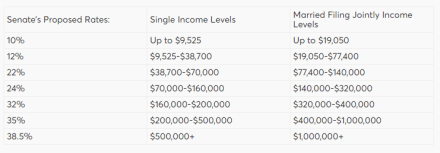
Senate Plan: 8 brackets, like today, but with different rates and caps as shown below:  

SenateBrackets

All of these bracket changes would now sunset at the end of 2025 and revert back to today’s rates (inflation adjusted).  Would also change the “kiddie tax” such that a child’s investment income is taxed with trust and estates rates (higher), vs. being taxed at the parent rate after a threshold.

  • No change in tax rates for dividends and long-term capital gains. 0% applies if income puts you in the old 0%, 10%, or 15% tax bracket, 15% applies if in the prior 25%, 33%, or 35% bracket, and 20% applies if in the old 39.6% bracket.

Senate Plan is the same and specifically calls out that only the FIFO (first in first out) method of tax lot reporting will be allowed for the determination of gain (or average cost in the case of funds).

  • AMT is completely repealed.

Senate Plan now retains the AMT, but increases the exemption amount by almost 40%, so that it will impact fewer taxpayers.

  • The standard deduction is increased for everyone, but the personal exemption no longer applies. The standard deduction would be $24,400 for married filers (vs $13k now) and $12,200 for singles (vs. $6500 now). The $4150 per person personal exemption (which was phased out for upper incomers and treated differently for those in AMT) is eliminated.

Senate Plan is esentially the same, though the house plan eliminated the extra standard deduction for those age 65 and over and those who are blind while the Senate retains those additional standard deduction amounts.

  • The child tax credit is increased. It would be $1600 per dependent age 16 and under (vs $1000 today). The income phaseouts are increased as well ($75k single / $115k married now to $115k single / $230k married).

Senate Plan would now increase the credit to $2,000 (up from 1650 in the original Senate plan) per dependent, raise the age to age 17 and under, and raise the income phaseouts to $500k single, $1M married.  These changes would now sunset at the end of 2025.

  • A new, temporary $300 tax credit for each adult taxpayer and each dependent over age 16. This applies for 5 years only and essentially offsets part of the loss of the personal exemption. It also phases out at higher incomes.

Senate Plan does not include this new temporary credit.

  • Several credits go away. These include:
    • Adoption Credit
    • Credit for purchase of Plug-In Vehicles
    • Hope Scholarship Credit & Lifetime Learning Credit, though the larger American Opportunity Credit remains.

Senate Plan retains these credits.

  • Several itemized deductions go away or are reduced. Keep in mind though that with the higher standard deductions, fewer people will need to itemize so loss of some of the below isn’t as bad as it seems.  These include:
    • State and local tax deduction eliminated.  Senate Plan is the same.
    • Property tax deduction limited to $10k per year and only applies to real estate (no more auto registration deduction).  Senate Plan is now the same ($10k limit)
    • Mortgage interest deduction would only be allowed on up to $500k of new mortgage debt (vs. $1M today), only for primary residences (vs. first and second homes today), and there would be no more $100k of HELOC debt interest deduction allowed. Existing mortgages (closing prior to 11/2/2017 or with a binding contract prior to that date) would be grandfathered in the old rules.  Senate Plan retains the $1M cap, but still eliminates the $100k of HELOC debt interest deduction.
    • Casualty loss deduction eliminated (unless specifically authorized by special disaster relief).  Senate Plan is the same.
    • Medical expenses > 10% of AGI deduction eliminated.  Senate plan retains this deduction and now reduces the AGI threshold to 7.5% for 2017 and 2018.
    • Tax prep fees, and unreimbursed employee expenses (including mileage) would be eliminated.  Senate plan also eliminates these deductions, but goes a step further by eliminating all Misc. Itemized Deductions that are subject to the 2% of AGI floor (see IRS Publication 529 for a list of these deductions).
  • Other deductions / exclusions go away or are reduced.  These include:
    • Moving expenses deduction eliminated.  Senate Plan is the same.
    • Alimony deduction eliminated and alimony would no longer be taxable to the receiver.  Senate plan does not modify alimony rules.
    • The student loan interest deduction is eliminated.  Senate plan retains this deduction.
    • The tuition and fees deduction is eliminated.  Senate plan retains this deduction.
    • Sec 121 exclusion of gain on the sale of a principal residence is significantly changed. Instead of the exclusion applying regardless of income as long as the seller owned and lived in the residence for 2 of the last 5 years, the exemption would now be phased out for upper incomers (starts at $250k individual and $500k married) and the own/live requirement would be 5 of the last 8 years.  Senate Plan also includes the 5 of the last 8 condition, but excludes the income caps.
  • Retirement accounts are unchanged (401ks, Traditional IRAs, Roth IRAs, SEPS, SIMPLES, etc.)

Senate Plan is now the same.

  • 529 College Savings Plans would be enhanced. Specifically:
    • $10,000/year of tax-free distributions would be allowed from 529 college savings plans for (private) elementary and high school expenses
    • 529s could be created for unborn children

Senate Plan now allows for the tax-free distributions for private K-12 education costs, but not the 529s for unborn children (which can be really be opened anyway in the parent’s name.

  • The estate tax would be reduced and then eliminated. The exemption would be doubled for 2018 and eliminated completely in 2024. The gift tax system would be kept in place to prevent gaming the income tax system by shifting assets to those in lower tax brackets.

Senate Plan doubles current exemptions, but keeps the estate tax in place.

  • ACA (“Obamacare”) provisions remain unchanged. The Individual Mandate (requiring health insurance or paying a penalty) remains, as do the other ACA-imposed Medicare surtaxes on wages and investment income.

Senate Plan now repeals the “Individual Mandate” (the provision that requires everyone to have health insurance, or pay a penalty on their taxes), by reducing the penalty for not having insurance to $0.  

  • Some employee benefits changes. These include:
    • No more dependent care FSAs
    • No more adoption benefits
    • No more tuition reimbursement plans and no more reduced / free tuition for employees of educational institutions.
    • No more moving expense reimbursements.
    • No more pre-tax transportation plans (parking / commuting).
    • No more free gym memberships or similar amenities without including their value in taxable income.
    • 401k hardship withdrawals would still be subject to tax and penalties, but could now include employer contributions and employees would no longer be prevented from making new contributions to the plan for 6 months.
    • 401k plan loan repayments get a little easier in the case of a termination. Rather than needing to repay the loan within 90 days of termination or treating the loan as a distribution, borrowers would have the ability to repay the loan to a new retirement plan or IRA by the due date of that year’s tax return (including extensions).

Senate Plan does not contain this language except for the moving expense reimbursements.  Those would not be allowed in the Senate plan either.  There would also no longer be deductions to the employer for (1) an activity generally considered to be entertainment, amusement or recreation, (2) membership dues with respect to any club organized for business, pleasure, recreation or other social purposes, or (3) a facility or portion thereof used in connection with any of the above items.

Individual Income Tax Provisions of the Tax Cuts & Jobs Act – Updated w/ Senate Plan

The Senate has now released its version of the Tax Cuts & Jobs Act.  I thought it would be helpful to re-post the House plan points from my last blog post and update with how the Senate plan would treat each item.  Again, all of this is subject to change before a final bill is put together and voted upon.  Each chamber needs to pass its version of the bill (after votes on various amendments).  Then the two bills will be reconciled in Committee to produce a final bill.  Then both chambers need to pass that bill.  Then the President needs to sign it.  Long path ahead with many changes likely.

  • Income tax rates fall for everyone. The current 7 tax brackets would be compressed into 5: 0%, 12%, 25%, 35% and 39.6% (the 0% rate applies due to deductions and exemptions which subtract from income causing the first $x of income to be subject to no tax).. For singles, the 12% rate would run to $45,000, the 25% rate would top out at $200,000, the 35% one would end at $500,000, and the 39.6% rate would kick in for taxable incomes that exceed $500,000. For marrieds, 12% rate up to $90,000, 25% would max out at $260,000, 35% would end at $1 million, and the 39.6% rate would apply above $1 million. The 12% on the first $45k or 90k of income wouldn’t apply for those in the top tax bracket. Note that this schema reduces the marriage penalty that exists in the current tax brackets since the married brackets (with the exception of the 25% bracket) are double the single brackets.

Senate Plan: 8 brackets, like today, but with different rates and caps.  Those rates are 0%, 10%, 12%, 22.5%, 25%, 32.5%, 35%, and 38.6%, with the top bracket at $500k single, $1M married, like the House plan.  Would also change the “kiddie tax” such that a child’s investment income is taxed with trust and estates rates (higher), vs. being taxed at the parent rate after a threshold.

  • No change in tax rates for dividends and long-term capital gains. 0% applies if income puts you in the old 0%, 10%, or 15% tax bracket, 15% applies if in the prior 25%, 33%, or 35% bracket, and 20% applies if in the old 39.6% bracket.

Senate Plan is the same and specifically calls out that only the FIFO (first in first out) method of tax lot reporting will be allowed for the determination of gain (or average cost in the case of funds).

  • AMT is completely repealed.

Senate Plan is the same.

  • The standard deduction is increased for everyone, but the personal exemption no longer applies. The standard deduction would be $24k for married filers (vs $13k now) and $12k for singles (vs. $6500 now). The $4150 per person personal exemption (which was phased out for upper incomers and treated differently for those in AMT) is eliminated.

Senate Plan is the same, thought the house plan eliminated the extra standard deduction for those age 65 and over and those who are blind while the Senate retains those additional standard deduction amounts.

  • The child tax credit is increased. It would be $1600 per dependent age 16 and under (vs $1000 today). The income phaseouts are increased as well ($75k single / $115k married now to $115k single / $230k married).

Senate Plan would increase the credit to $1650 per dependent, raise the age to age 17 and under, and raise the income phaseouts to $500k single, $1M married.

  • A new, temporary $300 tax credit for each adult taxpayer and each dependent over age 16. This applies for 5 years only and essentially offsets part of the loss of the personal exemption. It also phases out at higher incomes.

Senate Plan does not include this new temporary credit.

  • Several credits go away. These include:
    • Adoption Credit
    • Credit for purchase of Plug-In Vehicles
    • Hope Scholarship Credit & Lifetime Learning Credit, though the larger American Opportunity Credit remains.

Senate Plan retains these credits

  • Several itemized deductions go away or are reduced. Keep in mind though that with the higher standard deductions, fewer people will need to itemize so loss of some of the below isn’t as bad as it seems.  These include:
    • State and local tax deduction eliminated.  Senate Plan is the same.
    • Property tax deduction limited to $10k per year and only applies to real estate (no more auto registration deduction).  Senate Plan completely eliminates the property tax deduction.
    • Mortgage interest deduction would only be allowed on up to $500k of new mortgage debt (vs. $1M today), only for primary residences (vs. first and second homes today), and there would be no more $100k of HELOC debt interest deduction allowed. Existing mortgages (closing prior to 11/2/2017 or with a binding contract prior to that date) would be grandfathered in the old rules.  Senate Plan retains the $1M cap, but still eliminates the $100k of HELOC debt interest deduction.
    • Casualty loss deduction eliminated (unless specifically authorized by special disaster relief).  Senate Plan is the same.
    • Medical expenses > 10% of AGI deduction eliminated.  Senate plan retains this deduction.
    • Tax prep fees, and unreimbursed employee expenses (including mileage) would be eliminated.  Senate plan also eliminates these deductions, but goes a step further by eliminating all Misc. Itemized Deductions that are subject to the 2% of AGI floor (see IRS Publication 529 for a list of these deductions)
  • Other deductions / exclusions go away or are reduced.  These include:
    • Moving expenses deduction eliminated.  Senate Plan is the same.
    • Alimony deduction eliminated and alimony would no longer be taxable to the receiver.  Senate plan does not modify alimony rules.
    • The student loan interest deduction is eliminated.  Senate plan retains this deduction.
    • The tuition and fees deduction is eliminated.  Senate plan retains this deduction.
    • Sec 121 exclusion of gain on the sale of a principal residence is significantly changed. Instead of the exclusion applying regardless of income as long as the seller owned and lived in the residence for 2 of the last 5 years, the exemption would now be phased out for upper incomers (starts at $250k individual and $500k married) and the own/live requirement would be 5 of the last 8 years.  Senate Plan also includes the 5 of the last 8 condition, but excludes the income caps.
  • Retirement accounts are unchanged (401ks, Traditional IRAs, Roth IRAs, SEPS, SIMPLES, etc. Note that there are strong rumors that the Senate plan will change this, removing or reducing the ability to save pre-tax for retirement.

Senate Plan makes some changes to 457, 403b, and 401k plans so that they all use the limits of today’s 401k plans (no additional catch-up for 403b and governmental 457 plans going forward).  It also clarifies that the aggregate contribution rules apply across all retirement plans, not just retirement plans of the same type.  Finally, it eliminates “catch-up” contributions for individuals whose wages exceeded $500k in the prior year.

  • 529 College Savings Plans would be enhanced. Specifically:
    • $10,000/year of tax-free distributions would be allowed from 529 college savings plans for (private) elementary and high school expenses
    • 529s could be created for unborn children

Senate Plan does not include these changes.

  • The estate tax would be reduced and then eliminated. The exemption would be doubled for 2018 and eliminated completely in 2024. The gift tax system would be kept in place to prevent gaming the income tax system by shifting assets to those in lower tax brackets.

Senate Plan doubles current exemptions, but keeps the estate tax in place.

  • ACA (“Obamacare”) provisions remain unchanged. The Individual Mandate (requiring health insurance or paying a penalty) remains, as do the other ACA-imposed Medicare surtaxes on wages and investment income.

Senate Plan also leaves the ACA unchanged.  

  • Some employee benefits changes. These include:
    • No more dependent care FSAs
    • No more adoption benefits
    • No more tuition reimbursement plans and no more reduced / free tuition for employees of educational institutions.
    • No more moving expense reimbursements.
    • No more pre-tax transportation plans (parking / commuting).
    • No more free gym memberships or similar amenities without including their value in taxable income.
    • 401k hardship withdrawals would still be subject to tax and penalties, but could now include employer contributions and employees would no longer be prevented from making new contributions to the plan for 6 months.
    • 401k plan loan repayments get a little easier in the case of a termination. Rather than needing to repay the loan within 90 days of termination or treating the loan as a distribution, borrowers would have the ability to repay the loan to a new retirement plan or IRA by the due date of that year’s tax return (including extensions).

Senate Plan does not contain this language except for the moving expense reimbursements.  Those would not be allowed in the Senate plan either.  There would also no longer be deductions to the employer for (1) an activity generally considered to be entertainment, amusement or recreation, (2) membership dues with respect to any club organized for business, pleasure, recreation or other social purposes, or (3) a facility or portion thereof used in connection with any of the above items.

Individual Income Tax Provisions of the Tax Cuts & Jobs Act

The House of Representatives recently released the first draft of the long-anticipated tax overhaul bill, now called the “Tax Cuts & Jobs Act”. The bill itself is 429 pages of text, addressing both Corporate and Individual tax laws. I’m 100% confident that the final bill, after reconciliation with the Senate’s still-unreleased-version, will look remarkably different than this first version. As such, we don’t recommend any action at this time. But, I still thought it would be helpful for you to understand what’s being proposed. Some quick highlights on the Individual side of the bill are below:

  • Income tax rates fall for everyone. The current 7 tax brackets would be compressed into 5: 0%, 12%, 25%, 35% and 39.6% (the 0% rate applies due to deductions and exemptions which subtract from income causing the first $x of income to be subject to no tax).. For singles, the 12% rate would run to $45,000, the 25% rate would top out at $200,000, the 35% one would end at $500,000, and the 39.6% rate would kick in for taxable incomes that exceed $500,000. For marrieds, 12% rate up to $90,000, 25% would max out at $260,000, 35% would end at $1 million, and the 39.6% rate would apply above $1 million. The 12% on the first $45k or 90k of income wouldn’t apply for those in the top tax bracket. Note that this schema reduces the marriage penalty that exists in the current tax brackets since the married brackets (with the exception of the 25% bracket) are double the single brackets.
  • No change in tax rates for dividends and long-term capital gains. 0% applies if income puts you in the old 0%, 10%, or 15% tax bracket, 15% applies if in the prior 25%, 33%, or 35% bracket, and 20% applies if in the old 39.6% bracket.
  • AMT is completely repealed.
  • The standard deduction is increased for everyone, but the personal exemption no longer applies. The standard deduction would be $24k for married filers (vs $13k now) and $12k for singles (vs. $6500 now). The $4150 per person personal exemption (which was phased out for upper incomers and treated differently for those in AMT) is eliminated.
  • The child tax credit is increased. It would be $1600 per dependent age 16 and under (vs $1000 today). The income phaseouts are increased as well ($75k single / $115k married now to $115k single / $230k married).
  • A new, temporary $300 tax credit for each adult taxpayer and each dependent over age 16. This applies for 5 years only and essentially offsets part of the loss of the personal exemption. It also phases out at higher incomes.
  • Several credits go away. These include:
    • Adoption Credit
    • Credit for purchase of Plug-In Vehicles
    • Hope Scholarship Credit & Lifetime Learning Credit, though the larger American Opportunity Credit remains.
  • Several itemized deductions go away or are reduced. Keep in mind though that with the higher standard deductions, fewer people will need to itemize so loss of some of the below isn’t as bad as it seems.  These include:
    • State and local tax deduction eliminated
    • Property tax deduction limited to $10k per year and only applies to real estate (no more auto registration deduction).
    • Mortgage interest deduction would only be allowed on up to $500k of new mortgage debt (vs. $1M today), only for primary residences (vs. first and second homes today), and there would be no more $100k of HELOC debt interest deduction allowed. Existing mortgages (closing prior to 11/2/2017 or with a binding contract prior to that date) would be grandfathered in the old rules.
    • Casualty loss deduction eliminated (unless specifically authorized by special disaster relief).
    • Medical expenses > 10% of AGI deduction eliminated.
    • Tax prep fees, and unreimbursed employee expenses (including mileage) would be eliminated.
  • Other deductions / exclusions go away or are reduced.  These include:
    • Moving expenses deduction eliminated.
    • Alimony deduction eliminated and alimony would no longer be taxable to the receiver.
    • The student loan interest deduction is eliminated.
    • The tuition and fees deduction is eliminated.
    • Sec 121 exclusion of gain on the sale of a principal residence is significantly changed. Instead of the exclusion applying regardless of income as long as the seller owned and lived in the residence for 2 of the last 5 years, the exemption would now be phased out for upper incomers (starts at $250k individual and $500k married) and the own/live requirement would be 5 of the last 8 years.
  • Retirement accounts are unchanged (401ks, Traditional IRAs, Roth IRAs, SEPS, SIMPLES, etc. Note that there are strong rumors that the Senate plan will change this, removing or reducing the ability to save pre-tax for retirement.
  • 529 College Savings Plans would be enhanced. Specifically:
    • $10,000/year of tax-free distributions would be allowed from 529 college savings plans for (private) elementary and high school expenses
    • 529s could be created for unborn children
  • The estate tax would be reduced and then eliminated. The exemption would be doubled for 2018 and eliminated completely in 2024. The gift tax system would be kept in place to prevent gaming the income tax system by shifting assets to those in lower tax brackets.
  • ACA (“Obamacare”) provisions remain unchanged. The Individual Mandate (requiring health insurance or paying a penalty) remains, as do the other ACA-imposed Medicare surtaxes on wages and investment income.
  • Some employee benefits changes. These include:
    • No more dependent care FSAs
    • No more adoption benefits
    • No more tuition reimbursement plans and no more reduced / free tuition for employees of educational institutions.
    • No more moving expense reimbursements
    • No more pre-tax transportation plans (parking / commuting).
    • No more free gym memberships or similar amenities without including their value in taxable income.
    • 401k hardship withdrawals would still be subject to tax and penalties, but could now include employer contributions and employees would no longer be prevented from making new contributions to the plan for 6 months.
    • 401k plan loan repayments get a little easier in the case of a termination. Rather than needing to repay the loan within 90 days of termination or treating the loan as a distribution, borrowers would have the ability to repay the loan to a new retirement plan or IRA by the due date of that year’s tax return (including extensions).

There are many other (and mostly more complicated) changes on the corporate and small business side of things. I suspect even more of those proposed changes will be substantially modified before the final bill. In an effort to keep the length of this post manageable, I’ll refrain from getting into the Corporate changes at this time.

The effective date for most of the changes, on both the Individual and Corporate side, would be the start of 2018, though that could also change. Current prediction markets (via PredictIt) imply an 86% chance of the House voting on the Tax Cuts & Jobs Act in 2017, an 81% chance of passing it (including any changes between now and the final bill) in 2017, a 47% chance of a Senate vote on their version of the bill in 2017 and a 27% chance of the Senate passing their version in 2017. There is also a market on a Corporate tax cut by 3/31/2018, giving a 65% chance of success. If those are correct, it would mean progress by end of year, but likely not passage until sometime in early 2018 (if at all).

Updated 2018 Tax Numbers

The IRS has released the key tax numbers that are updated annually for inflation, including tax rates, phaseouts, standard deduction, exemption amount, and contribution limits. Since inflation was relatively low in 2017, only small changes have been made in most cases. Note that all of this is subject to change if new tax legislation is passed in 2017 (doubtful) or in 2018, retroactive to 1/1/2018 (I’d give this a 50% chance). Some notable callouts for those who don’t want to read all the way through the update:

· Social Security payments will increase by 2.0% in 2018. The Social Security Wage Base (the max amount of income subject to the 6.2% Social Security Tax) increases from $127,200 to $128,700.

· Max contributions to 401k, 403b, and 457 retirement accounts increases by $500 to $18,500 (+$6000 catch-up if you’re at least age 50).

· Max contribution to a SIMPLE retirement account remains unchanged at $12,500 (+$3000 catch-up if you’re at least age 50).

· Max total contribution to most employer retirement plans (employee + employer contributions) increases from $54,000 to $55,000.

· Max contribution to an IRA remains unchanged at $5,500 (+$1,000 catch-up if you’re at least age 50).

· The phase out for being able to make a Roth IRA contribution is $199k (married) and $135k (single). Phase out begins at $189k (married) and $120k (single).

· The standard deduction increases by $300 to $13,000 (married) and by $150 to $6,550 (single) +$1,300 if you’re at least age 65.

· The personal exemption increases by $100 to $4,150 per family member. Remember that exemption amounts begin to be phased out if your income exceeds $320,000 (married) or $266,700 (single). The exemption is reduced by 2% for every $2500 of AGI over threshold until reduced to $0.

· Itemized deductions are reduced by 3% of the amount AGI is over $320,000 (married) or $266,700 (single).

· The annual gift tax exemption increases by $1,000 to $15,000 per giver per receiver.

· The maximum contribution to a Health Savings Account (HSA) increases to $6,900 (married) and $3,450 (single).

· Standard mileage rates have not been updated yet for 2018.

2018 Key Tax Numbers

Note: The key tax numbers linked above are always updated at http://www.perpetualwealthadvisors.com/Resources/Tax2018.htm


Tax Impacts of the New Administration

There is still much uncertainty about what will change, when it will change, and how it will change, but it seems pretty clear that some fundamental modifications are going to be made to the Tax Code as part of the new administration. The following is my attempt to summarize the relevant proposed changes along with my educated guess on what is really likely to get done. Some of the modifications to the Tax Code, if they were 100% certain, would lead to tax-saving recommendations for many of you.  Unfortunately, virtually nothing is certain. For example, if marginal tax rates fall in 2017 from 2016, then it would make sense to accelerate deductions into 2016 that could otherwise be taken in 2017. But, if those rates don’t change until 2018, and there are offsetting factors that impact 2017 (Alternative Minimum Tax or “AMT”, for example), taking those deductions in 2016 instead of 2017 could actually raise the overall 2016 + 2017 tax bill. Still, for most of you, I think there are some takeaways that are likely to help in the best case scenario, and unlikely to hurt in the worst case scenario. I conclude this post with my advice on those items.

Before jumping into the likely/proposed changes, there’s an important point that I want to make. Yes, Republicans have control of the House, the Senate, and the Presidency, so you might think that they will have their way without debate. However, they don’t have a filibuster-proof, sixty members of the Senate which may force some negotiation. Yes, there are some things that can be changed through the Budget Reconciliation process, which requires a simple majority of Congress, and yes, they have the “nuclear option” available, which Harry Reid famously used as Senate Majority Leader in 2013 to eliminate the filibuster in particular cases. But, the current Senate Majority Leader, Mitch McConnell, is on record as a proponent of the filibuster and as saying after the election that “I don’t think we should act as if we going to be in the majority forever… We’ve been given a temporary lease on power if you will, and I think we need to use it responsibly.” There’s also the matter of the national debt (approaching $20 Trillion) and an annual deficit at over $500 Billion and projected to increase dramatically over the next few years, without even considering the tax changes discussed here and the potentially $1 Trillion in infrastructure spending that is proposed. We simply can’t just cut taxes, increase spending, and assume all will be ok. So, it’s in everyone’s best interest to pass a bipartisan set of changes to the tax code with reasonable tax relief that will stimulate economic growth (some of which will lead to additional tax revenue), and keep spending in line. Whether or not that gets done remains to be seen. I suspect Republicans will mostly get their way, but will stop short of steamrolling the entire Trump/House plan through with no Democratic participation and without any concern for the deficit. If they do, it seems very likely that all of these changes will be temporary and reversed as soon as the power pendulum swings back toward the Democrats or the country’s ability to borrow cheaply is taken away. Said another way, the more moderate the changes, the more likely they are to persist for the long-term. The more extreme the changes, the shorter the likely duration before those changes are repealed.

So what changes are we talking about?

· A reduction in corporate tax rates – Current rates range from 15% for the first $50k of corporate income to 35% for income over $18.33M. Trump and the House plan want to cut the top rate to 15%, while eliminating many deductions and credits (“tax expenditures”), including the ability to defer tax on foreign earned income until it is repatriated. Included in the proposal is a one-time tax on previously deferred foreign income that is repatriated to the US (a “repatriation holiday” of sorts). It’s very likely that a reduction in the top rate will take place as will some sort of repatriation holiday. If I had to bet, I’d guess the top corporate marginal tax bracket will wind up somewhere between 20-25% and a one-time 10% tax on repatriated income will apply. The likelihood of this occurring, is in my opinion, the biggest factor in the gains in the US stock market since the election (notably non-US stocks have been excluded from the rally). The repatriation tax will be used to fund a portion of the infrastructure program, which may be a public-private partnership to keep the Federal cost down. Also unclear is whether the new corporate tax rate will apply to small business pass through income (LLCs, partnerships, and S-Corps). Trump’s original plan was for that to happen. That then morphed to only include the lower corporate tax on profits that were reinvested in the business. Now it seems more like that the current method of simply passing through income to be taxed at individual rates will be maintained. Due to the small chance that pass-through income will be taxed at a lower rate under the new plan, deferring income and accelerating expenses makes the most sense on the margin.

· A reduction in individual tax rates – Current rates are graduated at 10%, 15%, 25%, 28%, 33%, 35%, and 39.6% each applying to an increasing income level (see https://blog.perpetualwealthadvisors.com/wp-content/uploads/2016/10/taxprojectionspptforblog2017.pdf for more detail on each bracket). The Trump plan and the House plan call for compressing the tax brackets to 12%, 25% and 33%, while eliminating various deductions (see below). The House plan would compress the 10% and 15% bracket to 12%, the 25% and 28% bracket to 25% and the 33%, 35%, and 39.6% brackets to 33%. Trump’s plan used 12% on income up to $75k, 25% up to $225k, and 33% above that (all for married filing jointly). The Trump and House plans align pretty closely. I suspect the bottom two brackets will compress close to the proposed 12% and 25%, but that the top rate could only drop to 33% if there was a substantial decrease in deductions for taxpayers in those brackets and/or the addition of something like the “Buffet Tax”, which was proposed by Warren Buffet as a new Alternative Minimum Tax for those earning over $1M per year. We’ll need to watch and see what legislation looks like when drafted and what kind of support it gets through Congress before taking action on this. I think it’s safe to say that rates will at worst be the same, and likely will be lower in the future than they are now (whether that’s 2017 or 2018 remains to be seen). All else being equal, this means that deferring income, where possible, to a future year will likely not hurt, and likely will help most taxpayers.

· An Increase in the standard deduction and elimination of a number of itemized deductions – Trump’s plan would increase the standard deduction to $15k single / $30k married vs. today’s $6350 single / $12,700 married while eliminating the personal exemption ($4050 per family member including children, but eliminated at high income levels and in AMT). He would cap itemized deductions at $100k single / $200k married regardless of the type of the deduction. The House plan calls for the elimination of virtually all deductions with the exception of the mortgage interest deduction and charitable contributions. If the House gets their way, the deductions for medical expenses (not a huge deal since they have to exceed 10% of AGI to be deductible anyway), state and local income or sales taxes (a pretty big deal, esp. in high tax states), property taxes (somewhat of a big deal for homeowners), and misc. itemized deductions (only a big deal for those who have misc deductions that exceed 2% of their income), would be eliminated. There have also been proposals in the past to limit the mortgage interest deduction to $500k, and/or to limit the impact of a deduction to 25% or 28%, effectively reducing their value to high-income individuals so that the value of the deductions is in-line with middle-incomers. An overall limit to deductions is thought to be a problem for charitable giving, since it takes away the financial reward for giving more than $200k per couple per year for upper incomers. The selective elimination of certain deductions instead creates winners and losers somewhat haphazardly and changes the rules on taxpayers in the middle of the game (if you bought a house figuring you’d be able to write off the property taxes, what happens if you can’t and that makes the house less affordable?). I’m not sure where this will fall out. What is clear is that there is a strong possibility of deduction limits in the future. In many cases, this means accelerating deductions into 2016 where possible, is probably the best tactic (though AMT makes this hard to generalize).

· An expansion of the Child Tax Credit and the Dependent Care Credit (and/or Dependent Care Flexible Spending Accounts) – Trump has proposed changes that would allow individuals to deduct childcare and elder care from their income, incent employers to provide on-site childcare, and create tax-free savings accounts for children and elderly dependents. No details have emerged. I suspect an expansion of the Child Tax Credit ($1k per child, phased out by income) and a higher Dependent Care Credit and/or higher dependent care FSA limits (currently $5k per family). There is no way to take advantage of these changes in advance, even if we knew they would occur for certain.

· An elimination of the Alternative Minimum Tax (AMT) – AMT is a parallel income tax calculation that has a bigger personal exemption, fewer allowed deductions, and only two tax rates (26% and 28%). You pay either the standard income tax or the alternative minimum tax, whichever is higher. AMT is typically paid by middle-high income taxpayers with a lot of deductions that are allowed for regular tax purposes, but not allowed for AMT purposes. Those include state & local income & sales taxes paid, property taxes paid, miscellaneous itemized deductions (like unreimbursed employee expenses). AMT also hits those who receive Incentive Stock Options (ISOs) from their employer and exercise those but hold the stock. So if you live in CA, work in Silicon Valley, have a bunch of ISOs, an expensive house with high property taxes, and pay CA’s very high state income taxes, you’re likely facing AMT.  Eliminating AMT will be a huge win from a complexity standpoint. I’d give it about a 50% chance of happening, though there’s also the chance for something like the AMT to be added under a different name (like the “Buffet Tax” mentioned above).

· A repeal / replacement of some of the various tax provisions associated with the Affordable Care Act (“ACA” or “Obamacare”) – these include the penalty for not having insurance, the subsidies for insurance purchased through the exchange for those with low income, and the surtax of 3.8% on investment income if you earn over $200k single / $250k married in income per year. Notably, the 0.9% Medicare surtax on earned income over $200k / 250k looks like it would remain. It’s likely that other credits / penalties would need to be created / imposed in whatever ultimately replaces the ACA. The elimination of the NIIT seems pretty likely and would mean that investment income (interest, dividends, gains, rents, etc.) will be taxed 3.8% less in the future than it is today for those with incomes of at least $200k (single) / $250k married. It’s not a huge amount, but it could be worth trying to defer investment income into that future year if possible (i.e. if you’re selling something with a big gain in Dec 2016, you might be better off waiting until Jan 2017 instead, all else being equal).

· A repeal of the Federal Estate Tax along with an elimination of “stepped-up” basis and elimination of the tax deduction for giving appreciated assets to a private foundation / charity – Some Republicans have an issue with eliminating stepped-up basis (heirs receiving property get a cost basis equal to the fair market value of the property as of the date of death of the decedent). Many Democrats have an issue with eliminating the Estate and Gift tax completely. This one seems unlikely to me. At present, couples are exempt from Estate Tax if their estate’s (plus lifetime gifts) are less than ~$11M. So while the concept of taxing wealth at death after already having taxed the income that created that wealth multiple times doesn’t seem completely right, eliminating the tax would clearly only benefit the uber-wealthy and that’s a tough sell given the other tax cuts and the current debt.

Note that no changes are expected in dividends / long-term capital gains rates, other than the elimination of the 3.8% NIIT described above.

To summarize, here are the actions you should take in order to most likely benefit if the changes above go into effect in 2017. Keep in mind that nothing is certain and it is possible that taking any of these actions could lead to the exact opposite of the intended tax savings. This is a probabilities game at best.

1) Defer income from work to 2017 from 2016 where possible. You obviously can’t change your salary, but perhaps year-end bonuses or severances are negotiable. More importantly, any self-employment income may be able to be shifted by a month or two as necessary.

2) Consider putting off the exercise of employer stock options, or accepting any deferred compensation payouts until 2017.

3) If you’re not maxing out pre-tax savings vehicles like 401ks, consider increasing your contribution for the last pay period of 2016. You have until 4/15/2017 to fund 2016 Traditional IRAs / HSAs, which means you can hold off on those and see if we have more information by then.

4) If your total income is greater than $200k (single) or $250k (married), and you can defer taking investment income in 2016 to 2017 (e.g. put off a large capital gain until January), do it.

5) Accelerate deductions that aren’t impacted by AMT from 2017 to 2016. For example, consider making future years’ charitable contributions in 2016 if possible. Pay your January mortgage payment in December to get the extra month’s mortgage interest into 2016. Pay any medical expenses that you can if your total for the year exceeds 10% of your income.

6) If you’re not impacted by AMT, accelerate other deductions from 2017 to 2016. For example, if you control the timing of the payment of your property taxes and you have the choice between a payment in calendar year 2016 or 2017, make the payment in 2016. If you make estimated tax payments, consider paying your Q4 2016 estimated taxes in December 2016 rather than January 2017.

7) If you are impacted by AMT, and a particular deduction like payment of property taxes is unlikely to help you because it will be offset by AMT, then continue to make that payment on the schedule that you usually use (i.e. pay one year’s worth of property tax each year unless your income or other deductions are going to change substantially from year to year).

8) Don’t die with an estate valued at over $11M in 2016. Hold off until 2017 if possible just in case the estate tax is repealed. 😉

As with most financial planning, these are just generalizations. And, in this case, they’re generalizations grounded in the uncertainty of future tax policy. If you have questions about your specific situation, contact your financial advisor.
Mileage Rates for 2017

The IRS announced the mileage rates for 2017 for those who use their own vehicle for (non-commuting) work-related driving, medical or moving-related driving, and charitable-related driving. Those rates are:

Business: 53.5 cents per mile (down from 54 cents in 2016)

Medical Or Moving: 17 cents per mile (down from 19 cents in 2016)

Charity: 14 cents per mile (same as 2016)

Who Pays Federal Income Taxes

Per the Tax Foundation, the IRS released updated federal tax burden numbers for tax year 2013. In case anyone is interested, some numbers below that show the progressivity of the federal tax system and help you figure out where you fit in. No political intentions with this post… I leave that to the politicians. I’m sure there are about as many readers who feel there’s too much progressivity as there are those who feel there’s not enough.

· The top 1% of filers had adjusted gross income (AGI) of at least $429k, earned 19% of the total AGI for all filers, and paid 38% of all Federal income tax.

· The top 5% of filers had AGI of at least of at least $180k, earned 34% of total AGI, and paid 59% of all Federal income tax.

· The top 10% of filers had AGI of at least $128k, earned 46% of total AGI, and paid 70% of all Federal income tax.

· The top 25% of filers had AGI of at least $75k, earned 68% of total AGI, and paid 86% of all Federal income tax.

· The top 50% of filers had AGI of at least $37k, earned 89% of total AGI, and paid 97% of all Federal income tax.

· The bottom 50% of filers had AGI less than $37k, earned 11% of total AGI, and paid 3% of all Federal income tax.

Note that in most cases, AGI is all sources of income (wages, self-employment, investments, rents, etc.) minus items that are excluded from income (401k contributions, health insurance premiums, FSAs, etc.) and certain “above-the-line” deductions (HSA contributions, IRA contributions, etc.). It does not subtract out itemized deductions, the standard deduction, or personal exemptions. Those come out of AGI to determine taxable income, to which the tax rates are then applied. The taxes paid above also excludes social security and medicare taxes since they’re not part of the federal income tax.

Full analysis and historical date back to 1980 are available on The Tax Foundation website.