Updated 2016 Tax Numbers

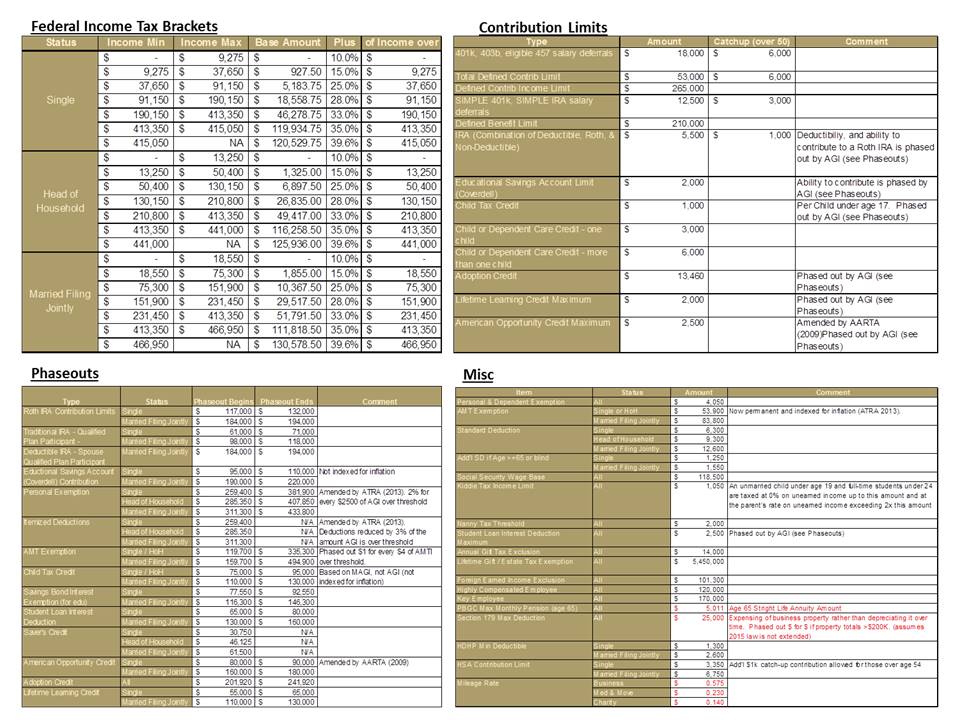
The IRS has released the key tax numbers that are updated annually for inflation, including tax rates, phaseouts, standard deduction, exemption amount, and contribution limits. Since inflation was very low in 2015, only very small changes have been made. Some notable callouts for those who don’t want to read all the way through the update:

· Social Security payments will not increase (no cost-of-living-adjustment) in 2016. That also means that by law, the Social Security Wage Base (the max amount of income subject to the 6.2% Social Security Tax) also must remain unchanged at $118,500.

· Max contributions to 401k, 403b, and 457 retirement accounts remain unchanged at $18,000 (+$6000 catch-up if you’re at least age 50).

· Max contribution to a SIMPLE retirement account remains unchanged at $12,500 (+$3000 catch-up if you’re at least age 50).

· Max total contribution to most employer retirement plans (employee + employer contributions) remains unchanged at $53,000.

· Max contribution to an IRA remains unchanged at $5,500 (+$1,000 catch-up if you’re at least age 50).

· The phase out for being able to make a Roth IRA contribution is $194k (married) and $132k (single). Phase out begins at $184k (married) and $117k (single).

· The standard deduction remains unchanged at $12,600 (married) and $6,300 (single) +$1,250 if you’re at least age 65.

· The personal exemption increases slightly from $4,000 to $4,050 per family member. Remember that exemption amounts begin to be phased out if your income exceeds $311,300 (married) or $259,400 (single). The exemption is reduced by 2% for every $2500 of AGI over threshold until reduced to $0.

· Itemized deductions are reduced by 3% of the amount AGI is over $311,300 (married) or $259,400 (single).

· The annual gift tax exemption remains at $14,000 per giver per receiver.

· The maximum contribution to a Health Savings Account (HSA) is $6,750 (married) or $3,350 (single).

· Note that mileage rates have not been updated yet for 2016.

Click image below for details…  red indicates not yet updated from 2015.

Presentation1

Withholding On Bonuses & Other Supplemental Wages

When you receive a bonus from your employer, have restricted stock vest, have taxes collected on the cashless exercise of a stock option, or receive any other form of supplemental wages, you may have too much or too little tax withheld depending on your marginal tax bracket and the method your employer uses for tax withholding. On a normal (non-bonus paycheck), payroll withholding tables take the amount of taxable income you earn for the pay period and translate that to the amount of tax that should be withheld, using the marginal tax brackets for your filing status (from your W-4), the number of allowances you claim (from your W-4), and number of pay periods in a year. For example, if you claim “Single, with 0 allowances”, you earn $8k in a pay period, and you are paid bi-weekly (26 x per year), the withholding tables will determine the projected annual tax liability based on the Single tax brackets, $8,000 * 26 = $208,000 of projected taxable income for the year. Dividing by 26 gives the Federal withholding amount for the pay period.

From the example above, you should be able to see how wildly the withholding rate can vary if your paycheck varies from period to period, which is why it is so hard to accurately set your withholding and why you never seem to get the same refund or owe the same amount year after year. (Add in exemptions, deductions, and credits, and it gets even more difficult). If you receive bonus pay as part of your regular pay, your employer can combine the two and determine the withholding on that paycheck based on the extrapolated annual income if you earned that amount each pay period. In this case, your projected annual income and the withholding tax rate will be very high because 26 * your combined wage and bonus is a very large number. You’d therefore have more withholding than is necessary for the period and would accumulate that amount toward a tax refund when you file. The more typical scenario is that your bonus would be paid either as a separate paycheck, or as a separate line item on your regular paycheck but considered as supplemental wages. In both of these cases, a statutory 25% withholding rate is used for the supplemental wages. If your marginal tax bracket is actually higher than 25% (taxable income over about $90k as a single filer, or over $150k as a married couple), then you’d have less withholding than is necessary for the period. That would accumulate toward an amount you’d owe when you file your taxes. In an extreme example, let’s say that you earn $250k per year as a single filer (33% tax bracket), but that you have an windfall of an additional $250k (bonus, stock, whatever). That $250k windfall is taxed at 25% when it should be taxed at ~35%, meaning you’d stand to owe $25k in tax when you file for that tax year.

The moral of the story is to be careful whenever you receive a bonus (or earn some other form of supplemental income like vesting equity). If the following conditions exist, it may cause you owe a substantial amount of tax at the end of the year:

1) It is paid in a separate paycheck, as supplemental wages on your normal paycheck, or withheld automatically as part of an equity transaction

2) You earn more than $90k per year (single) or $150k per year married, including the bonus payment.

Note that the tax is the same whether it is appropriately withheld at the time of the bonus payment or if you pay it at the end of the year. The problem isn’t that you pay additional tax. The potential problem is that you may owe a lot of tax and may not have been prepared for it (e.g. you used the bonus for a downpayment on a house or to payoff debt, and don’t have the cash remaining to pay your tax). It’s always a good idea to keep 10-15% of your gross bonus tucked away to make sure you have it available for taxes if needed. If you need a more detailed estimate of the potential tax impact of a large bonus payment, contact your financial advisor.

IRS Updates Key Tax Numbers For 2014

The IRS released its 2014 inflation adjustments yesterday. Some key takeaways:

· All tax brackets increased by ~1.7%, meaning that you’ll pay slightly less tax given the same amount of taxable income in 2014.

· The maximum allowed employee contribution to a 401k remains the same at $17,500 (+$5500 if over age 50)

· The total contribution to a 401k plan (employee + employer combined) increases from $51k to $52k.

· The maximum income allowed to be considered for defined contributions plan matches, profit sharing, etc. increased from $250k to $260k.

· The Standard Deduction amounts increased slightly to $6200 single (S), $12,400 married filing jointly (MFJ)

· The Personal Exemption increased to $3950 per family member from $3900.

· The Social Security Wage Base increased to $117,000 (this is the amount of your income that is subject to the 6.2% employer and employee social security tax).

· The Annual Gift Tax limit stayed the same at $14,000.

· The Lifetime Gift/Estate Tax Exemption increased to $5,340,000.

· The maximum allowed contribution to a Health Savings Account (HSA) increased to $3300 for single coverage, $6550 for more than one covered person.

· The Traditional IRA / Roth IRA contribution limits remained the same at $5500 (+$1000 additional if over age 50)

· The Roth IRA contribution income limits increased. The $5500 contribution begins to phase out at $114k and is eliminated completely at $129k of AGI for singles. It’s $181k and 191k for joint filers. Note, there still are no income limits on converting to a Roth IRA from a Traditional IRA.

· Itemized Deductions and Personal Exemptions begin to be limited if AGI exceeds $254,200 for singles and $305,050 for joint filers. Personal exemptions are reduced by 2% for every $2500 of AGI over that threshold. Itemized deductions are reduced by 3% of the amount that AGI is over that threshold.

· The income limits for being able to deduct up to $2500 of student loan interest start at $65k S and $130k MFJ. The deduction is completely phased out at $80k S and $160k MFJ.

· 2014 IRS Mileage Rate updates have not yet been released.

As always, you can find all tax brackets and key tax numbers listed on the Resources section of the PWA Website.

American Taxpayer Relief Act (ATRA) a.k.a. Fiscal Cliff Deal

I’ve parsed through the legislation (which can be found here if you want to check it out for yourself), as well as a ton of analysis, and to the best of my ability, here’s a quick summary of the relevant portions of the new law that averted the tax portion of the fiscal cliff. Note that while $400k/450k are getting all the press for paying higher taxes, there are a number of provisions which impact $200k(single)/$250k(married), and one really big one that impacts everyone (Payroll Tax Holiday Ended):

· Income Tax Rates: All existing rates remain the same with brackets increased for inflation (10%, 15%, 25%, 28%, 33%, 35%) and a new 39.6% bracket begins at taxable income over $400k for singles and $450k for joint filers.

· Long-Term Capital Gains: These were set to move from 0% for the bottom two tax brackets and 15% for everyone else to 20% for everyone. The legislation keeps the 0% and 15% rates for everyone except those in the new 39.6% tax bracket. They’ll pay 20% (not including the new Obamacare Medicare Surtax, see below).

· Dividend Rates: These were set to move from 0% for the bottom two tax brackets and 15% for everyone else to ordinary income rates for everyone. The legislation keeps this rate tied to the long-term capital gains rate with the same rules as above.

· Estate Tax Rates & Exemption: Retained the $5M per person exemption (was set to reset to $1M) and kept it portable (each spouse gets $5M instead of the couple getting $10M which forces complicated bypass trusts to be set up to try to use the $5M from the first to die spouse). Set the top tax rate at 40% (up from 2012’s 35%, but down from the 55% to which 2013 was due to revert).

· AMT Exemption: Patched the AMT exemption amount to the 2011 amount, increased for inflation. This was a big one since it was 2012 they were fixing, not 2013. Even better, they permanently fixed this so that each year’s exemption will be indexed to inflation going forward. This means no end of year scramble to get an AMT patched passed each year.

· Phaseout of Itemized Deductions: this was due to happen in 2013 without any new law, but ATRA tweaked the thresholds. If you are Single with AGI over $250k or married with AGI over $300k, your itemized deductions will be reduced by 3% of the amount that your AGI exceeds the threshold, up to a maximum reduction of 80% of your itemized deductions. To simplify, if you’re over the threshold by $10k, you lose $300 of itemized deductions. If you’re over by $100k, you lose $3k.

· Phaseout of Exemptions: this was also due to happen in 2013, but ATRA unified the phaseout level with the Itemized deduction phaseout. If you are Single with AGI over $250k or married with AGI over $300k, your exemptions ($3800 per family member) are reduced by 2% for every $2500 that you’re over the threshold. To simplify, if you’re over by $10k, you lose 8% of your exemptions. If you’re over by $100k, you lose 80% of your exemptions. This can be a pretty big bite.

· Payroll Tax Holiday Ended: this was due to happen in 2011, but was extended for two years and now is finally gone. It impacts everyone with income from work (employment or self-employment) by restoring the employee portion of Social Security (FICA) tax to 6.2% from 4.2%. This means everyone will pay 2% more tax in getting this level back to its pre-2011 setting (which still grossly underfunds Social Security over the long-term).

· Marriage Penalty: The standard deduction for married filers and the 15% tax brackets were due to revert to 1.67x the single amounts. ATRA kept them at 2x the single amount and made that change permanent. There is still a very large marriage penalty in the code anyway, as described here.

· Bonus Depreciation & Higher 1st Year Expensing: For business owners, 50% bonus depreciation on new purchases is extended into 2013 as is the higher limit for immediate expensing of certain purchases (Section 179).

· Misc. Permanent Extensions: Child Tax Credit ($1k per child subject to limits), Exclusion for Employer Provided Tuition Assistance ($5250 tax free reimbursement).

· Misc. Temporary Extensions: American Opportunity Tax Credit (college), teacher’s deduction ($250), exclusion from discharge of debt on primary residence (no income on short-sale or foreclosure), deduction for Mortgage Insurance Premiums, Deduction for State and Local Sales Tax paid (big in no income tax states), Tuition Deduction.

While not included in the ATRA legislation, it’s important to remember that two new fairly large changes also being in 2013 as Obamacare is rolled out. They are:

1) 0.9% Medicare Surtax on earned income (income from work) that exceeds $200k (single) or $250k (married). It’s important to note here that this will cause underwithholding from your employer if you have multiple jobs or are marred and both spouses have income since payroll systems will not realize that your earned income will exceed $200k/250k until you exceed that amount from a single employer.

2) 3.8% Medicare Surtax on investment income (interest, dividends, capital gains, rents collected, passive business income) if your Adjusted Gross Income exceeds $200k (single) or $250k (married). While there is no withholding on most investment income and you’re used to paying tax when filing or making estimated tax payments on that income through the year, the 3.8% additional tax effectively raises the tax rates on interest, dividends, gains, etc., even if you don’t meet the now well-publicized $400k (single) / $450k (married) income from the fiscal cliff deal.

I have no doubt that more tax changes will come in 2013 and/or 2014 since ATRA only reduces the > $1 trillion deficit by ~$60 billion per year, so it’s hard to count on anything above as permanent even where legislation made it permanent. The next major debate, likely to be more focused on spending than taxes will be in February as the Debt Ceiling will need to be raised again at that time. It’s quite possible that taxes, especially beyond 2013, become part of that negotiation as well.
Fiscal Cliff Deal Update 12/31

At the 11th hour, as expected, here comes the mini-deal. All speculation so far, but here’s what it’s looking like:

· Threshold for income tax rate increase would be $400k for individuals or $450k for families. Top rate on these taxpayers would increase from 35% to 39.6% though the marginal rates below that level will remain the same as they are now.

· Long-Term Capital Gains rates AND dividend rates go to 20% from 15% (but not 39.6%) for those above the $400k/450k income level. 15% would be maintained for those below.

· Extension of unemployment benefits for ??? time

· AMT Patch for 2012

· Deferral of sequestration-related spending cuts for a limited amount of time

· 40% top tax rate on estates over $5M (per individual??), up slightly from current 35%

Details still to be worked out. Votes in both the Senate and House required to pass. Not a given by any means. This would also do nothing for the debt ceiling (which needs to be raised sometime around late Feb / early Mar) and does VERY little to close the $1 Trillion per year deficit at the heart of the matter.

Fiscal Cliff Update

Reporters are already beating this story to death, but I wanted to provide a quick update from my perspective. Going over the Fiscal Cliff means higher taxes for all via the expiration of the 2001 and 2003 tax cuts, and forced spending cuts via the sequestration that was agreed upon during the debt ceiling debacle last year. We will technically go over the cliff on Jan 1 if Congress and the President don’t pass a law to extend the tax cuts and/or modify the sequestration. By now, everyone knows that. Ultimately, the “answer” is not to perpetually extend tax cuts and keep spending more than we can afford. But, the idea is to extend some of the tax cuts and some of the spending until the economy is back on its feet while setting the stage for major tax and entitlement reform in 2013/2014.

What isn’t as readily apparent is that virtually everything that changes if we go over the cliff can be modified retroactive to Jan 1. I hate to get into politics on this blog, but there seems to be a substantial incentive to go over the cliff, or come as close to it as possible, and then to place blame on the other party for doing so while each party is able to appeal to its base for sticking to its guns. Speaker Boehner’s re-election vote is on Jan 3 and the odds of re-election are thought to be higher if he stands his ground, consistent with the motivation for each party to obstruct progress and issue blame. Then, post Jan 1, after payroll systems are at the deadline for change to charge higher taxes, markets are on edge, constituents are threating to stop funding Congressional election campaigns, etc., a deal can be reached without losing face.

Whether a minor deal is passed on 12/31 or in early January is not relevant (2012 AMT exemption aside – this will almost certainly get passed). What is relevant is avoiding a traumatic shock to the economy and laying the groundwork for long-term reform, at least far enough to prevent another debt downgrade, and prevent the market from demanding higher interest rates in order to lend money to the US government. It’s hard to have faith in government at this point. But, as Winston Churchill supposedly once pointed out, you can always trust Americans to do the right thing once all other possibilities have been exhausted. I believe we’re getting close to that exhaustion.

One more thing… a CNBC commentator recently drew a parallel between Congress’s fiscal cliff actions and term paper deadlines saying, “Did you ever turned in a term paper ahead of its deadline?” Of course the answer for virtually everyone is a resounding “No”. Congress acts similarly. However, I think this is a little different. This is like a term paper where you’re penalized one point for every day late. If the deadline is 12/31, you would be tempted to miss the deadline by a few days, but would be unlikely to never turn in the paper. Even though the incentive to turn it in on any particular day is fairly low and you might be ok with losing a few points, there comes a time where you start to add up the damage, sit down at your computer, and just get it done. Damage will be done to the economy and to confidence each day that passes beyond 12/31, but it’s important to note that we’re not going to immediately get an “F” or fall off a cliff into the abyss, despite claims from ratings-hungry reporters. Markets will get antsy, reporting will get ugly, and the political blame game will be enhanced to its highest level yet. But, as long the short-term is handled in the next few weeks and the long-term is handled in the next few years, this crisis will pass like all others before it.

Have a Happy New Year. The Mayan’s couldn’t take it away and neither will the Politicians.

The Marriage Penalty

No, I don’t mean the price of dealing with your spouse on an every-day basis as many sitcoms illustrate (frankly, I don’t consider that a penalty at all in case you’re reading this, honey!). I’m talking about the “features” built into the tax code so that a married working couple pays more tax than the same two working individuals would if they were not married. Few people understand this, but it can have a really big impact on your taxes when you get married and starting in 2013, the impact will be even bigger.

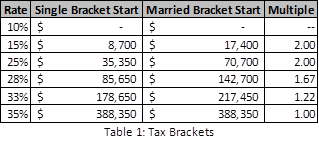
Let’s start with the most basic form of the marriage penalty, the tax brackets. Table 1 shows the starting income level for each 2012 income tax bracket for both the single and joint filer. As I described in Am I Working Too Much, a taxpayer pays tax at the rate indicated in the table for each bracket. For example, a single taxpayer would pay 10% tax on her first $8,700 of taxable income + 15% tax on her next $26,650 of taxable income up to $35,350 + 25% on her next $50,300 of income and so on. A married couple would pay tax in the same manner using the married tax brackets. Notice that while for the lower tax rates, the married bracket is two times the single bracket, the higher your income, the faster the married tax brackets increase vs. the single tax rates. This closes the gap between the married brackets and single brackets slowly until they are identical once reaching the top tax bracket. Let’s use an example to see the impact on two individuals, each with $150k of taxable income who get married. As single filers, they each pay 10% of $8700 + 15% of $26,650 + 25% of $35,350 + 28% of the remaining $64,350 for a total tax bill of $35,461 each or $70,922 in total. As married filers, using the married part of the table and a similar calculation, they’d pay $75,907 in tax. This additional ~$5k of tax is the most basic form of the marriage penalty. Note that electing to file Married Filing Separately does not reduce the marriage penalty since the MFS brackets are not the same as the Single brackets. Instead they are ½ of the Married Filing Jointly brackets. Additionally, it is not legal to file as a single taxpayer if you are legally married so you can’t just choose to file Single. To make things worse, starting in 2013 after the “Bush tax cuts” are eliminated, the multiple for the 25% tax bracket will be 1.67, instead of 2 as it is today. That will compress the 25% tax bracket for married filers down to $58,900 and add another few hundred dollars of tax.

There are other forms of marriage penalty in the tax code as well, some in existence now and others coming back in 2013 after the Bush tax cuts expire:

· For those claiming the standard deduction, the married standard deduction is currently $11,900, exactly twice the single deduction of $5,950. Starting in 2013 though, the old standard deduction marriage penalty kicks in here too with the standard deduction for married filers reverting back to ~1.67 times the single deduction (would have been $8700 for 2012).

· The qualifying income level for the Earned Income Tax Credit for married filers is less than 2x the Single levels.

· The new healthcare reform taxes starting in 2013 on investment income and earned income only impact those single filers with income up to $200k, but hit married filers starting at $250k per year in income).

· For those paying the Alternative Minimum Tax (AMT), the personal exemption for a married couple is less than 2x the Single level.

· The reduction in itemized deductions and personal exemptions which is due to return in 2013 will start at an income level for married couples that is less than twice the single income level.

· The threshold for determining whether a married couple’s social security benefits are taxable is substantially less than 2x that of a single filer.

· Multiple other deductions, credits, and exclusions in the tax code phase-out for married couples at less than 2x the single level including deductible IRA contributions, Roth IRA contributions, the Child Tax Credit, the deduction for capital losses taken in any one year, and the deduction for current year loss on a rental property.

More to come on the marriage penalty in future posts regarding 2013 tax changes.

Am I Working Too Much?

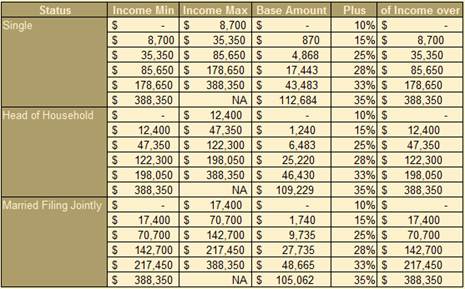
Am I working too much? If you’re like me, the answer is probably "yes". In this particular case though, I’m asking the question from a tax standpoint, specifically referring to a popular misconception about the way we pay income taxes. There are currently six tax Federal tax brackets: 10%, 15%, 25%, 28%, 33%, and 35% as shown in the table below from the Resources section of the PWA webpage.

Your marginal tax bracket increases with your taxable (after exemptions and deductions) income. So, if you’re married and have combined taxable income of $143k, your marginal tax rate is 28%. If your combined taxable income is $142k, your marginal tax rate would be 25%. So, doesn’t this mean that you could save tax more than $1k in tax by earning $1k less at work for the year because 143k * 28% is more than $1k greater than 142k * 25%? That’s where the misconception lies. The answer is no and here’s why. Your entire income is not taxed at your marginal tax rate. You are taxed at each incremental tax rate along the way. So if your taxable income is $143k (and you’re married), you’re taxed 10% on the first $17,400 of taxable income + 15% on the additional income up to $70,700 + 25% on the additional income up to $142,700 + 28% on the last $300. You should be able to see that your tax on the first $142k is exactly the same as if you only made $142k. The only income you pay 28% on is the incremental income which puts you in that bracket. The tax code is created so that you can never make more net (after-tax) income by earning less money. Virtually everyone to whom I’ve explained this over the years, including the students in the CFP® classes I’ve taught have breathed a sigh of relief. It seems that people tend to stress a little bit over the fact that they may be making a little too much income, pushing them into the next tax bracket, and costing them a ton of money when they could have enjoyed a week of unpaid vacation relaxing on the beach and made more after taxes. This can’t happen, so don’t worry that it’s happening to you. Of course that still doesn’t mean you’re working too much, but at least you’re not working so much that it’s actually costing you money.

Healthcare Reform Taxes Starting in 2013

I’ll have several upcoming posts on tax changes for 2013 including what’s going to happen if nothing changes, what’s likely to happen (IMHO), and what’s not going to happen.  Here though is a quick list of changes that will take place as part of the new healthcare laws…  I’d label these as almost certainly going to happen, with the only possible exception being if Republicans win majorities in the House and Senate and win the Presidency in November (17% chance of all three happening based on Intrade.com’s betting odds) and pass a repeal of some or part of the Act.  For now, it’s safe to say these are happening:

  • A 0.9% additional tax to employees on wages over $200k per year ($250k if married filing jointly, hereafter abbreviated “MFJ”).  As we understand it, this would be part of employee’s payroll tax, known by many as FICA. This is the 6.2% social security tax that’s capped at $110,100 of income in 2012 and 1.45% Medicare tax that is uncapped.  It’s the Medicare tax that will rise by 0.9% to 2.35% of income and will remain uncapped starting in 2013.  Since this is a payroll tax, it will by withheld from paychecks of employees.  This means that even if you pay the Alternative Minimum Tax (AMT), you’ll still pay this new tax through payroll.
  • A 3.8% new tax on unearned income by those earning at least $200k per year ($250k MFJ).  If you earn less than $200k or $250k but have unearned income that puts you over those thresholds when added to your earned income, you’d pay the 3.8% tax on the excess over $200k or $250k.  The types of income to which this applies are: interest, dividends, capital gains, annuity income, royalty income and passive rental income.  It does not apply to tax-free interest or retirement plan distributions.  This tax is generally paid at the time of filing or via estimated tax payments through the year.
  • Healthcare flexible spending accounts will be capped at $2500 (reducing the amount of tax that can be saved by deferring income into these accounts).
  • Medical expenses paid out of pocket will only be deductible for those under age 65 if they exceed 10% of income (a hike from the current 7.5% floor).
  • A 2.3% tax on the sale of medical devices (except those commonly sold at retail like glasses, contacts, and hearing aids).

Additional taxes begin in 2014, including the tax penalty to individuals without health insurance (AKA the “Individual Mandate”) and businesses who have at least 50 employees but either don’t offer coverage, or offer sub-par coverage that leads employees to buy insurance on one of the newly created healthcare insurance exchanges (AKA the “Employer Mandate”).  More on these changes in a future post.