Market Update (08-07-2011)

*** We believe communicating with our clients is of utmost importance, especially during turbulent times in the market. While we don’t claim to have a crystal ball on the future of any financial market at a given point in time, we do believe that keeping clients informed on why things are happening increases their comfort level and understanding. This post contains a message initially sent to clients just after the S&P downgrade of the U.S. credit rating as part of that communication effort***

As you all know by now, S&P downgraded U.S. long-term debt from AAA to the next notch down, AA+ on Friday night. Before digging too far into that, I’d like to reflect back on what happened this week, one of the worst for the stock market since the Lehman Bankruptcy era, to make sure you understand why there are far bigger issues out there than one rating agency’s opinion of our debt repayment prospects. I apologize in advance for the length of this message, but I’d rather provide you with too much information which you can choose not to read than to leave you wondering about what’s going on.

On Monday of last week, we received the good news that the leaders of both parties in Congress had reached an agreement that would enable a majority of both the Senate and the House to pass a bill to raise the debt ceiling. The vote passed, the president signed the bill into law, and the crisis, if you believed there ever was one, was behind us. Markets initially rallied on the news as the general public had been told there was a chance of the end of the financial world stemming from a default on U.S. debt. When that chance disappeared, there was a lot of relief from those who believed it. Like I said in recent updates though, the debt ceiling was not a crisis, it was a political game using a completely irrelevant measure of how much debt we allow ourselves to have, rather than how much debt the market (i.e. our lenders) allows us to have. So, it didn’t take long for the markets to erase the “debt ceiling has been raised” gains and start to really worry about the banking system in Europe and the potential for a U.S. debt rating downgrade by the credit agencies.

First, a quick explanation of what’s going on in Europe. Several countries in Europe have taken on too much debt, well more than the U.S. as a % of their GDP (though our trajectory will have us catching up too soon to be comfortable about it). The markets have started fear that lending more money to those governments is too risky unless there’s a high interest rate to go along with the loan to account for the chance of not being paid back. The higher interest rates lead to more interest payments as a percentage of the tax revenue these countries collect which strains their budgets farther and requires more borrowing. More borrowing means even higher rates, and eventually there is no way out of debt and the only answer is default. Who owns most of Europe’s debts? Generally speaking, the banks in Europe do. The story from here should sound very familiar as it’s much the same as what happened during our mortgage meltdown that caused the same stress on the financial system. If the bank holds something that is starting to look worthless, it can become insolvent, it can fail, and depositors as wells as other banks that have lent it money can be left in the dust. In a way, it becomes self-fulfilling. The fear that the bank could become insolvent removes depositors and stops lending to that bank which can in turn make it insolvent (see the history of Bear Sterns and Lehman for a deeper dive into the process). So, to stop the rapid downward spiral in our case, our government got involved. They essentially provided the liquidity that the banks needed to reassure lenders and depositors they weren’t going out of business, while they raised money privately so that the government could be paid back. Most of you now know this campaign as TARP. The market is hoping that something similar can be pulled together in Europe to temporarily save the countries that are in jeopardy of defaulting on their debts. It’s more difficult there though, because each country has its own government, but they don’t have their own currency. It would take a huge amount of collaboration in good faith by the countries who don’t have debt problems, led by Germany, to rescue the other countries and prevent a banking collapse and a collapse of the Euro. In return for the effort, the debtor countries have to respond by agreeing to stop their over-spending ways and stop adding more debt… essentially providing a plan that will get them off life support over the medium term. The details over the possible coordinated efforts and the austerity measures would make this email longer than I imagine you want to read, so I’ll just leave it with this: if Europe as a whole doesn’t come to the rescue of the countries in Europe, then Europe as a whole is in for far worse than what we’ve seen from the mortgage meltdown. In a globally integrated world like we have, a depression in Europe would spread fairly quickly across the Atlantic and hit our companies and employment prospects very hard. Many don’t realize this but the European economy as a whole is even bigger than ours. Start to project a major haircut in their production and consumption and that is why the stock market plunged last week, with some areas down more than 25% from their highs less than a month ago, and the broad market down more than 10%.

Friday afternoon, there were rumors of a rescue package agreement in Europe and the stock market had a fairly dramatic turnaround. As of the time I’m writing this, the details have not be revealed, nor has the agreement’s existence been confirmed, but I have to believe there is a scramble going on to reveal some positive news before Asian markets open tonight and definitely before the U.S. market opens tomorrow. What happens this week is highly dependent on whether there is an agreement, and if there is one, whether the market believes it will work.

Adding fuel to the fire now is S&P’s downgrade of the U.S. credit rating on Friday night. There were rumors of the downgrade happening on Friday all week, and pretty strong ones on Friday morning. S&P telegraphed the measure to allow markets to prepare so it wouldn’t be a shock to the system. My personal opinion is that this is the last straw in S&P’s credibility as a rating agency (these are the same people who rated the mortgage-backed securities that went belly-up in our crisis as AAA in many cases). While my opinion of S&P is not relevant, the market’s opinion of U.S. long-term debt is, and it’s far more relevant than S&P’s opinion of U.S. long-term debt. A $14.3 Trillion market is made of so many people, institutions, and countries that to think S&P has some crystal ball, research ability, or magical formula that the collective $14.3 Trillion worth of market of participants does not have, is ludicrous. We need S&P to do the due diligence on individual companies and their sometimes hundreds of securities because there isn’t enough time in the day for every fund manager or individual to do the research on their own. But here, we’re talking about the U.S. government. Do we really think that China isn’t doing their homework on our ability to repay our debts before they decide to lend us a trillion dollars at 2.5% interest for 10 years?!? There’s no doubt we’re on a bad fiscal path, no doubt. Without getting into political views, I think it’s also safe to say that our political system is showing signs of weakness as well. But the markets say we’re the safest thing out there. Add in our ability to print money as a last resort if we need it, which we could use to pay off debts at the cost of high inflation, and there’s just no more chance of default today than there was before the S&P downgrade, and certainly not more chance of a default than during/after World War II.

So what does it mean for the markets? Unfortunately, despite the fact that the downgrade was telegraphed and essentially priced into the market in advance, there are some short-term technical problems that can result from the actual downgrade. There are funds (pension funds, mutual funds, etc.) that have legally obligated themselves to hold AAA-rated securities for a certain percentage of the fund. If they hold long-term U.S. debt, they will be contractually obligated to sell. This forced selling could drive down prices of U.S. Treasuries which in turn drives up interest rates. Over the medium term, I believe others who aren’t contractually obligated to sell will see great value in treasuries at a higher rate and will swoop in to buy up all the Treasuries that the other are coughing up. Short-term though, the forced selling could create instabilities and dislocations in the market. Selling can beget selling and the spillover effects to other markets like the stock market can be severe. In addition to the forced selling, there is the problem that banks, states, government agencies, and municipalities rely on the Federal government as a last resort for funding. The government is now rated AA+, all those organizations who are AAA likely have to be re-rated lower. If you believe the S&P downgrade, you can’t put your full faith in FDIC insurance, in social security, in Medicare, in Fannie Mae and Freddie Mac (who hold about 50% of the mortgages in the U.S.), or well-capitalized U.S. banks. Downgrades of all those entities could cause a domino effect on everything that relies on them. Trying to see the end of the line of downgrades due to this one is impossible.

But, in thinking about it, I keep coming back to the same thing. There’s not a single entity today who has a lower chance of repaying its debts than last week. If that’s the core guiding principal, then everything else has to have at most a short-term impact. Dislocations in markets that cause violent reactions should have a snap-back effect as value is recognized by those who are not obligated to sell. Of course when dealing with markets like the stock market, we never know how long short-term will last and how long it takes to get back to something grounded in fact, value, and thought vs. rumor, momentum, and fear.

In short, I’m not worried about the S&P downgrade. What happens over the short-term is unknown. It could be very ugly. There’s a part of me that thinks that ugliness would be very short-lived and we could even see the market rise this week if Europe makes a credible announcement that would end their financial downward spiral. So, I’m watching Europe, way more than I’m watching S&P’s opinion about something that $14.3 Trillion dollars have already decided. The U.S. bond market is safe and we remain one of, if not THE safest place to have money in the world.

What we’re doing is preparing to rebalance all portfolios as triggers to do so occur. We don’t anticipate a negative response to short-term bonds which is what makes up much of the conservative portions of your portfolios. As stocks fall, if they fall enough, we will sell bonds and buy stocks to rebalance your portfolio back to its target. It is the same thing we did during 2008/2009 and the reverse of what we’ve been doing as the stock market rose 100%+ over the past 2 ½ years. This results in a natural buy low sell high rhythm that doesn’t require us to predict bottoms and tops in the market, something I know is impossible. 50% of everyone who makes and up or down prediction are going to be correct. You just can’t know ahead of time who they are or that they’ll be in the same 50% the next time. Note that this rebalancing strategy only works if your target allocation is aligned with your broader financial plan. I’m sure there are people out there (obviously not PWA clients) who are 6 months from retirement and have their 401k in funds that hold 90% stocks. I’m sure there are others who want to buy a house in a year and they have most of their liquid assets, needed for the downpayment, in individual stocks. They probably felt pretty good about their portfolio as little as 3 weeks ago but now there’s a chance they can’t buy that house all because their plan didn’t align with their portfolio. As Vanguard’s chief economist Joe Davis has said, “Treat the future with the humility it deserves.” Planning is a much better way to do that than gambling or hoping.

I’ll send out another update (hopefully shorter) as events warrant. As always, if you have questions or comments on this topic or anything else, please don’t hesitate to ask.

Market Update (07-26-2011)

*** We believe communicating with our clients is of utmost importance, especially during turbulent times in the market. While we don’t claim to have a crystal ball on the future of any financial market at a given point in time, we do believe that keeping clients informed on why things are happening increases their comfort level and understanding. This post contains a message initially sent to clients with the debt ceiling fiasco on the horizon as part of that communication effort***

Given the press coverage around the debt limit issue, I thought it would be useful for you if I gave a quick update as to what’s going on. Long-time clients will remember messages like this one that I sent frequently during the post-Lehman Brother’s bankruptcy era and around Congress’s shenanigans regarding the passage of what eventually became known as TARP. Even though no change or action is required by you, I think staying informed helps people sleep better at night during a potential crisis. So here goes…

We’ve all heard August 2nd is the deadline for raising the debt ceiling or the U.S. will not be able to pay its bills. At the same time, politicians seems to be getting further from an agreement on how to raise the debt ceiling instead of getting closer to one. Much of the press will have you believe that if the debt ceiling is not raised by August 2nd, life as we know it, will not go on and yet the urgency to raise the ceiling doesn’t seem to be there given that 8/2 is a week away. There are three things wrong with that presentation.

First, August 2nd is not the date at which the U.S. will stop paying its debts and run out of money. It is a date that the treasury secretary estimated several weeks ago based on the pace of expenditures and tax revenues. As it turns out, revenues have been higher than projected and the real date appears to be closer to August 10th. Congress is supposed to take their next recess (read: vacation) starting August 6th, so the 2nd was a much more convenient political deadline. There are also Social Security payments which need to go out on August 3rd, debt principal payments that need to go out shortly thereafter, and interest payments that need to be made to Treasury holders later in the month so that crisis is real and important. It’s just not as urgent as the talking heads would make it seem and so the lack of urgency in resolving the crisis is because there is more time that most people realize, even if it is only another week.

Which brings me to point number two. When you’re playing a game of chicken, and by all means that’s what we have here between the politicians, you always have to seem more confident in your path as you get closer to the end game. “I’m not going to move.” “I’m not going to move either… you’ll realize you’re going to move”. All the back and forth as the two get closer to a head-on high-speed collision. It’s not until the very last second that one or both parties are actually ready to move. Therefore, I expect little movement and the appearance of no chance of a deal up until the last few days of the debate. As of yesterday, both parties have put their stake in the ground followed by a stomping of their feet and a “take it or leave it” statement. The soap opera couldn’t be written any better. One or both parties will move as the threat of collision becomes imminent.

Finally, and most importantly, if the U.S. were insolvent and unable to pay its bills, a global financial catastrophe would take place well in advance of the last few cents coming out of the piggy bank. I won’t go into the goriest of details, but basically it would start a panic that U.S. Treasury Bonds were worthless (i.e. those who lent to the U.S. government would permanently stop getting their interest payments and lose their principal). This would make all of the banks and other financial institutions across the world that hold Treasuries potentially insolvent. Within days if not hours of this realization, there would be no more ATMs, no open banks, most money would be worthless, and the world economy would cease to exist. OK, maybe that is pretty gory…. Deep breath… Let’s look around though. We’re a couple of weeks away from potentially not paying our bills and none of this is happening. The U.S. Treasury today auctioned off $35 billion of 2-year notes. The annual interest rate demanded by the auction was 0.417%. That means investors were willing to lend the U.S. government $35 billion dollars today for less than a half penny of interest on every dollar each year for the next two years. Would they really do that if there were any chance of not being paid back? The answer is “no” and the reason is that the U.S. is not insolvent. People, institutions, and countries are scrambling to try to lend us money because we are the safest place in the world to put money. At that same auction, there were bidders for over $100 billion of that $35 billion in debt. The point is that even if lawmakers on both sides don’t give in (and that won’t happen) and the debt ceiling is reached (and that won’t happen) and all other avenues for paying bills are exhausted (and that won’t happen) and we really do legally run out of money because of the debt ceiling (and that won’t happen), the ramifications will be so huge, so fast, that both sides will scramble to save the day almost instantly with a simple act of raising the debt ceiling. One vote, 5 minutes to end the end of the world and this crisis is over. The U.S. is not insolvent and will pay its bills.

The bigger issue, which I’ll save for another update is far more important. We’re on a fiscal path to insolvency and unless that trajectory is corrected, our debt will no longer be the safest instrument in the world. Our borrowing costs will rise, rapidly, and the impact on the economy will be severe. Imagine the value of your house today if someone had to pay 10% for a mortgage to buy it. That has to be corrected and in principal, tackling the beginning of that correction as part of the agreement with ourselves that we’ll increase the debt limit makes some sense. But in the end, whether it happens or not, the debt limit will be raised and life will go on. Unfortunately, politics and the media’s over-dramatic reporting of those politics will go on with it.

If anything changes over the next few weeks that warrants action on your part, I’ll be sure to let you know. As always, if you have questions or comment, please feel free to contact me.
Market Update (07-14-2011)

*** We believe communicating with our clients is of utmost importance, especially during turbulent times in the market. While we don’t claim to have a crystal ball on the future of any financial market at a given point in time, we do believe that keeping clients informed on why things are happening increases their comfort level and understanding. This post contains an excerpt from the PWA Q2 2011 newsletter to clients, sent just the end of “QE2” (Fed stops buying new treasuries), explain three key issues for a continued rebound in the economy, as part of that communication effort***

• The End of QE – On 3/24/09, just after what we now know was the stock market bottom, I wrote in a “Market Update” note to clients that the announcement that the Federal Reserve was going to purchase U.S. Treasuries and other securities represented a “game changer” for the financial markets. Those purchases became known as Quantitative Easing (QE) with two distinct rounds of purchases being coined “QE1” and “QE2”. These were in fact a game-changer for the markets, with the S&P 500 rallying more than 100% from March ’09 to April ’11. They were a game-changer because the Fed was, in simplified terms, printing money to buy financial assets which put that newly printed money into circulation to offset the deflationary spiral that was occurring (the value of everything from houses, to bank assets, to the stock market, to commodities was falling rapidly and simultaneously causing credit markets, job markets, and the overall economy to grind to a halt). As of July 1st of this year, the Fed ended QE2 and has signaled that a QE3 is unlikely. This means the game-changer is over. However, the Fed is not selling the assets they’ve purchased to date and they will keep reinvesting in those assets as they mature which means we don’t expect a game-changer in the other direction to send the markets back down. What we do expect is that the days of 50% per year stock market gains are behind us for quite a while. We also expect interest rates to start to gradually rise on medium to long-term treasuries and mortgages, though probably not sharply because any sharp increase would set the economy back and likely force more intervention from the Fed. In the next 12-months we expect short-term rates on savings accounts, CDs, and short-term bonds to start to gradually increase as the Fed hikes the Fed Funds rate back to something less extraordinary (we believe 2-3% would still provide support for economic recovery without risking the inflationary dangers of the 0% emergency rate we have today. Finally, we expect a higher level of volatility (up and down) in all financial markets as the Fed-induced tailwind is no longer behind us and now the economy, business cycle, productivity, earnings, and jobs will take more focus.

• The Debt Ceiling – Much is being made of the U.S. debt ceiling and what might happen if it’s not raised and we’re unable to pay our bills. For the most part, this is political grandstanding. There is absolute certainty that the debt ceiling will be raised. But, there’s an important problem in the way Congress is currently dealing with the issue. August 2nd has been set as the “deadline” by the treasury secretary by which the ceiling must be raised in order to proceed with business as usual. For this reason, the credit rating agencies have to consider the possibility that the U.S. will not be able to pay its debts if the ceiling is not raised by that date. Ironically, Congress bashed the credit agencies for maintaining AAA status on collateralized debt obligations that later failed during the peak of the financial crisis, arguing that any risk of default should have caused an immediate downgrade of those instruments way before the crisis occurred. Those same credit rating agencies must now act accordingly and not wait until August 2nd to cut the U.S. rating or they risk having a AAA rating on August 2nd morning and a default rating on August 2nd evening. This means the real deadline to raise the limit is well before August 2nd, because a downgrade of the U.S. credit rating, if taken seriously by the world, will having a snowball effect through the financial markets and set off another deep, albeit temporary, financial crisis. The President’s comment that he will not approve a short-term extension, while obviously in good a faith effort to try to prevent this from being a recurring quarterly problem, actually worsens the situation because it makes the possibility of no deal by August 2nd more likely to the credit agencies. Congress is now playing a game of chicken and I expect a short-term deal is likely with an understanding of more short-term deals through the 2012 elections which will keep the ratings agencies at bay for now. In the meantime though, expect potentially violent moves in the markets, akin to those of the days of TARP being voted on, as momentum traders try to take advantage of the headlines. Since even a credit downgrade would be temporary (garnering a swift response in Congress if it ever did happen), market volatility due to these events is in my opinion, nothing more than an opportunity to rebalance portfolios taking advantage of dips in the market and to get a 401k or other savings contribution in at a cheaper price than without the debt ceiling issue. This issue will pass. The longer-term question of our government’s ability to govern if it’s willing to put us in these kinds of situations to begin with is a much broader issue but I’ll leave that discussion to those who enjoy politics.

• European Sovereign Debt – A less-urgent, but much more important issue to long-term global financial markets is the vast amount of sovereign debt that exists in the world and the sudden realization by financial markets that some countries truly may not be able to pay their bills. This issue is not about an arbitrarily set debt ceiling. Countries like Greece and Ireland are struggling to pay their debts because they’ve taken on so much debt that tax revenues can’t support government spending plus interest payments any longer. These countries, with others like Italy, Portugal, and potentially Spain, not too far behind them, have simply lived on a national credit card for the last decade and are now forced with extreme austerity in return for global bailouts or default. Default means the loans made to those countries become worthless and the banks holding those loans lose the loans as assets. This has the potential to kick off a global financial crisis that is all too familiar after the ‘08/’09 Lehman Brothers default created much of the same. It can also kick off a currency crisis as it threatens the Euro, thereby strengthening the U.S. Dollar and causing harm in our own recovery as it makes our goods, services, and assets seem more expensive to the rest of the world. So far, rescue packages from the International Monetary Fund have staved off default for Ireland & Greece, but this warrants further monitoring. There are three important actions to take here:

· Like others, we have no crystal ball and believe that markets price information and risks fairly in general. That means that in most cases the market would fall before we have reason to believe it would fall or it would rise before we have reason to believe it would rise meaning there is no way to time news events. However, as I’ve discussed with all of you at one point or another, if I hear the whisper of a freight train coming, and sometimes it comes without making a whisper first, I will take corrective action. This means moving all models temporarily to a slightly more conservative allocation or using other protective measures as I see fit.

· It’s easy to be complacent when the stock market is rallying like it has for the better part of the last 28 months. If you have short-term needs for your money that is currently invested as if it was not needed for the short-term, please communicate that need to me ASAP. If your portfolio is 80% stocks and the stock market falls 50%, which has happened twice in the last decade, you will lose ~40% of your portfolio. For long-term money, by definition, you don’t need it over the short-term so that’s not an issue. In that case, continue to invest as planned, buying at lower prices if markets fall and when markets eventually recover you’ll actually be better off than if the fall hadn’t happened. For short-term money though, that kind of a loss could mean not being able to fulfill a goal and goal-fulfillment is the only reason to invest.

· Expect the market to move both up and down. Many have become accustomed to seeing their portfolio balances only increase, and quite sharply quarter after quarter. Don’t be shocked to see more volatility. As long as you’ve heeded the point in the preceding bullet, and you have an overarching financial plan, don’t worry about the short-term movements of the markets. The only ways to ensure that your account statements will only show increases in value are to 1) keep your money in the bank earning slightly more than 0% per year in interest while the cost of living increases far faster, or 2) have a crooked financial advisor that’s cooking the books (and we all know how that ends… google “Bernard Madoff”).

The Lost Decade, Or Was It?

***The following is an excerpt from the Q1 2010 PWA Newsletter regarding the so-called “lost decade of investing”, a term used by much of the press to describe the performance of the stock market during the 2000’s.***

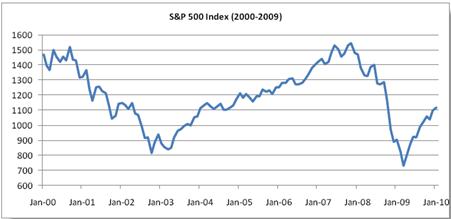
The gloom-and-doom crowd has already taken a stance that the 2000’s were the lost decade for stocks as evidenced by the miserable performance of the S&P 500, the most popular market-weighted benchmark for U.S. stocks. A chart of the S&P 500 from 2000-2009 backs up their point quite nicely.

As the chart below shows, the S&P started the decade at 1,469 and ended it 24% lower at 1,115. Obviously, a terrible return. If we use this as evidence that investing in the 2000’s was a losing proposition, we might reach the conclusion that a passive approach to investing over the long term or a goals-based approach to investing are dead. But, there are three fundamental points that are excluded from this argument.

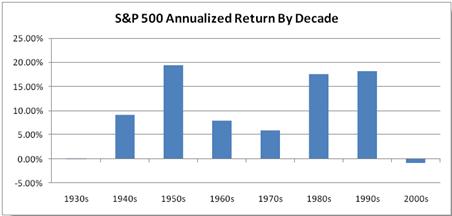
First, the chart completely ignores dividends. Adding the dividends that the S&P 500 companies (and therefore any fund that held those companies) paid improves the return to -9% over the ten year period. Annualized, that’s -0.95% per year with dividends vs. -2.71% without. It’s still not attractive, not even positive, but much better than without dividends. Second, a look at how the last eight decades have performed gives a sense of the volatility of the stock market. The chart below shows the annualized S&P 500 return (including dividends) over each ten-year period. While the 2000’s were the worst of all the decades shown, they’re not far behind the 1930’s. Had one reached the conclusion that long-term investing was dead after 1939, the opportunity to turn $1 into $1,430 over the next 70 years with an investment in the S&P 500 would have been missed.

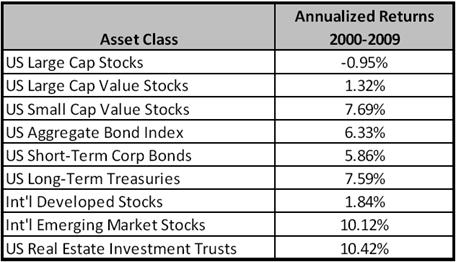
Finally, the argument above takes a large leap in using the S&P 500 as an approximation for “investing”. Any professional asset manager (including yours truly), incorporates many other asset and sub-asset classes into an overall portfolio allocation. The ultimate selection is of course based on the return that clients need in order to achieve their goals, with the minimum amount of risk that is possible to get there. While the S&P 500 certainly performed poorly during the 2000s, and just about every asset manager would have had some component of client portfolios in large capitalization U.S. stocks (like the S&P 500), the other asset classes performed much better. In fact, a simple indexing of equal components of each asset class shown below would have led to a 6.85% annualized return throughout the 2000’s (94% return over the 10 years!). And, what’s even better is that only two years in the 2000’s would have had negative returns. This shows the impact of having a truly diversified portfolio, as opposed to one that just contains many stocks in the same assets class (as is the case with the S&P 500).

So, while large cap U.S. stocks may have had a really hard time in the 2000’s, the nearly 7% compounded returns that could have been achieved with the combination of assets above would have satisfied the 10-year goals of many investors. In other words, passive investing and goal-based investing focused on diversification seems far from dead.

The keys to success are in choosing the right portfolio for your goals, adjusting as events in your life warrant, and making sure that not only aren’t all your eggs in one basket, but they’re in as many baskets as possible. That worked during the bull market run of the 1990’s, during the more stagnant 2000’s and we continue to believe it is an investor’s best chance at achieving his/her goals in the 2010’s and beyond. ∎

Has The Housing Market Bottomed Yet?

***This post was originally published in PWA’s Newsletter: The Pretirement Press in Q4 2009 and it’s publish date has been edited here to reflect the approximate initial publish date***

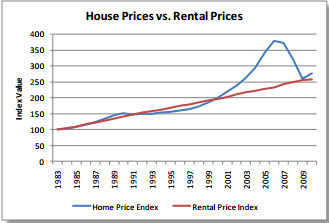
By now we all know we were in the midst of a housing bubble earlier this decade, which peaked in 2006-2007 in most areas. While it’s easy to say in hindsight, one of the clearest depictions of just how dislocated prices were compared to the fundamental value of a home is a comparison of housing prices to rental prices. A house’s value can always be tied back to the cash flows that an owner of that house could earn if she rented the house to a tenant. In other words, a good way of determining if a house is too expensive compared to renting is to determine if you can cover the costs of ownership (mortgage interest, insurance, property taxes, association fees if applicable, maintenance, potential vacancy, management, etc.) with the rental income. If you’re planning to buy a rental property, contact your advisor who can help you project the long-term return on your investment taking all of these factors into account.

The U.S. government tracks average rental prices across the country in an index which is a component into inflation measurements. Industry organizations track median house prices over time and so it’s easy to compare how each trends in relation to the other. Not surprisingly, as the chart below shows, the house price index and the rental price index track each other quite closely in most cases. What can also be seen is the huge spike in the home price index with no accompanying spike in rental prices from 2000 to about 2006-2007. As is usually the case in a bubble, prices have returned to a level that coincides with their fundamental value (measured by rental prices). So, does this mean the market has bottomed? Not necessarily, because there’s nothing to say that prices can’t fall to an extreme on the other side of the rental price index just like they peaked above it, but it does look like market is reasonably priced when compared to historical rents.

Additionally, there have been strong signs of life in the housing market in recent months with existing home sales gaining ground in four consecutive months (Aug-Nov). Not only have sales been increasing month over month, November’s sales are up 44% over November of 2008, showing the people are definitely out there buying. The number of homes for sale has also come down in the past four months, from just over 4 million, to just over 3.5 million. If the pace of sales from November could continue and no additional houses were put on the market, the current inventory of homes for sale would be depleted in 6.5 months. That compares to about 4-5 months of supply in a steady housing market, and a peak of 10-11 months around this time last year during the worst of the downturn.

What about prices? There are two different nationally recognized sources for home prices, the National Association of Realtors (NAR) and the Case-Shiller (CS) Index. CS always runs a month behind NAR, so we only have CS data through October where both sources show about an 7-8% drop in median home price year-over-year, but CS shows no change in month-over-month price vs. a decrease of about 2% from NAR. NAR’s November report shows virtually no change in price compared to October. Both reports show a trough in prices in April of 2009, at a level approximately 5% lower than today. It’s a mish-mosh of data, but it appears there has been some stabilization in prices, and when compared with the increase in sales data, it looks as though a recovery is in progress.

Before concluding that the housing crisis is over however, we have to look at the extraordinary circumstances that are currently affecting buyers as well as the impact of potentially increasing foreclosures. First, the First-Time Homebuyer Tax Credit of $8,000 was set to expire in November which could have

influenced buyers who were planning to buy soon to accelerate their purchase into the last few months. Congress has since extended (to April) and expanded (to include some existing homeowners) the credit, but at some point it will have to end. The extended credit could cause a lull in sales in December/January before spiking again to beat the April deadline.

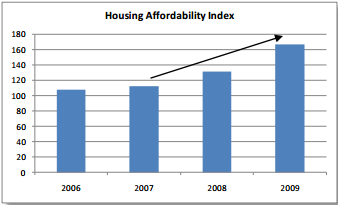
Second, the housing market is still being stimulated by the Federal Reserve as they purchase mortgage backed securities on the open market to keep mortgage rates low. With prices down significantly and historically low interest rates at the same time, home affordability is extremely good. NAR calculates

a housing affordability index based on median income vs. the principal and interest owed monthly on the average mortgage for a home with the median home price. This index has soared as prices and rates have come down, but incomes have remained fairly steady in the past few years. The Fed has indicated that it plans to end its mortgage purchase program in March 2010 which could allow rates to start increasing. Combined with the credit ending in April 2010, this could put pressure on the housing market for a second wave down in prices.

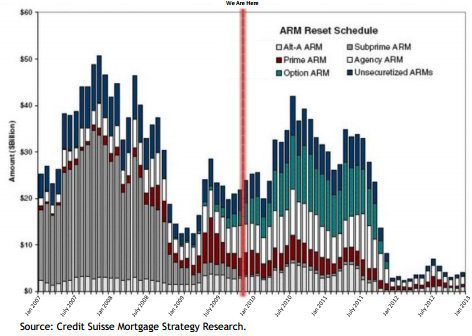
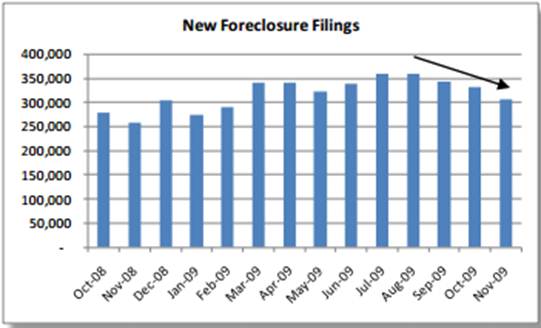
Also potentially impacting prices going forward is the rate of foreclosures. Again, a bit of improvement in recent months as new foreclosure filings have decreased. This is in part due to the moratorium on foreclosures in some states as well as the ramp down in subprime, adjustable rate mortgage (ARM) resets. But, while we’re almost out of the woods on subprime, there is a new wave of ARM resets coming, in the form of option-ARMs. These are adjustable rate mortgages that allow the borrower to choose his monthly payment, sometimes even less than the interest amount, which can result in increasing rather than decreasing mortgage balances. As those rates reset from extremely low teaser rates, more homeowners could find themselves unable to make their payments, just like the subprime situation that peaked in 2008.

Another factor that could restart another wave of foreclosures is the increasing number of homes that have negative equity. As prices continue to fall, more owners find themselves upside-down on their mortgage, owing more than the house is worth. The Wall Street Journal recently published an article with some staggering statistics in it on this point.

· 23 % of homes that have a mortgage are worth less than the mortgage balance

· 50% of under-water homes are more than 20% under-water

· 40% of mortgages started in 2006 are underwater

· 10% of mortgages started this year are already underwater (so much for bargain hunting!)

The lack of equity in many homes contributes to the growing number of foreclosures which in turn puts more pressure on neighboring home values. So, while we have definitely seen recent signs of life in the housing market in terms of sales and prices, there is good reason to suspect another tick up in foreclosures, mortgage rates likely increasing after March, and the homebuyer tax credit expiration slowing down the pace of sales again. For those reasons, it’s too early to feel like the housing market and housing prices have bottomed on a national level. Temporary stability, yes. Recovery, not quite yet.

Market Update (03-24-2009)

*** We believe communicating with our clients is of utmost importance, especially during turbulent times in the market. While we don’t claim to have a crystal ball on the future of any financial market at a given point in time, we do believe that keeping clients informed on why things are happening increases their comfort level and understanding. This post contains a message initially sent to clients just after what turned out to be the market bottom in March of 2009 as part of that communication effort***

With so much focus on the seemingly endless economic collapse that is happening around us I’ve been looking forward to begin able to send a more optimistic update for quite a while. Toward the end of 2008, I provided a few regular updates to all of you as events unfolded that led us into this decline. Over the last week, much has changed and while I’m sure it won’t get as much TV airtime as the bad news did, it’s just as important. Many of you know by now that the stock market rallied more than 7% today. This followed previous rallies over the past two weeks such that the market is now up more than 20% from its recent lows. Many regard the stock market as a view into what is around the next corner for the broader economy. This was certainly true last October when the credit markets froze, the stock market fell 25% in a week, and the real impact hit most people a few months later when layoffs rapidly accelerated. Similarly, I suspect the events of the last week, including today, will not be felt by Main St. until mid to late summer when those layoffs will slow down or cease. So, I wanted to provide a similar update to you now on what has changed, and why the market is reacting the way it did today.

To some of you in our conversations, I’ve already described the announcement by the Federal Reserve last week as a “game-changer”. In case you don’t know what I’m talking about, let me summarize what the Fed said they’re going to do. First some background. We all know that the government is spending a ton of money right now and that we don’t have enough tax revenue to pay for it all. This is commonly known as “The Deficit”. Years of deficits have added up to a very large national debt of just over $11 trillion, or some $36,000 per U.S. citizen. The debt is financed by issuing government bonds called “treasuries”, which are purchased by individuals, corporations, and foreign nations. Because the U.S. has a very stable political system and has never defaulted on its debts in the past, it is considered credit worthy and lenders don’t demand a very high rate in return for their money. But, the deeper the hole we dig, the greater the interest that we have to pay on our debt. As that interest becomes a bigger and bigger slice of the tax revenue, it creates some risk that we might not pay our debts off. This risk would push interest rates up, just at a time that the government wants to keep them low for investment, refinancing, etc. So, we seem to have to choose between deficit spending (needed to turn the economy around) or low interest rates (also needed to turn the economy around). Quite the dilemma. Meanwhile, the recession continues to take its toll on asset prices (stocks, real estate, commodities, etc.). To put it simply, there is just less money out there than there used to be which means people can’t afford to pay what they previously could for similar assets. This creates a deflationary spiral where asset prices are falling because of the recession, and the recession is deepening because of falling asset prices. To combat this, the Fed announced last week that they will now be buying treasuries directly from the Treasury to finance the deficit, and mortgages directly from mortgage lenders to free up capital for new lending and keep mortgage rates low. Where will they get the money? Good question. Believe it or not, they’re just printing it.

Printing money is highly inflationary. If we just double the amount of dollars in the economy, then we double the demand for everything which raises prices until it takes two dollars to buy what we used to be able to buy with one dollar. No one is wealthier, but because prices are rising so quickly, people start to hoard assets pushing up prices further, which can start an inflationary spiral. But, if we’re in a deflationary spiral now, putting some seemingly inflationary actions into play could break the spiral. If done carefully, we’ll end up perfectly replacing the lost wealth that is pressuring the economy which will put a floor under asset prices and return confidence to the normal buyers of those assets. In short, the recession will end and growth will be restored… a game-changer. Things won’t get better overnight, but for the first time in several months, I believe recovery is in sight and that the economy will begin to slowly stabilize over the next 3-6 months. Note that by stabilize I don’t mean the Dow returns to 2007 levels, that unemployment returns to 5%, that housing prices start increasing 10% per year, and that things feel “normal” (per 2004-2006 expectations) again. I mean that stocks will stop falling, unemployment will stop rising, and we’ll have time to get used to the new normal (stable, sustainable, moderate growth). It’s likely that the stock market today and over the past couple of weeks senses this as well, and is pointing toward signs of recovery.

In some additional good news, the Treasury today announced their long-awaited plan for handling illiquid mortgage-backed securities commonly known in the press as “toxic assets”. The plan includes a public-private partnership that will team up private capital, government programs such as TARP (the name for the $700 billion “bailout” that Congress passed in December), and the FDIC to purchase and create a market for these previously illiquid assets. Without a market to sell them, banks were forced to keep ownership despite their rapidly declining value and uncertain future. This in turn rattled investor confidence and prevented banks from raising new capital from private markets; hence the need for government bailouts. The details of the program make a lot of sense, with the private investors determining what price they’re willing to pay for the assets via an auction process, the government backing their investment in a way that will reward them for taking risk while also rewarding taxpayers alongside the private investors, and no penalties for banks that participate in a sale of their assets. As stated currently, this program should be another big positive for both the markets and the economy.

Before we sound the “All Clear” signal, we have to realize that along with all the positives come some greater risks as well. Buying treasuries and mortgages is bold action by the Fed and while it is likely to end the recession in the medium term, if it’s not done carefully, it will lead to potentially bigger problems down the road. We could face runaway inflation, lost confidence in the dollar as a currency, and political tensions with other nations who suffer because our actions devalue the dollar that they own a ton of in the form of our debt (the financial engineering equivalent to highway robbery). The Treasury, the Fed, and the Federal government will all have to work together to cut spending, remove excess dollars, and reign back the flood of liquidity as soon as confidence is restored and the recession is over. If they don’t, $140 oil will seem like a bargain compared to the prices we’ll be paying in a few years!

In addition to the risk of inflation going forward, there is another risk that is worth mentioning. The government is beginning to meddle in the private markets in ways that could hurt the willingness of corporations to do business with them in the future. Last week, the House passed a bill that would tax AIG bonuses at a 90% rate as a way of punishing the firm for paying bonuses after taking government money via the TARP program. While I think we can all agree that rewarding failure at the expense of the taxpayer is not what was intended by TARP, we have to be very careful in retroactively changing the rules on government programs. When TARP was passed there were no stipulations on how the money could be used. While the focus is on AIG who took the money to keep their business afloat, many firms took TARP money so that they could provide additional loans to homebuyers and businesses that needed credit. Now, the government is imposing additional rules on executive compensation for all companies that took TARP funds. If you change the rules in the middle of the game, it’s possible that no one will play with you anymore. In this case, many companies are now seeking to return TARP money which would cut off the added credit to the economy and reduce the effectiveness of the program. This government behavior could also cause skepticism of the new public-private partnership announced today. If there’s danger that participating banks may face new rules 3 months into the program, they may not want to participate at all. Congress needs to make sure that it writes all the rules ahead of the release of programs like TARP, and whatever those rules are, that it consistently enforces them without modifying them midstream. If we have a fair and consistent set of rules, which encourage participation in government sponsored programs to stimulate the economy, then those programs stand a chance of working. If not, we’re just wasting our time creating the programs that no one will use and the downward spiral will continue.

In conclusion, let me be clear… I’m not claiming that the worst is over for the economy. There will be more layoffs, there will be more housing price declines, and there will be more foreclosures as the current damage flows through the system. But, over the next few months, these new programs and the lack of new damage will stabilize the economy and it will eventually begin to grow again. I’m also not claiming the stock market has necessarily bottomed. The short-term stock market is too unpredictable to say with certainty what will happen over a matter of days. But, IF the risks stated above are controlled, and that is a BIG IF, then I believe these plans are likely to stabilize the market. That is why we saw the gains we saw today and why we probably have seen the last of the 20% monthly market drops for a while.

As always, if you have any questions about this update or anything else, feel free to contact me.

Market Update (10-12-2008)

*** We believe communicating with our clients is of utmost importance, especially during turbulent times in the market. While we don’t claim to have a crystal ball on the future of any financial market at a given point in time, we do believe that keeping clients informed on why things are happening increases their comfort level and understanding. This post contains a message initially sent to clients just after the “bailout” (TARP) in 2008 as part of that communication effort***

What in the world happened in the markets last week?

Make no mistake about it, the US stock market crashed last week. It happened over five days instead of just one as it has happened in the past, but the broad US stock market (as measured by the S&P 500) fell more than 23% from its closing value one week ago to the morning lows on Friday. Foreign markets in Europe and Asia actually fared worse, and emerging markets even worse than that. Panic and fear dominated as credit has become virtually frozen and companies, funds, and some individuals have been forced to liquidate portfolio holdings to free up cash that is badly needed. Forced selling leads to lower prices which leads to more forced selling and even more credit restrictions. It is a vicious cycle and the result is a loss on the order of $4 trillion dollars of aggregate wealth in the U.S. stock market. Additional circumstances likely contributed to the cause, like the unwinding of some complex derivatives (think of them as huge bets b/c that’s really what they are) that had to do with the Lehman bankruptcy and worsening economic data that has increased the probability of a technical recession in the U.S. and abroad. But for the most part, market action last week was based on emotion and fear rather than facts and events.

How did we get into this mess?

Our banking system is built on leverage. For every dollar of assets that a bank has, they’re allowed to loan out $10 (that number isn’t exactly right and isn’t fixed, but it is determined by the Fed, and it’s the fact that they can loan more than they have that matters). As long as their loans continue to be repaid close to on schedule, the system continues to work. Banks have plenty of money to pay back deposits, provide new loans to individuals and other banks, and continue to do business. Some of the biggest loans that these banks own are mortgages. Many mortgages, for reasons I won’t get into, were given to people who never should have had them and who had no ability to pay them back over the long term. The thought was that as long as housing prices continued to rise, repayment risk really wouldn’t matter because if the borrower couldn’t pay their mortgage, they’d just sell their house for more than they paid for it, repay the loan, and move somewhere more affordable. When many of these risky loans are lent in the same time period, especially on an adjustable interest rate basis (which is what happened in 2001-2004), and those rates start to adjust upward as they are now, it puts pressure on a lot of people at the same time. They all start to try to sell their houses because they can’t pay their mortgages. That pushes house prices down because it floods the market with houses for sale. Pushing prices down scares more people who bought speculative investment properties and they start to sell as well, pushing prices down more. More scared people, who might have bought a house, now stay out of the market. Lack of demand means even lower prices. Now the people that can’t pay their mortgage can’t sell their house for more than they paid anymore. The only way out of the mortgage is foreclosure. This pushes prices down more and the cycle continues.

Meanwhile, the banks that rely on these mortgages (and related products that are too complicated to describe here) start to lose a LOT of money very fast b/c they’re not getting their interest payments anymore and they’re losing huge chunks of principal through foreclosure. That ratio of assets to loans deteriorates and the Fed requires them to raise more capital to maintain a safe ratio. To do that they sell pieces of the company and some of their bad assets for less than they are worth (“fire sale prices”) to try to raise cash. By doing so, accounting standards require that similar businesses with similar assets have to mark down their assets to those prices immediately which puts pressure on their required assets to loans ratio forcing them to liquidate holdings as well. When all is said and done, there isn’t anyone left to put money into these companies b/c they’re all looking for money and in the same situation. If they can’t find the money, they’re forced into failure / bankruptcy which forces more asset sales through liquidation and puts pressure on the other banks again. This domino effect, if not stopped, could literally bring down all the institutions that the economy depends on for business loans, mortgages, car loans, credit cards, and investment products. While doing so, it would lay off millions of workers and force the rapid shutdown of the businesses that rely on credit to build and grow. That would cause layoffs of other workers and cut aggregate spending in the economy, hurt retail, cut more jobs and so on. The single source of strength in all of this is the government (as scary as that is). Both US and foreign governments have the capacity to end the cycle by providing liquidity to the markets so that loans/credit can continue to be obtained, and invest in the banks that caused the problem in order to keep them afloat and keep the banking system running. That’s what governments around the world are doing, but they have to do it in a careful way that takes a bit of time. While time passes, the problem gets worse. What you witnessed last week in the financial markets is the result.

Didn’t the government just pass a $700 billion package to prevent this from escalating?

Yes, we authorized it, but we haven’t started using it yet. In order to make sure the $700 billion is used optimally, several vehicles have to be set up to allow the government to purchase distressed assets at appropriate prices from the banks and other institutions that may be looking to sell them. While this is being set up, the Federal Reserve and the Treasury continue to inject capital and provide liquidity to the markets through a variety of tools including complex short-term loans. Eventually, these injections of liquidity will unlock the credit markets because enough money will be available to meet the demands of borrowers.

When will end?

In some ways, we may have already started to see the end of this crisis. The market rallied more than 5% from its lows on Friday morning before closing for the weekend. Gold, which is usually a safe haven in times of trouble, plunged when the market rallied back. These are good signs but the short answer here is that we really don’t know when it will end. Over the short-term, especially when panic sets in, the stock market is incredibly unpredictable. No one knows when it will bottom or if it already has. It’s very possible that we see an extreme rebound in the stock market over the short-term. By no means does that mean the economic turmoil or credit crisis is all behind us. However, the actions that our government has taken and the coordinated actions of governments around the world (like those coming out of the G7 meeting this weekend) will start to set a floor under panic-driven selling. The open question is, once the panic driven selling stops, how much damage will have been done to the economy and how long will it take to recover.

So how bad is it going to get?

From an economic perspective, it could get pretty bad. Some industry experts are predicting the worst holiday season for retail sales since the popping of the tech bubble and subsequent economic turmoil after Sept 11th. The financial services sector has already seen, and will continue to see big layoffs from bank failures and merger activity. Unemployment is likely rise throughout the entire economy. Housing prices will likely continue to fall for some time as the inventory of available homes is simply too great when compared to the demand for purchases. Recession is almost a certainty. On the bright side, the cost of living appears to be decreasing for the first time in a long time. Energy prices have tumbled. On Friday, gasoline futures bottomed at $1.80 per gallon. When that flows through the system, it should translate into retail gasoline prices well under $3 / gallon, and potentially as low as $2.50 in some places. Food prices (corn, grains, meats, etc.) are also falling. As housing prices come down, the cost of buying a new home comes down with it. Investing in companies has become dramatically cheaper, and in a sense, 40% less risky since it costs about 40% less to purchase the same stock than it did a year ago. All of these things lay the groundwork for a strong economy in the future. Once the excesses of a rapidly growing economy that was fueled by greed and leverage are pulled out the system, there comes potential for a period of fantastic growth. This has happened again and again in our history, and will likely happen again. It’s just a matter of how long it will take, and how involved governments will be in facilitating (or blocking) a natural rebound through regulation.

OK, so what should I do now?

From an investment perspective, you probably shouldn’t do anything different than what you were doing before this happened. If the money you need for long-term goals is in the stock market (as it probably should be), then this is just part of the volatility you have to accept in order to target long-term growth. In time, unless you believe the world will end or the U.S. economy will completely grind to a permanent halt, the markets will recover. For shorter term goals, your money should be more diversified with more and more of it in safer investments like bonds as the need for the money comes closer and closer to the present time. This means the stock market volatility won’t have as large of an effect on that money. During your upcoming reviews, we will re-evaluate your goals, the current funding for those goals, and your asset allocation to determine if any changes should be made in your allocation strategy. In the meantime, I’m taking care of keeping your portfolio in sync with the strategy we determined during the creation of your financial plan, and making sure we’re using the best funds possible to achieve your allocation.

Is there anything else I can do to get through this period and come out in a better position when it’s all over?

Yes. Here’s a short list of recommended actions that would likely benefit everyone during this period:

1) If you’re not retired and are depending on income from an employer, make yourself indispensable at work. Layoffs are coming in most industries. Make sure your boss would go out of his/her way to keep you off the layoff list by performing to the best of your ability. During times of layoffs, it’s often your performance during the past few months that counts most in deciding your fate.

2) Make sure your emergency fund is well-funded. Cut back on discretionary spending if needed to make sure this is the case. The likelihood of needing it in the next year has increased as the economy has faltered. Now is the time to make certain your emergency fund will be there if you need it.

3) Have a contingency plan. Think for a few minutes about your worst case scenario (job loss, retirement asset loss, etc.). What’s your first move if this happens tomorrow (is your resume up to date, do you have enough money to cover your basic needs, etc.)?

4) Continue to make regular deposits to your goal-funding vehicles (401k, brokerage account, etc.). Prices are 40% cheaper on average than they used to be. Take advantage of this and continue to build toward your goals.

5) Be exceptionally careful with employer stock holdings. We continue to see companies go out of business seemingly without warning. You do not want to lose your job and significant assets at the same time if your company experiences troubles. So, even if your stock is down from its highs, it probably makes sense to diversify it and spread the risk to other areas of the market.

As I finish writing this update, US stock futures are up 3%+ from their close on Friday. While this is certainly no guarantee of a successful day tomorrow or an end to the turbulence, I believe it is a good sign. Wherever this week’s rollercoaster market takes us, I hope the knowledge of what’s going on helps you worry less about it. As always, please feel free to contact me if you have any questions or comments.

Volatile Markets & Active Trading

***This post was originally published in PWA’s Newsletter: The Pretirement Press in Q1 2008 and it’s publish date has been edited here to reflect the approximate initial publish date***

The sharp up-and-down in the markets tends to draw more market-timing traders in. These speculators attempt to profit from momentum by buying when the market is going up and selling when it’s going down, creating even more of a whipsaw effect. For the inexperienced investor, it can be tempting to try to pick a top or a bottom in the market and profit from these wide swings. There are four issues with doing this.

1) You need to pick the right top to sell your investments and if you’re wrong you risk missing the upside.

2) You need to pick the right bottom to buy back into your investments.

3) You need to pay taxes when you sell (assuming you have gains), which means you’ll be unable to buy the same amount back later.

4) You pay commissions to your broker each time you make a trade.

Brokers will win with this strategy since they collect trading fees. Uncle Sam will win with this strategy since he collects taxes. A few individuals will win with this strategy if they pick the exit and entry points correctly. Everyone else will lose, and will experience much more long-term volatility than necessary. A much more successful strategy is to work with your advisor to outline your goals, the returns you need to achieve those goals, and implement an asset allocation that is designed to target that return over the timespan you need. You can’t measure it over months, you won’t get the exhilaration of a “winning trade”, and it won’t be as much fun to try. What you will get is enough money to fund your lifelong aspirations and that should be much more meaningful than occasional short-term wins.

Youthful Savings

***The following was originally posted on PWA’s main website in 2008. It is reposted here in its original form.***

The following is an illustrative story only. Any similarity between the characters portrayed here and any actual person, living or dead, is purely coincidental.

Meet Mike and Ike Jones, 23-year-old twins from Tampa, FL who recently graduated from Clemson University in South Carolina. Both are engineers by education and have taken entry-level positions with an esteemed construction management company in Atlanta, GA where they can make good use of their civil engineering degree. Both Mike and Ike have a some college loans outstanding, but are making a decent salary of $45,000 / year and are paying loans down as planned. Mike has always been a bit more mature than Ike, and has always put building a successful future for himself ahead of having the most fun possible in the present. Ike is also generally responsible, but tends to focus on today more than tomorrow. As they’ve both been with their company for 2 years now, they’ve recently qualified to start contributing to the firm’s 401k retirement plan. While the company doesn’t match contributions, Mike and Ike both realize the value of tax-deferred growth in such a savings plan. Mike decides to immediately start contributing to the plan, deferring $5,000 of his salary each year for the next ten years. Ike, on the other hand, decides that there is plenty of time to save for retirement and decides to wait ten years before contributing.

At age 33, after 10 years have passed, Mike has a dramatic lifestyle change and can no longer contribute to his 401k as he needs every dollar to pay the bills and support his pregnant wife and 2-year-old child. He never contributes another dollar to his 401k. Ike now at age 33 decides to start contributing and contributes $5,000 per year for the next 32 years until both brothers retire at age 65.

Let’s assume both brothers earned an average annual return of 10% on their 401k account balance. After 32 years of contributions and that 10% annual growth, Ike’s account balance would be just over $1.1 million dollars. But, with only 10 years of contributions and earning that same 10% per year, Mike’s account balance is $1.85 million dollars! Even though he put significantly less into the account over 42 years, the fact that Mike started contributing early allowed the “miracle” of compounding to produce 66% more money for retirement than his brother.

The lesson here is clear. Start saving early in life and you wind up letting your money work for you longer. The longer your money’s working for you, the less time you’ll have to spend working for your money.

Why Choose A CERTIFIED FINANCIAL PLANNERT Professional

***The following was originally posted on PWA’s main website in 2008.  It is reposted here in its original form.***

Did you know that today anyone can claim to be a “financial planner”? It’s true. But not just anyone can call himself or herself a CERTIFIED FINANCIAL PLANNER™ professional. As a consumer, it’s important to understand the difference. Allow me to take this opportunity to explain why.

I have earned the right to call myself a CFP® professional because I have voluntarily agreed to meet rigorous education, examination and experience standards. I participate in ongoing professional education. And, I follow a strict code of professional ethics and standards of practice. The standards I adhere to are promulgated and enforced by Certified Financial Planner Board of Standards Inc. The CFP Board refers to these standards as “the 4Es.”

· Education. I completed an education requirement to demonstrate to CFP Board that I have the theoretical and practical financial planning knowledge to practice personal financial planning. In addition, every two years, I complete a minimum of 30 hours of continuing education to stay current with developments in the field.

· Examination. I passed an exam administered by CFP Board to test my understanding of the financial planning process, tax planning, employee benefits, retirement planning, estate planning, investment management and insurance.

· Experience. Before earning the CFP® certification, I fulfilled a minimum of three years’ experience in the financial planning process.

· Ethics. I agree to abide by CFP Board’s “Code of Ethics and Professional Responsibility.” The “Code of Ethics” requires CFP® certificants to act fairly and diligently, with integrity and objectivity, when providing financial planning services to clients. I also have agreed to submit to background checks by CFP Board and have promised to disclose any investigation or legal proceedings related to my professional or business conduct.

If you are looking for a measure of a financial planner’s commitment to ethical behavior and adherence to high professional standards … if you are looking for a financial planner who will put you and your needs at the center of every financial planning engagement … I suggest that you look for a CFP® professional.

It’s never too early and never too late to take charge of your financial future. To learn more, I encourage you to contact me. I would be pleased to meet with you to answer your questions.