All-Time Highs – A Historical Perspective

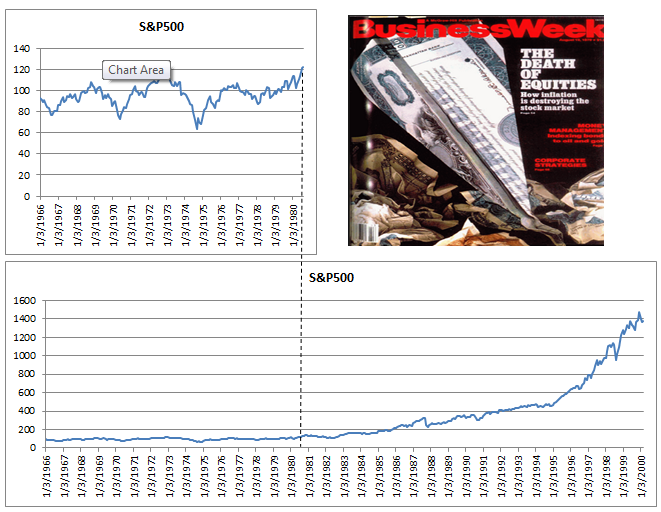
If you watch business news TV, read the business section of the newspaper, or follow business/investing websites, you’ve undoubtedly heard a lot of “due for a pullback”, “too much too fast”, “need a correction” and “not safe to invest at all-time highs” lately. Mind you, many of these predictions started when the stock market was 10-20% lower than it is today. While I continue to believe predicting the short-term direction of the market is a fool’s game, and I’m definitely not saying it’s going to happen this way again, it’s worth looking at the last time in history that the stock market moved essentially sideways for 13-14 years and then broke out to new highs. The first chart below shows the S&P 500 from 1966 to mid-1980. Essentially no gains for over a decade, two massive drops (one near 50%). This was the period of the infamous Businesweek cover that claimed “The Death Of Equities”. The second chart shows the same S&P 500 index starting from the same point, but extending to 2000. If investors were too scared in 1980 to invest in the stock market, or were waiting for a correction to invest because it was breaking to new highs, they may have missed the run from 120 to 1500 on the S&P 500 (1150% return).

The moral of the story is not that you should invest now because the stock market is going to go up for the week, month, year, or decade. It’s that trying to use the recent past (or even 14 years of past) to determine the value of the stock market today is useless. It may even be worse than useless… it could lead you to feel that the market it overvalued, right before it increases 1150% over the longest bull market in history.

Charitable Contributions – Deductions and Recordkeeping

I receive lots of questions around tax time about what charitable contributions are deductible and what records need to be kept to validate the deductions.  Here’s my brief attempt at the basics of donating cash, donating property, or performing charitable services through which you incur expenses:

Cash

1)      If you make a donation in cash that is under $250, an acknowledgement from the organization is not required as long as you have a bank record of the transaction (account statement, credit card bill).  The record must include the name of the charity and the amount of the contribution.  Alternatively, you can have a receipt from the organization, or a payroll record if you donated through a payroll deduction.

2)      If you make a donation in cash that is $250 or over, you must receive acknowledgement from the organization dated prior to the due date of your tax return, and it must state:

  1. The amount of cash and a description (but not the value) of any property other than cash contributed.
  2. Whether the organization receiving the donation provided any goods or services in consideration, in whole or in part, for any cash or property that was contributed.  This is important.  A simple letter saying you donated $1,000 to the organization will not qualify because it doesn’t say specifically that you didn’t receive anything in return for the donation.  In a recent court case, a couple contributed $25,171 to their church over multiple donations through the year, most of which were over $250.  At the end of the year, they received a letter stating the total (and thanking them for their generosity), but the letter didn’t include a statement that said they received nothing in return.  The IRS challenged the deduction, it went to court, and the Tax Court sided with the IRS since this clearly violated the rules for taking a deduction.
  3. A description and good faith estimate of the value of any goods or services received by the donor or if such goods and services consist solely of intangible religious benefit.

Property

If you donate property to a qualified charitable organization, you generally can deduct the fair market value of the property.  This is not the amount you paid for it.  It is the amount the property is worth at the time of the donation (generally not to exceed the value you paid for it).  The recordkeeping rules differ based mainly on the deductible value of the donation:

1)      If the deductible value is less than $250, you need a receipt from the organization showing the name of the organization, the date and location of the donation, and a reasonably detailed description of the property (“1 large bag of clothes” will not do).  Note, the IRS says that you do not need a receipt for donations < $250 if it is impractical to get one (like an unattended drop box).  You must also keep records of the donation which include:

  1. The name and address of the organization
  2. The date and location of the donation
  3. A reasonably detailed description of the property
  4. The fair market value of the property and how you determined it (i.e. thrift shop value, comparative sales, etc.)
  5. Your cost basis in the property
  6. The amount you claim as the deduction
  7. The terms of any conditions attached to the donation.

2)      If the deductible value is between $250 and $500 (inclusive), you need:

  1. the information from #1 above, AND,
  2. a written acknowledgement from the organization detailing the property donated, whether you received anything in return or not, and a description and good faith estimate of anything you did receive in return.  This must be received before the due date of your tax return.

3)      If the deductible value is over $500 but not over $5,000, you need:

  1. the information from #2 above, AND,
  2. your own records showing how you obtained the property, the approximate date you obtained the property, and your cost basis in the property.

4)      If the deductible value is over $5,000, you need:

  1. the information from #3 above, AND,
  2. a qualified appraisal

Special rules exist for cars, boats, and airplanes which include receiving a 1098-C from the charitable organization and your deduction being limited to the amount for which your donated item was sold by the organization (e.g. if you donate your car with a blue book value of $2k to your church and they sell it for $750, your deduction is limited to $750).

Expenses

You can deduct expenses you incur in connection with performing charitable work as long as the expenses are:

1)      not reimbursed,

2)      directly connected with the services you provided,

3)      expenses you only incurred because of the services you provided, AND

4)      not personal, living, or family expenses.

The cost of travel to perform charitable services is deductible including the cost of driving your own car at the annual charitable mileage deduction amount as posted by the IRS (14 cents per mile for 2012 and 2013).  Meals are generally only deductible if you’re required to be away from home overnight.

Note: you cannot deduct the value of your time in performing or traveling to/from charitable services.

See IRS Publication 526 for more information.

Where’s My Refund Tool

The IRS is not providing estimates for direct deposit this year as part of your Form 9325 (E-File Confirmation). If you expect a refund from the IRS, you can check the “Where’s My Refund” tool available at irs.gov. See the information below from the IRS with more detail on the tool:

After the IRS starts processing returns, it expects to process refunds within the usual timeframes. Last year, the IRS issued more than nine out of 10 refunds to taxpayers in less than 21 days, and it expects the same results in 2013. Even though the IRS issues most refunds in less than 21 days, some tax returns will require additional review and take longer. To help protect against refund fraud, the IRS has put in place stronger security filters this filing season.

After taxpayers file a return, they can track the status of the refund with the “Where’s My Refund?” tool available on the IRS.gov website. New this year, instead of an estimated date, Where’s My Refund? will give people an actual personalized refund date after the IRS processes the tax return and approves the refund.

“Where’s My Refund?” will be available for use after the IRS starts processing tax returns on Jan. 30. Here are some tips for using “Where’s My Refund?” after it’s available on Jan. 30:

  • Initial information will generally be available within 24 hours after the IRS receives the taxpayer’s e-filed return or four weeks after mailing a paper return.
  • The system updates every 24 hours, usually overnight. There’s no need to check more than once a day.
  • “Where’s My Refund?” provides the most accurate and complete information that the IRS has about the refund, so there is no need to call the IRS unless the web tool says to do so.
  • To use the “Where’s My Refund?” tool, taxpayers need to have a copy of their tax return for reference. Taxpayers will need their social security number, filing status and the exact dollar amount of the refund they are expecting.

For the latest information about the Jan. 30 tax season opening, tax law changes and tax refunds, visit IRS.gov.

Additional IRS Resources:

IRS YouTube Video:

  • When Will I Get My Refund? –

American Taxpayer Relief Act (ATRA) a.k.a. Fiscal Cliff Deal

I’ve parsed through the legislation (which can be found here if you want to check it out for yourself), as well as a ton of analysis, and to the best of my ability, here’s a quick summary of the relevant portions of the new law that averted the tax portion of the fiscal cliff. Note that while $400k/450k are getting all the press for paying higher taxes, there are a number of provisions which impact $200k(single)/$250k(married), and one really big one that impacts everyone (Payroll Tax Holiday Ended):

· Income Tax Rates: All existing rates remain the same with brackets increased for inflation (10%, 15%, 25%, 28%, 33%, 35%) and a new 39.6% bracket begins at taxable income over $400k for singles and $450k for joint filers.

· Long-Term Capital Gains: These were set to move from 0% for the bottom two tax brackets and 15% for everyone else to 20% for everyone. The legislation keeps the 0% and 15% rates for everyone except those in the new 39.6% tax bracket. They’ll pay 20% (not including the new Obamacare Medicare Surtax, see below).

· Dividend Rates: These were set to move from 0% for the bottom two tax brackets and 15% for everyone else to ordinary income rates for everyone. The legislation keeps this rate tied to the long-term capital gains rate with the same rules as above.

· Estate Tax Rates & Exemption: Retained the $5M per person exemption (was set to reset to $1M) and kept it portable (each spouse gets $5M instead of the couple getting $10M which forces complicated bypass trusts to be set up to try to use the $5M from the first to die spouse). Set the top tax rate at 40% (up from 2012’s 35%, but down from the 55% to which 2013 was due to revert).

· AMT Exemption: Patched the AMT exemption amount to the 2011 amount, increased for inflation. This was a big one since it was 2012 they were fixing, not 2013. Even better, they permanently fixed this so that each year’s exemption will be indexed to inflation going forward. This means no end of year scramble to get an AMT patched passed each year.

· Phaseout of Itemized Deductions: this was due to happen in 2013 without any new law, but ATRA tweaked the thresholds. If you are Single with AGI over $250k or married with AGI over $300k, your itemized deductions will be reduced by 3% of the amount that your AGI exceeds the threshold, up to a maximum reduction of 80% of your itemized deductions. To simplify, if you’re over the threshold by $10k, you lose $300 of itemized deductions. If you’re over by $100k, you lose $3k.

· Phaseout of Exemptions: this was also due to happen in 2013, but ATRA unified the phaseout level with the Itemized deduction phaseout. If you are Single with AGI over $250k or married with AGI over $300k, your exemptions ($3800 per family member) are reduced by 2% for every $2500 that you’re over the threshold. To simplify, if you’re over by $10k, you lose 8% of your exemptions. If you’re over by $100k, you lose 80% of your exemptions. This can be a pretty big bite.

· Payroll Tax Holiday Ended: this was due to happen in 2011, but was extended for two years and now is finally gone. It impacts everyone with income from work (employment or self-employment) by restoring the employee portion of Social Security (FICA) tax to 6.2% from 4.2%. This means everyone will pay 2% more tax in getting this level back to its pre-2011 setting (which still grossly underfunds Social Security over the long-term).

· Marriage Penalty: The standard deduction for married filers and the 15% tax brackets were due to revert to 1.67x the single amounts. ATRA kept them at 2x the single amount and made that change permanent. There is still a very large marriage penalty in the code anyway, as described here.

· Bonus Depreciation & Higher 1st Year Expensing: For business owners, 50% bonus depreciation on new purchases is extended into 2013 as is the higher limit for immediate expensing of certain purchases (Section 179).

· Misc. Permanent Extensions: Child Tax Credit ($1k per child subject to limits), Exclusion for Employer Provided Tuition Assistance ($5250 tax free reimbursement).

· Misc. Temporary Extensions: American Opportunity Tax Credit (college), teacher’s deduction ($250), exclusion from discharge of debt on primary residence (no income on short-sale or foreclosure), deduction for Mortgage Insurance Premiums, Deduction for State and Local Sales Tax paid (big in no income tax states), Tuition Deduction.

While not included in the ATRA legislation, it’s important to remember that two new fairly large changes also being in 2013 as Obamacare is rolled out. They are:

1) 0.9% Medicare Surtax on earned income (income from work) that exceeds $200k (single) or $250k (married). It’s important to note here that this will cause underwithholding from your employer if you have multiple jobs or are marred and both spouses have income since payroll systems will not realize that your earned income will exceed $200k/250k until you exceed that amount from a single employer.

2) 3.8% Medicare Surtax on investment income (interest, dividends, capital gains, rents collected, passive business income) if your Adjusted Gross Income exceeds $200k (single) or $250k (married). While there is no withholding on most investment income and you’re used to paying tax when filing or making estimated tax payments on that income through the year, the 3.8% additional tax effectively raises the tax rates on interest, dividends, gains, etc., even if you don’t meet the now well-publicized $400k (single) / $450k (married) income from the fiscal cliff deal.

I have no doubt that more tax changes will come in 2013 and/or 2014 since ATRA only reduces the > $1 trillion deficit by ~$60 billion per year, so it’s hard to count on anything above as permanent even where legislation made it permanent. The next major debate, likely to be more focused on spending than taxes will be in February as the Debt Ceiling will need to be raised again at that time. It’s quite possible that taxes, especially beyond 2013, become part of that negotiation as well.

Fiscal Cliff Deal Update 12/31

At the 11th hour, as expected, here comes the mini-deal. All speculation so far, but here’s what it’s looking like:

· Threshold for income tax rate increase would be $400k for individuals or $450k for families. Top rate on these taxpayers would increase from 35% to 39.6% though the marginal rates below that level will remain the same as they are now.

· Long-Term Capital Gains rates AND dividend rates go to 20% from 15% (but not 39.6%) for those above the $400k/450k income level. 15% would be maintained for those below.

· Extension of unemployment benefits for ??? time

· AMT Patch for 2012

· Deferral of sequestration-related spending cuts for a limited amount of time

· 40% top tax rate on estates over $5M (per individual??), up slightly from current 35%

Details still to be worked out. Votes in both the Senate and House required to pass. Not a given by any means. This would also do nothing for the debt ceiling (which needs to be raised sometime around late Feb / early Mar) and does VERY little to close the $1 Trillion per year deficit at the heart of the matter.

2013 Tax Changes & “The Fiscal Cliff”

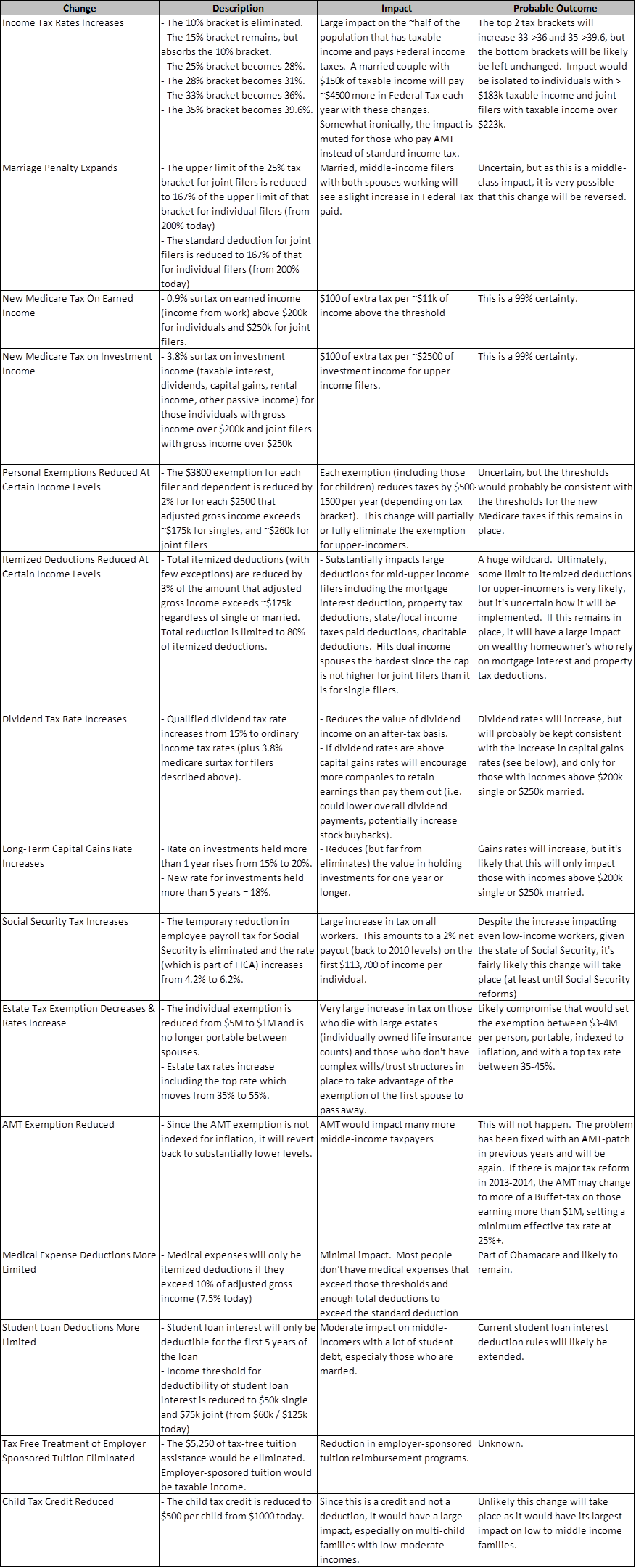
By now everyone has heard of the tax increases and spending cuts that will take effect in 2013 under current law, not-so-affectionately-called “The Fiscal Cliff”. This post takes a look at many of the tax changes which will have a broad impact on individuals and joint filers regardless of income. While the list is not all-inclusive, it covers most of the changes that would affect individuals and couples (leaving out some of the business tax impacts). Some of these may come as a surprise since they don’t get much attention in the press. The chart below shows the changes as they are currently on the books, the impact of each change if left as is, and the probable outcome of efforts to avoid the Fiscal Cliff.

The probable outcomes on the changes above are not likely to close the deficit enough to prevent another rating downgrade of U.S. debt, especially if the proposed spending cuts are also scaled back to avert the fiscal cliff. To close the deficit, a broader “grand bargain” will be necessary to cut spending on entitlements and discretionary items while raising tax revenue through a major tax revamp. There is no time for this to be negotiated in late 2012 / early 2013, but I think it’s on the table toward the end of 2013 / beginning of 2014, especially if motivated by the debt rating agencies and/or market-based increases in long-term interest rates as the U.S. loses credibility as a borrower. The solution needs to be a balance of higher taxes and reduced government spending, but most of it needs to be focused on long-term changes, rather than sudden short-term shocks to the economy. I suspect this will include pushing out the SS retirement age for those currently below age 50, greater Medicare limitations and/or higher Medicare premiums for those currently below age 50 when they reach Medicare age, an increase in the SS wage base, means testing of both Social Security and Medicare (i.e. if you have high income from other sources in retirement, you’ll receive less from these programs), a slight reduction in marginal tax brackets, a large reduction in items that are excluded from income or deductible (especially for mid-high incomers), and a modified AMT that will impose a minimum effective tax rate on all income for those earning $1M or more. It’s too early to know specifics, but I’ll continue to post about these items as ideas run through Congress and become more than just speculation.

College Costs

I just read through an article in Investment News that shared some trends and averages for the cost of sending a child to college today and wanted to share.  Here are the highlights:

· According to the National Association of Independent Colleges and Universities, from 1998-2008, average private college year over year cost increases were 5.7% (many of you who have children may have heard me quote this “about 6% per year” number in the past).

· In 2009 and 2010, the average increase was 4.5%.

· In 2011, the average increase was 3.9% (thankfully the growth is slowing, but prices are still rising faster than the overall rate of inflation and the average middle-income earner’s cost-of-living adjustments at work).

· According to The College Board, the average tuition & fees for non-profit, private colleges and universities for the 2011-12 school year was $28,500. Add room and board and the total is $38,589 per year. The average amount a family pays after financial aid (grants and loans) is $12,970 per year, but given that most of that is Federally funded by Federally borrowed funds (e.g. the deficit/debt), counting on financial aid of this magnitude, especially in the form of grants, for the future is on par with counting on Social Security to be around in 20 years and continuing to operate the way it does today.

· For clients who have a goal of paying for all or part of college for their child(ren), we’re still using the ~6% annual increase in financial planning.  We think it’s easier to plan conservatively and be pleasantly surprised than to plan aggressively and come up short, though we’ll ratchet back the expectations somewhat if the annual cost increases continue to slow. For now, using 6%, a child born this year and starting school in 18 years would face a staggering four-year total tuition, fees, room, and board bill of $481,846.  Even using the 3.9% from last year, the total is $325,779 per child.

Save early and save often if you have a goal of paying for any substantial portion of that cost. In a future post, I’ll go through the best way to do that saving.

Housing Market Progress

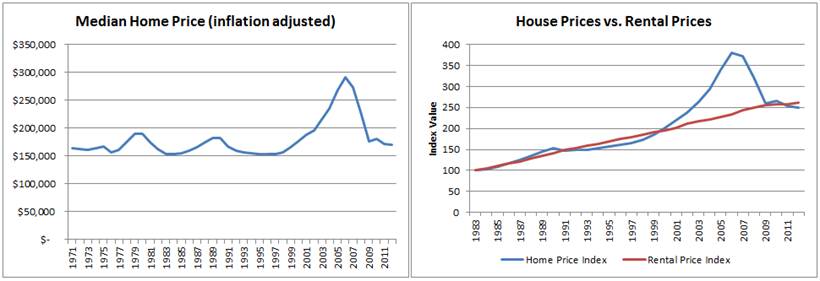
I wanted to quickly update two of the housing charts that I originally posted in the PWA Newsletter back in Q4 2009 (I’ve posted that article in the blog archives for reference). The first shoes the inflation-adjusted median price of a home in the U.S over time. The second shows a comparison of a national house price index (proxy for cost to buy) with a national rent index (proxy for cost to rent).

A few key takeaways (all from a national level of course):

1) House prices generally do not outpace inflation by very much on average. While there are repeated boom and bust cycles, and the 2000-today cycle is very fresh in memory, looking at the first chart above, you can see that on an inflation-adjusted basis (as measured by CPI), house prices have remained fairly steady over the past 40 years.

2) House prices, on average, are strongly correlated with rents.

3) The 2007-2012 bust in housing prices has not depressed the market as a whole to absurdly low levels. Real estate is not at a bargain price today as compared with rents or inflation-adjusted historical prices. Rather, the boom of 2001-2007 created prices that were absurdly high. These prices are now back to reasonable levels on a national level (local pockets of under/over valuation can obviously occur).

4) With mortgage rates at historical lows and prices at reasonable levels, affordability is near all-time highs. Buyers with a 20% downpayment and the median income level are able to afford a monthly payment that is very low as a proportion of their income, as measured by historical standards.

5) It’s tempting to say that prices are about as low as they can go, but it is a bit dangerous to make that assumption because:

a. If mortgage rates were at a more normal level by historical standards, buyers would be able to afford much less. What happens when rates eventually move back up?

b. The mortgage interest tax deduction is in question for the future. While we strongly doubt the deduction will be taken away in full, it is possible that it will be capped at a level much lower than the $1M of mortgage as it is today, and probable that the deduction for 2nd residences may be taken away completely. This would make the playing field between renting and buying much more equal, all other things being equal.

c. There is nothing to say that prices can’t overcompensate to the low side just like they did to the high side in 2001-2007.

6) Conclusion: no crystal ball, but the future of house prices looks considerably better than it did a few years ago.

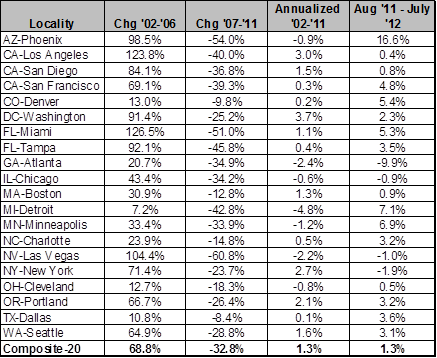
On a more local level, I did some slicing and dicing of the Case-Shiller home price index data. As you might expect, the localities that had the largest price increases in 2002-2006 had some of the sharpest falls in 2007-2011. I also included a column for change over the past year so you can tell what’s currently going on in your area (or an area near you). Sad story for the Atlantans who are reading this, but Phoenix, wow. Many cities definitely starting to see a (at least temporary) turnaround. Amazingly, the annualized increase in prices from 2002-2011 for the Composite of all 20 localities in the index (weighted by number of units) was still positive 1.3% per year even after the traumatic drops over the last few years. The last 12 months have shown an increase at that same 1.3% pace nationwide.

The Marriage Penalty

No, I don’t mean the price of dealing with your spouse on an every-day basis as many sitcoms illustrate (frankly, I don’t consider that a penalty at all in case you’re reading this, honey!). I’m talking about the “features” built into the tax code so that a married working couple pays more tax than the same two working individuals would if they were not married. Few people understand this, but it can have a really big impact on your taxes when you get married and starting in 2013, the impact will be even bigger.

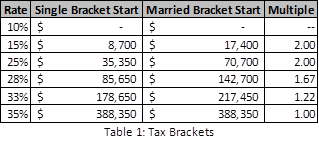
Let’s start with the most basic form of the marriage penalty, the tax brackets. Table 1 shows the starting income level for each 2012 income tax bracket for both the single and joint filer. As I described in Am I Working Too Much, a taxpayer pays tax at the rate indicated in the table for each bracket. For example, a single taxpayer would pay 10% tax on her first $8,700 of taxable income + 15% tax on her next $26,650 of taxable income up to $35,350 + 25% on her next $50,300 of income and so on. A married couple would pay tax in the same manner using the married tax brackets. Notice that while for the lower tax rates, the married bracket is two times the single bracket, the higher your income, the faster the married tax brackets increase vs. the single tax rates. This closes the gap between the married brackets and single brackets slowly until they are identical once reaching the top tax bracket. Let’s use an example to see the impact on two individuals, each with $150k of taxable income who get married. As single filers, they each pay 10% of $8700 + 15% of $26,650 + 25% of $35,350 + 28% of the remaining $64,350 for a total tax bill of $35,461 each or $70,922 in total. As married filers, using the married part of the table and a similar calculation, they’d pay $75,907 in tax. This additional ~$5k of tax is the most basic form of the marriage penalty. Note that electing to file Married Filing Separately does not reduce the marriage penalty since the MFS brackets are not the same as the Single brackets. Instead they are ½ of the Married Filing Jointly brackets. Additionally, it is not legal to file as a single taxpayer if you are legally married so you can’t just choose to file Single. To make things worse, starting in 2013 after the “Bush tax cuts” are eliminated, the multiple for the 25% tax bracket will be 1.67, instead of 2 as it is today. That will compress the 25% tax bracket for married filers down to $58,900 and add another few hundred dollars of tax.

There are other forms of marriage penalty in the tax code as well, some in existence now and others coming back in 2013 after the Bush tax cuts expire:

· For those claiming the standard deduction, the married standard deduction is currently $11,900, exactly twice the single deduction of $5,950. Starting in 2013 though, the old standard deduction marriage penalty kicks in here too with the standard deduction for married filers reverting back to ~1.67 times the single deduction (would have been $8700 for 2012).

· The qualifying income level for the Earned Income Tax Credit for married filers is less than 2x the Single levels.

· The new healthcare reform taxes starting in 2013 on investment income and earned income only impact those single filers with income up to $200k, but hit married filers starting at $250k per year in income).

· For those paying the Alternative Minimum Tax (AMT), the personal exemption for a married couple is less than 2x the Single level.

· The reduction in itemized deductions and personal exemptions which is due to return in 2013 will start at an income level for married couples that is less than twice the single income level.

· The threshold for determining whether a married couple’s social security benefits are taxable is substantially less than 2x that of a single filer.

· Multiple other deductions, credits, and exclusions in the tax code phase-out for married couples at less than 2x the single level including deductible IRA contributions, Roth IRA contributions, the Child Tax Credit, the deduction for capital losses taken in any one year, and the deduction for current year loss on a rental property.

More to come on the marriage penalty in future posts regarding 2013 tax changes.

401k’s: Just Because You’re Not Writing A Check…

Just because you’re not writing a check, doesn’t mean you’re not paying for administration and access to your 401k. I’ve seen recent polls indicating that 50-75% of 401k participants believe they’re not paying anything for their 401k. They couldn’t be more wrong. There are two broad types of fees that plans participants and/or their employers incur: investment fees and administrative fees. All plans incur investment and administrative expenses, most plans pass those expenses onto investors in the plan as fees, and some plans do it in a way that is very difficult for the average investor to notice.

Investment fees are those charged by the investment funds themselves as a ways of generating a profit on their funds as well as offsetting the cost to create, maintain, and distribute the funds. These fees are passed onto investors in the fund (whether it’s through a retirement plan or an individual investment) through the fund’s expense ratio. You can find the fund’s expense ratio in the Fact Sheet or Prospectus for the fund. If the fund is publicly traded with a 5-letter ticker symbol, you can also look it up at Morningstar.com (snip from Morningstar for a particular mutual fund is shown below with the expense ratio highlighted).

If a fund has an expense ratio of 1%, it means that over the course of each year, 1% of the fund’s total holdings are paid to the investment company and eliminated from the fund. Another way of looking at this is that the fund’s investors each pay 1% of their fund assets each year to the investment company (e.g., if you have $100k in the fund, you pay $1k per year to the fund through the expense ratio). Because this payment takes place inside the fund, it doesn’t appear on any statements or in account histories. It simply erodes the value of the fund over time, either creating larger losses than would otherwise have been incurred or reducing gains. All funds have an expense ratio, but many funds have different classes set up with different expense ratios. The more money a retirement plan has to put in the fund, the better the class they have access to and therefore the lower the cost to participants. As will be explained below though, the lowest cost class of a fund, or the lowest cost fund for a particular type of asset (large cap U.S. stocks for example) is not always the one chosen by the plan administrator.

Administrative fees are those fees charged by a third party administrator (i.e. not you and not your employer) to do the plan recordkeeping, fulfill legal requirements, provide disclosures, file government-required forms, accept payroll deposits, payout withdrawal/loan requests, and likely provide a plan website where participants can interact with the plan. Purely administrative fees paid by plan participants as either a flat amount per quarter/year or as a percentage of account value per quarter/year are usually fully disclosed on account statements and in transaction histories. In some cases, these fees are no bourn by the plan participants, but are instead paid directly by the employer. In this case, the fees are not typically disclosed to participants since they don’t directly pay the fees. In many cases, the administrative fees are not paid by the investor directly or by the employer directly, but are instead paid by the investment companies that provide the funds in the plan in the form of a commission. In these cases, the plan administrator typically selects investment funds that have a fairly high expense ratio for participation in the plan (either higher cost classes of certain funds, or higher cost funds of certain asset classes. The investment companies earn more on these funds than they would if lower-fee funds were selected, so they provide a portion of the difference to the administrator to compensate them. In this case, the administrative fees are not shown on participant statements or in account histories. They’re harder to track, and process is more convoluted (reminds me of the healthcare system of payments – but that’s another blog post for another day), but it should still be clear that the investor is paying the administrative costs nonetheless. As an extreme example, one of the worst 401k plans I’ve seen has only investment funds in it with expense ratios well over 2%. Some of the best plans have funds with expense ratios as low as 0.02%. You could argue that this means 1.98%+ of those fund fees are in excess of what they could be and that the investment company and the plan administrator are sharing those profits. If you use that 401k plan and you slowly build assets to over $500k with an average balance of $100k in the plan over 20 years, you are paying 1.98% in excess fees per year * $100k average annual balance * 20 years = $39,600 in excess fees! In many plans, there are good funds from an expense standpoint and there are bad funds. Cherry-picking the good ones and then using other retirement accounts (a spouse’s 401k/403b, IRAs, Roth IRAs, etc.) to fill in the rest of your retirement asset allocation is a good way to minimize the fund/admin expenses that you pay, and something that any good financial advisor should help you do (or do for you as is the case with PWA clients).

Recent law changes by the Department of Labor have increased the disclosures required by 401k plans so that you, as the plan participant, and your employer as the sponsor of the plan, can get a better idea of the fees that are being charged directly and indirectly. These disclosures become mandatory this month for most employers and quarterly statements will include fee information going forward by the end of the year. As part of the process, many plans are introducing new fund selections and/or changing the way they deal with administrative fees in the plan (e.g. billing them directly per participant rather than using the commission method described above). Please communicate any plan changes and send any fee disclosure documents to your PWA advisor so that we can recommend any changes you should make to your plan investments as a result.

Having access to a very diversified set of investment options in a tax advantaged retirement plan is something that is worth paying for. However, you and/or your financial advisor should know how much you’re paying for it and make sure that you’re not getting ripped off and are taking advantage of the best low-cost investment vehicles available to you.