The PWA (Perpetual Wealth Advisors) Financial Tastings Blog is intended to provide our clients and other interested readers with bite-sized, easily digestible information on personal finance topics. We used to publish a quarterly newsletter with similar information and will be archiving some of those topics here. Instead of continuing with a publication that was akin to a seven-course meal every three months, we have found that the fast-paced, mobile-driven world required smaller amounts of information, communicated more frequently. We’ve turned to the blogging concept to provide it. Topics will include both original content and links to other articles of interest. They will span key areas of personal finance including planning, goal setting, budgeting, cash flow management, debt management, risk management, employee benefits, tax, investments, retirement planning, and estate planning. We’ll try to keep posts brief, simplify where possible, and answer as many questions as we can. Speaking of questions, feel free to send them to blog@perpetualwealthadvisors.com. We’ll occasionally open up the mailbag for a Q&A post. Bon appetit!
Author: tomatpwa
Hello World!
I guess that’s the traditional way to start a new venture on the web, right? Well, hello world! More coming soon.
Market Update 4/10/2012
*** We believe communicating with our clients is of utmost importance, especially during turbulent times in the market. While we don’t claim to have a crystal ball on the future of any financial market at a given point in time, we do believe that keeping clients informed on why things are happening increases their comfort level and understanding. This post contains a message initially sent to clients just after the start of Q2 2012 as part of that communication effort***
Let’s take a look at a few things that occurred / conditions that existed during Q1:
· One of the biggest fears of the financial markets over the past year was fulfilled as Greece defaulted on some of its government debt, triggering Credit Default Swaps associated that debt.
· Gasoline prices hit $4.00 per gallon in many parts of the country (well north of $4.00 in some parts).
· Tensions in the middle east, especially between Iran & Israel and Iran and most of the rest of the world escalated to threats of war and the imposition of extreme economic sanctions
· The US National Debt topped $15 trillion dollars for the first time ever, now exceeding US GDP, and would take $50,000 per citizen to pay it off. The Federal government is also spending $1.50 for every $1 in tax it collects so that debt is still increasing very rapidly.
· The unemployment rate closed the quarter at 8.2% (~1 in 12 people country wide out of work who are looking for it) and the underemployment rate closed at 17.8% (more than 1 in 6 people out of work and looking, out of work and gave up, or working reduced hours due to economic conditions).
· A handful of major banks failed the latest Federal Reserve stress test. Another 15 smaller U.S. banks failed completely and were closed by the FDIC.
· Median home prices fell to new lows (surpassing the 2009 lows) and the Case-Shiller home price index now has average home prices nationwide a full one-third lower than they were 5 years ago.
I point all this out because despite all the bad news, Q1 2012 was a fantastic quarter for risk-based asset classes. In fact, for the S&P 500, it was the best calendar quarter since 1998. That doesn’t seem to make much sense though, does it? Since the lows in March of 2009, when it looked like we were on the brink of the Great Depression v2.0, the stock market has returned ~120%. 120% over three of the worst economic years we’ve seen in a century. Well, it does make sense if you realize that the short-term whims of the stock market don’t synchronize themselves perfectly with the long-term movements and trends of the overall economy. You simply can’t win by selling stocks when times are bad and buying them when times are good. People keep trying it, but they keep buying high and selling low and losing money in the process. The stock market priced in the years of bad news to come, and priced it in way worse than what has actually happened, all the way back in 2008/2009. That means that even a terrible economy still turned out better than what markets were expecting and therefore, prices had to move up accordingly. Of course there was no way to know that we were at the bottom when we were at the bottom or that economic conditions ultimately would be less terrible than the market was forecasting. This is why I continue to coach clients to focus not on “winning” the stock market game and trying to outperform an arbitrary benchmark, but instead to focus on achieving their own financial goals. Instead of predicting the short-term future, we can spend the time matching a portfolio to the needs of the client. Need $100k for a house downpayment in 2 years and have $95k today? We make sure most of that money is not in the stock market. There are short and medium term bonds that offer less reward potential, but substantially less risk. It’s better to miss out on a big up move and still be able to buy your house than to gamble it and maybe wind up with 150k or maybe only 50k. Need $4M for retirement in 30 years and have $100k today? We make sure most of that money is in the stock market. You really need the growth over the long-term and if you lose 50% of that $100k over the short term, it means you get to accumulate the other $3,950,000 starting from a lower level, likely with higher returns for the future as a result (see 2008/2009).
The moral of the story is that there are only two predictions that I’m confident in and that you should be confident in as well. First, the stock market will continue to be unpredictable (that’s right, predictably unpredictable) over the short-term and will almost certainly have ups and downs. Second, if you have a well-thought-out plan, incorporate flexibility to react to those things that don’t go according to plan, and actually take the time to react when the plan needs an adjustment, you will achieve your goals.
As you look through your account statements this quarter, try to keep both predictions in mind. If you saw large gains in Q1, you have an aggressive portfolio (very dependent on the stock market). Can you handle even bigger losses in a quarter to come? If yes, hang on and enjoy the ride. If not, please contact me. If you didn’t see huge gains in Q1, you have a more conservative portfolio (less dependent on the stock market). Are you still moving toward achieving your goals? If yes, try not to be jealous of your neighbor who has all his money in a leveraged stock fund and made 50% in Q1 because you don’t need that kind of risk to achieve your goals. If not, please contact me.
As always, if you have any questions, comments, or just want to chat, please feel free to send me an email or give me a call. For those of you who use Skype, I’ve even started to incorporate video chat and screen sharing where it makes sense. Technology keeps making the world seem smaller, but time seems to be moving faster than ever. As much as I can’t wait for the end of tax and allergy season (no better time to be trapped in my office for two months of the year), I can’t believe it’s already mid-April. Enjoy the great weather while we have it!
Market Update 1/13/2012
*** We believe communicating with our clients is of utmost importance, especially during turbulent times in the market. While we don’t claim to have a crystal ball on the future of any financial market at a given point in time, we do believe that keeping clients informed on why things are happening increases their comfort level and understanding. This post contains a message initially sent to clients just after the start of 2012 as part of that communication effort***
Those of you who review your quarterly reports will notice that much of the downturn in Q3 was reversed in Q4 as markets calmed and fears of a Europe-led global financial meltdown were at least temporarily eased. As we stated in previous updates, as the probability of a European meltdown is reduced, the value of all risk-based assets tends to increase. That certainly held true in Q4.
In my view, the primary reason for this is a new loan facility put in place by the European Central Bank (ECB) by which member banks can borrow money at low rates from the ECB, using virtually any types of assets as collateral, for a term of up to three years. This is a much broader loan program than is typically in place, both in the ECB’s acceptance of risky assets as collateral and also in the length of time that the banks can utilize the loans. This facility, known as the Long-Term Refinancing Operation (“LTRO”) essentially removes the possibility of a major European bank failure in the next three years because the banks know they can access cheap money from the ECB, even if no one else will lend to them. That in turn instills confidence in the inter-bank lending markets because if no banks are going to go bust, then loaning money to each other at reasonable rates suddenly has little risk associated with it. Additionally, because the ECB is willing to accept risky assets as collateral for the loans, the banks can borrow money cheaply from the ECB and they can purchase the debt of European governments (which have much higher interest rates than the ECB charges, due to the recent increased risk of government defaults). The banks can earn the spread on the interest of the debt they purchase and the low-interest they pay to the ECB to borrow the money used for the purchase. In this sense, the ECB has provided a way for governments like Italy, Spain, and Portugal to borrow money without having to lend large amounts to them directly (which would violate the treaties that created the ECB and the Euro). While the LTRO is a bit of a shell game that moves risky government debt to the balance sheet of the ECB, and therefore to the responsibility of the stronger countries in the Euro-zone like Germany and France, it is much more politically acceptable than Germany and France funding those other nations more directly. So, if we know banks aren’t going to fail anytime soon, and we know that European governments aren’t going default anytime soon (with the exception of Greece which is too far down that road to help), much of the financial catastrophic risk is off the table for the time being. Don’t read this to say that Europe’s problems are behind them, but the urgency to resolve them before the financial world ends has eased. That’s the primary reason why stock markets are improving, volatility is decreasing (for now), and credit markets are normalizing.
Along with improvements in Europe, the U.S. economy has been showing mild signs of life. Recent economic readings show mild expansion in both the manufacturing and services sectors of the U.S. economy. Jobs are being created (albeit at a slow pace and it should not be forgotten that we’re still down six million jobs from the peak in 2007). Housing is showing some signs of stabilizing as the inventory of homes available for sale has fallen to more balanced supply/demand levels over the last few months (though prices and sales are still falling in many areas). It remains to be seen whether this is an emerging trend that instills confidence in consumers and corporations to trigger more spending, more investment, more hiring, higher wages, and the virtuous cycle that follows. I’m skeptical that we can quickly return to the old-normal of 5% unemployment and 3-4% real annual GDP growth while the government is focused on cutting deficits and the consumer is focused on cutting debt and facing higher taxes. But, I do believe there is room for slow to moderate growth through productivity and population growth. There are certainly opportunities for both government and the private sector to be more efficient in our use of resources and in the way we create economic incentives for people to work hard, innovate, and deliver value back to the economy. That efficiency can drive growth for years to come even during an aggregate deleveraging cycle.
Speaking of economic incentives, there are some rather large changes to the tax code that will take effect in 2013 and will have an impact on all of you in their current form. In the coming months, look for a summary from me of what is headed your way from these changes (hint: it’s not lower taxes). We’re in a somewhat strange situation where the changes are already legislated because they come from expiring temporary changes to the tax code. So, the only way to stop them would be to pass new laws that prevent the old laws from returning. Given the political situation in Washington… let’s just say that I think it’s prudent to plan for higher taxes starting next year and that the higher up you are on the income scale, the more dramatic that increase is likely to be. More to come on that. We’ll also be formally kicking off 2011 tax season shortly with a blast message indicating what you need to do if PWA is preparing your taxes this year.
I hope you all had a wonderful holiday, that your 2012 is off to a great start, and that you continue to move closer to achieving all your personal and financial goals. As always, if you have any questions, please feel free to contact me.
Market Update (10-07-2011)
*** We believe communicating with our clients is of utmost importance, especially during turbulent times in the market. While we don’t claim to have a crystal ball on the future of any financial market at a given point in time, we do believe that keeping clients informed on why things are happening increases their comfort level and understanding. This post contains a message initially sent to clients after a terrible September 2011 and in the escalation of the European sovereign debt crisis as part of that communication effort***
Many of you will remember my messages at the beginning of Q3 which indicated that the Fed-provided updraft in financial markets was likely behind us with the end of their Quantitative Easing program as well as my fears about what seemed to be a troubling situation in European government debt (specifically Greece). I pointed out that despite 7-8 consecutive quarters of seeing account balances move up, you should be prepared for more typical up-and-down quarters to come. Those issues in Europe have intensified and put pressure on markets around the world as you’ve undoubtedly heard and noticed by now. U.S. stocks, as measured by the S&P 500 were down almost 14% for the quarter. Small-cap U.S. stocks and international stocks were down over 20% for the quarter with some sectors and emerging markets fairing even worse. Consequently, you will see that your account balances for aggressive portfolios have fallen along the same lines in Q3, while more conservative portfolios have had a more muted response, but have fallen nonetheless. Each day, and often multiple times per day, I ask myself if the fall in stocks is appropriate given the circumstances in the global economy. Should we be getting more aggressive because the markets have overpriced the probability of a global recession and another credit crisis led by Europe’s woes? Should we be getting more conservative because the markets haven’t priced in that probability enough? As I’ve discussed with all of you in the past, I believe that markets are generally extremely good at processing information and letting the aggregate intelligence of millions of participants determine the right price for a given security and the market as a whole. While there is sometimes misalignment for spectacular reasons, I don’t think we have that misalignment right now.
World economies have problems, very big problems, especially in Europe. Their government debt issues have the capability to bring down banks like our mortgage problems brought down banks here in 2008. If European banks fail, a chain of events will take place which will spill over to the U.S. in multiple ways. First, Europe as a whole is a bigger economy than the U.S. So many of our companies do a significant portion of their business in Europe. If Europe slows, so will those companies. Second, many U.S. banks own assets that derive their value in one way or another from European companies and countries. Those assets will fall in value, putting the same kind of strain on our banking system as it faced when mortgage assets fell in value. Third, the U.S. dollar will likely strengthen vs. European (and other global) currencies via a safety / liquidity trade. This will hurt U.S. exports and especially when combined with the bank issues which will make credit harder to obtain, it will stop any recovery we’re seeing dead in its tracks. As the probability of a Greek default rises, unless there is a credible plan in Europe to stop the chain of events (think dominos falling) that would occur because of it, values of markets around the world will fall. Along those same lines, as the probability of a Greek default falls, or containment plans that would stop the domino effect emerge with more credibility, markets rise. This impacts global markets in that they all begin to move in the same direction at the same time and, depressingly, that impact swamps the impact of individual company, industry, or even country performance.
The situation in Europe seems grave, but there are a few underlying mitigating factors that are seldom discussed. Companies have gone through major cost cutting in the last three years and have increased their own emergency funds drastically. In aggregate they have almost double the cash on hand than they did in the 2008 downturn which leaves much more room to survive another downturn without severe additional cost cutting and layoffs. Banks have been recapitalized and continue to be supported by lending programs from the Federal Reserve, lowering the odds of another Lehman-like failure dramatically from where it was pre-Lehman. Consumers have been paying down debt rather than taking on more of it over the last few years. House prices have continued to fall (yes, I’m calling that a good thing for the future even though it has been a bad thing for homeowners to date), while mortgage rates are at historic lows (30-year fixed avg’d 3.94% last week!!). Housing is the largest expense for most of people, and it hasn’t been this cheap in decades. Energy prices continue to move with the economy, softening the blow of a slow down with reduced prices for heating this winter and at the pump where many areas in the country have seen a 20% reduction in gas prices over the past few months.
My conclusion to all of this is that the market seems to have appropriately priced the risks that are present in the global economy. It’s also appropriately pricing in the fact that companies and individuals are more capable of handling an economic slowdown than they have previously been. It will continue to operate on a binary level, Europe’s looking better – the world’s not ending – stocks up… vs. Europe’s looking worse – we’re all doomed – stocks down. Eventually, governments and federal reserves will stop taking the headlines and company productivity and innovation will win it back. Until then, expect the volatility to continue, again, in both directions, and with all but the safest of asset classes moving in tandem.
We’re of course taking advantage of this volatility in two ways. One, through rebalancing, selling bonds (which have generally increased in value through the turmoil), and buying stocks (which have fallen) to re-establish the stock/bond ratio that is appropriate for your goals. When the market turns around, you’ll have more stock than you would have which means you’ll gain more than you would have, allowing us to sell stocks and buy bonds again to re-establish the proper ratio. This provides for a natural, non-emotional, buy low / sell high rhythm to the portfolio. Second, where possible, we’re beginning to take advantage of losing positions by selling them, realizing the capital loss, and reallocating the money in similar assets. This process, called “tax-loss harvesting”, allows us to capture the loss for tax purposes, either offsetting other gains in your portfolio, or allowing you to take a deduction for losses on your 2011 taxes, all while leaving your exposure to the asset the same so you’ll benefit when the market starts to rise again.
So what does this all mean to you? Well, it means that nothing has really changed from a financial planning standpoint. Your emergency fund money is in cash and continues to protect you in the case of an emergency. Money for short-term goals is protected in lower-risk portfolios with a higher percentage of short-term, high quality bonds that continue to pay interest though a downturn. Money for long-term goals is exposed to the short-term whims of the market in exchange for the likely higher average returns that will be earned over the long-term. In reality, long-term money is better off if the market would stay low for a while and let individuals get more into it before it rises over the long-term.
As long as the emergency fund is big enough (but not too big to impact your ability to fund future goals)… as long as the short-term portfolio is consistent in size with what’s needed for your short-term goals… and as long as the long-term portfolio is defined properly (i.e. you’ve communicated your lack of need for that money in the short-term properly)… then your ability to achieve your goals remains intact despite the stock market’s past quarter of performance. As always, I encourage you to communicate with me whenever something changes in your life that could impact the size or timing of your need for your money. Take your annual review seriously and really think through what you want for the future well in advance of needing money to get it. If you don’t know where you’re going, any road will take you there (thanks Lewis Carroll). But if you do know where you’re going, you have a map, you have the right vehicle for the bumps you might encounter, and you have the help of someone who understands the road, there’s a pretty darn good chance you’ll make it.
As always, if you have any questions, please feel free to contact me.
Market Update (08-07-2011)
*** We believe communicating with our clients is of utmost importance, especially during turbulent times in the market. While we don’t claim to have a crystal ball on the future of any financial market at a given point in time, we do believe that keeping clients informed on why things are happening increases their comfort level and understanding. This post contains a message initially sent to clients just after the S&P downgrade of the U.S. credit rating as part of that communication effort***
As you all know by now, S&P downgraded U.S. long-term debt from AAA to the next notch down, AA+ on Friday night. Before digging too far into that, I’d like to reflect back on what happened this week, one of the worst for the stock market since the Lehman Bankruptcy era, to make sure you understand why there are far bigger issues out there than one rating agency’s opinion of our debt repayment prospects. I apologize in advance for the length of this message, but I’d rather provide you with too much information which you can choose not to read than to leave you wondering about what’s going on.
On Monday of last week, we received the good news that the leaders of both parties in Congress had reached an agreement that would enable a majority of both the Senate and the House to pass a bill to raise the debt ceiling. The vote passed, the president signed the bill into law, and the crisis, if you believed there ever was one, was behind us. Markets initially rallied on the news as the general public had been told there was a chance of the end of the financial world stemming from a default on U.S. debt. When that chance disappeared, there was a lot of relief from those who believed it. Like I said in recent updates though, the debt ceiling was not a crisis, it was a political game using a completely irrelevant measure of how much debt we allow ourselves to have, rather than how much debt the market (i.e. our lenders) allows us to have. So, it didn’t take long for the markets to erase the “debt ceiling has been raised” gains and start to really worry about the banking system in Europe and the potential for a U.S. debt rating downgrade by the credit agencies.
First, a quick explanation of what’s going on in Europe. Several countries in Europe have taken on too much debt, well more than the U.S. as a % of their GDP (though our trajectory will have us catching up too soon to be comfortable about it). The markets have started fear that lending more money to those governments is too risky unless there’s a high interest rate to go along with the loan to account for the chance of not being paid back. The higher interest rates lead to more interest payments as a percentage of the tax revenue these countries collect which strains their budgets farther and requires more borrowing. More borrowing means even higher rates, and eventually there is no way out of debt and the only answer is default. Who owns most of Europe’s debts? Generally speaking, the banks in Europe do. The story from here should sound very familiar as it’s much the same as what happened during our mortgage meltdown that caused the same stress on the financial system. If the bank holds something that is starting to look worthless, it can become insolvent, it can fail, and depositors as wells as other banks that have lent it money can be left in the dust. In a way, it becomes self-fulfilling. The fear that the bank could become insolvent removes depositors and stops lending to that bank which can in turn make it insolvent (see the history of Bear Sterns and Lehman for a deeper dive into the process). So, to stop the rapid downward spiral in our case, our government got involved. They essentially provided the liquidity that the banks needed to reassure lenders and depositors they weren’t going out of business, while they raised money privately so that the government could be paid back. Most of you now know this campaign as TARP. The market is hoping that something similar can be pulled together in Europe to temporarily save the countries that are in jeopardy of defaulting on their debts. It’s more difficult there though, because each country has its own government, but they don’t have their own currency. It would take a huge amount of collaboration in good faith by the countries who don’t have debt problems, led by Germany, to rescue the other countries and prevent a banking collapse and a collapse of the Euro. In return for the effort, the debtor countries have to respond by agreeing to stop their over-spending ways and stop adding more debt… essentially providing a plan that will get them off life support over the medium term. The details over the possible coordinated efforts and the austerity measures would make this email longer than I imagine you want to read, so I’ll just leave it with this: if Europe as a whole doesn’t come to the rescue of the countries in Europe, then Europe as a whole is in for far worse than what we’ve seen from the mortgage meltdown. In a globally integrated world like we have, a depression in Europe would spread fairly quickly across the Atlantic and hit our companies and employment prospects very hard. Many don’t realize this but the European economy as a whole is even bigger than ours. Start to project a major haircut in their production and consumption and that is why the stock market plunged last week, with some areas down more than 25% from their highs less than a month ago, and the broad market down more than 10%.
Friday afternoon, there were rumors of a rescue package agreement in Europe and the stock market had a fairly dramatic turnaround. As of the time I’m writing this, the details have not be revealed, nor has the agreement’s existence been confirmed, but I have to believe there is a scramble going on to reveal some positive news before Asian markets open tonight and definitely before the U.S. market opens tomorrow. What happens this week is highly dependent on whether there is an agreement, and if there is one, whether the market believes it will work.
Adding fuel to the fire now is S&P’s downgrade of the U.S. credit rating on Friday night. There were rumors of the downgrade happening on Friday all week, and pretty strong ones on Friday morning. S&P telegraphed the measure to allow markets to prepare so it wouldn’t be a shock to the system. My personal opinion is that this is the last straw in S&P’s credibility as a rating agency (these are the same people who rated the mortgage-backed securities that went belly-up in our crisis as AAA in many cases). While my opinion of S&P is not relevant, the market’s opinion of U.S. long-term debt is, and it’s far more relevant than S&P’s opinion of U.S. long-term debt. A $14.3 Trillion market is made of so many people, institutions, and countries that to think S&P has some crystal ball, research ability, or magical formula that the collective $14.3 Trillion worth of market of participants does not have, is ludicrous. We need S&P to do the due diligence on individual companies and their sometimes hundreds of securities because there isn’t enough time in the day for every fund manager or individual to do the research on their own. But here, we’re talking about the U.S. government. Do we really think that China isn’t doing their homework on our ability to repay our debts before they decide to lend us a trillion dollars at 2.5% interest for 10 years?!? There’s no doubt we’re on a bad fiscal path, no doubt. Without getting into political views, I think it’s also safe to say that our political system is showing signs of weakness as well. But the markets say we’re the safest thing out there. Add in our ability to print money as a last resort if we need it, which we could use to pay off debts at the cost of high inflation, and there’s just no more chance of default today than there was before the S&P downgrade, and certainly not more chance of a default than during/after World War II.
So what does it mean for the markets? Unfortunately, despite the fact that the downgrade was telegraphed and essentially priced into the market in advance, there are some short-term technical problems that can result from the actual downgrade. There are funds (pension funds, mutual funds, etc.) that have legally obligated themselves to hold AAA-rated securities for a certain percentage of the fund. If they hold long-term U.S. debt, they will be contractually obligated to sell. This forced selling could drive down prices of U.S. Treasuries which in turn drives up interest rates. Over the medium term, I believe others who aren’t contractually obligated to sell will see great value in treasuries at a higher rate and will swoop in to buy up all the Treasuries that the other are coughing up. Short-term though, the forced selling could create instabilities and dislocations in the market. Selling can beget selling and the spillover effects to other markets like the stock market can be severe. In addition to the forced selling, there is the problem that banks, states, government agencies, and municipalities rely on the Federal government as a last resort for funding. The government is now rated AA+, all those organizations who are AAA likely have to be re-rated lower. If you believe the S&P downgrade, you can’t put your full faith in FDIC insurance, in social security, in Medicare, in Fannie Mae and Freddie Mac (who hold about 50% of the mortgages in the U.S.), or well-capitalized U.S. banks. Downgrades of all those entities could cause a domino effect on everything that relies on them. Trying to see the end of the line of downgrades due to this one is impossible.
But, in thinking about it, I keep coming back to the same thing. There’s not a single entity today who has a lower chance of repaying its debts than last week. If that’s the core guiding principal, then everything else has to have at most a short-term impact. Dislocations in markets that cause violent reactions should have a snap-back effect as value is recognized by those who are not obligated to sell. Of course when dealing with markets like the stock market, we never know how long short-term will last and how long it takes to get back to something grounded in fact, value, and thought vs. rumor, momentum, and fear.
In short, I’m not worried about the S&P downgrade. What happens over the short-term is unknown. It could be very ugly. There’s a part of me that thinks that ugliness would be very short-lived and we could even see the market rise this week if Europe makes a credible announcement that would end their financial downward spiral. So, I’m watching Europe, way more than I’m watching S&P’s opinion about something that $14.3 Trillion dollars have already decided. The U.S. bond market is safe and we remain one of, if not THE safest place to have money in the world.
What we’re doing is preparing to rebalance all portfolios as triggers to do so occur. We don’t anticipate a negative response to short-term bonds which is what makes up much of the conservative portions of your portfolios. As stocks fall, if they fall enough, we will sell bonds and buy stocks to rebalance your portfolio back to its target. It is the same thing we did during 2008/2009 and the reverse of what we’ve been doing as the stock market rose 100%+ over the past 2 ½ years. This results in a natural buy low sell high rhythm that doesn’t require us to predict bottoms and tops in the market, something I know is impossible. 50% of everyone who makes and up or down prediction are going to be correct. You just can’t know ahead of time who they are or that they’ll be in the same 50% the next time. Note that this rebalancing strategy only works if your target allocation is aligned with your broader financial plan. I’m sure there are people out there (obviously not PWA clients) who are 6 months from retirement and have their 401k in funds that hold 90% stocks. I’m sure there are others who want to buy a house in a year and they have most of their liquid assets, needed for the downpayment, in individual stocks. They probably felt pretty good about their portfolio as little as 3 weeks ago but now there’s a chance they can’t buy that house all because their plan didn’t align with their portfolio. As Vanguard’s chief economist Joe Davis has said, “Treat the future with the humility it deserves.” Planning is a much better way to do that than gambling or hoping.
I’ll send out another update (hopefully shorter) as events warrant. As always, if you have questions or comments on this topic or anything else, please don’t hesitate to ask.
Market Update (07-26-2011)
*** We believe communicating with our clients is of utmost importance, especially during turbulent times in the market. While we don’t claim to have a crystal ball on the future of any financial market at a given point in time, we do believe that keeping clients informed on why things are happening increases their comfort level and understanding. This post contains a message initially sent to clients with the debt ceiling fiasco on the horizon as part of that communication effort***
Given the press coverage around the debt limit issue, I thought it would be useful for you if I gave a quick update as to what’s going on. Long-time clients will remember messages like this one that I sent frequently during the post-Lehman Brother’s bankruptcy era and around Congress’s shenanigans regarding the passage of what eventually became known as TARP. Even though no change or action is required by you, I think staying informed helps people sleep better at night during a potential crisis. So here goes…
We’ve all heard August 2nd is the deadline for raising the debt ceiling or the U.S. will not be able to pay its bills. At the same time, politicians seems to be getting further from an agreement on how to raise the debt ceiling instead of getting closer to one. Much of the press will have you believe that if the debt ceiling is not raised by August 2nd, life as we know it, will not go on and yet the urgency to raise the ceiling doesn’t seem to be there given that 8/2 is a week away. There are three things wrong with that presentation.
First, August 2nd is not the date at which the U.S. will stop paying its debts and run out of money. It is a date that the treasury secretary estimated several weeks ago based on the pace of expenditures and tax revenues. As it turns out, revenues have been higher than projected and the real date appears to be closer to August 10th. Congress is supposed to take their next recess (read: vacation) starting August 6th, so the 2nd was a much more convenient political deadline. There are also Social Security payments which need to go out on August 3rd, debt principal payments that need to go out shortly thereafter, and interest payments that need to be made to Treasury holders later in the month so that crisis is real and important. It’s just not as urgent as the talking heads would make it seem and so the lack of urgency in resolving the crisis is because there is more time that most people realize, even if it is only another week.
Which brings me to point number two. When you’re playing a game of chicken, and by all means that’s what we have here between the politicians, you always have to seem more confident in your path as you get closer to the end game. “I’m not going to move.” “I’m not going to move either… you’ll realize you’re going to move”. All the back and forth as the two get closer to a head-on high-speed collision. It’s not until the very last second that one or both parties are actually ready to move. Therefore, I expect little movement and the appearance of no chance of a deal up until the last few days of the debate. As of yesterday, both parties have put their stake in the ground followed by a stomping of their feet and a “take it or leave it” statement. The soap opera couldn’t be written any better. One or both parties will move as the threat of collision becomes imminent.
Finally, and most importantly, if the U.S. were insolvent and unable to pay its bills, a global financial catastrophe would take place well in advance of the last few cents coming out of the piggy bank. I won’t go into the goriest of details, but basically it would start a panic that U.S. Treasury Bonds were worthless (i.e. those who lent to the U.S. government would permanently stop getting their interest payments and lose their principal). This would make all of the banks and other financial institutions across the world that hold Treasuries potentially insolvent. Within days if not hours of this realization, there would be no more ATMs, no open banks, most money would be worthless, and the world economy would cease to exist. OK, maybe that is pretty gory…. Deep breath… Let’s look around though. We’re a couple of weeks away from potentially not paying our bills and none of this is happening. The U.S. Treasury today auctioned off $35 billion of 2-year notes. The annual interest rate demanded by the auction was 0.417%. That means investors were willing to lend the U.S. government $35 billion dollars today for less than a half penny of interest on every dollar each year for the next two years. Would they really do that if there were any chance of not being paid back? The answer is “no” and the reason is that the U.S. is not insolvent. People, institutions, and countries are scrambling to try to lend us money because we are the safest place in the world to put money. At that same auction, there were bidders for over $100 billion of that $35 billion in debt. The point is that even if lawmakers on both sides don’t give in (and that won’t happen) and the debt ceiling is reached (and that won’t happen) and all other avenues for paying bills are exhausted (and that won’t happen) and we really do legally run out of money because of the debt ceiling (and that won’t happen), the ramifications will be so huge, so fast, that both sides will scramble to save the day almost instantly with a simple act of raising the debt ceiling. One vote, 5 minutes to end the end of the world and this crisis is over. The U.S. is not insolvent and will pay its bills.
The bigger issue, which I’ll save for another update is far more important. We’re on a fiscal path to insolvency and unless that trajectory is corrected, our debt will no longer be the safest instrument in the world. Our borrowing costs will rise, rapidly, and the impact on the economy will be severe. Imagine the value of your house today if someone had to pay 10% for a mortgage to buy it. That has to be corrected and in principal, tackling the beginning of that correction as part of the agreement with ourselves that we’ll increase the debt limit makes some sense. But in the end, whether it happens or not, the debt limit will be raised and life will go on. Unfortunately, politics and the media’s over-dramatic reporting of those politics will go on with it.
If anything changes over the next few weeks that warrants action on your part, I’ll be sure to let you know. As always, if you have questions or comment, please feel free to contact me.
Market Update (07-14-2011)
*** We believe communicating with our clients is of utmost importance, especially during turbulent times in the market. While we don’t claim to have a crystal ball on the future of any financial market at a given point in time, we do believe that keeping clients informed on why things are happening increases their comfort level and understanding. This post contains an excerpt from the PWA Q2 2011 newsletter to clients, sent just the end of “QE2” (Fed stops buying new treasuries), explain three key issues for a continued rebound in the economy, as part of that communication effort***
…
• The End of QE – On 3/24/09, just after what we now know was the stock market bottom, I wrote in a “Market Update” note to clients that the announcement that the Federal Reserve was going to purchase U.S. Treasuries and other securities represented a “game changer” for the financial markets. Those purchases became known as Quantitative Easing (QE) with two distinct rounds of purchases being coined “QE1” and “QE2”. These were in fact a game-changer for the markets, with the S&P 500 rallying more than 100% from March ’09 to April ’11. They were a game-changer because the Fed was, in simplified terms, printing money to buy financial assets which put that newly printed money into circulation to offset the deflationary spiral that was occurring (the value of everything from houses, to bank assets, to the stock market, to commodities was falling rapidly and simultaneously causing credit markets, job markets, and the overall economy to grind to a halt). As of July 1st of this year, the Fed ended QE2 and has signaled that a QE3 is unlikely. This means the game-changer is over. However, the Fed is not selling the assets they’ve purchased to date and they will keep reinvesting in those assets as they mature which means we don’t expect a game-changer in the other direction to send the markets back down. What we do expect is that the days of 50% per year stock market gains are behind us for quite a while. We also expect interest rates to start to gradually rise on medium to long-term treasuries and mortgages, though probably not sharply because any sharp increase would set the economy back and likely force more intervention from the Fed. In the next 12-months we expect short-term rates on savings accounts, CDs, and short-term bonds to start to gradually increase as the Fed hikes the Fed Funds rate back to something less extraordinary (we believe 2-3% would still provide support for economic recovery without risking the inflationary dangers of the 0% emergency rate we have today. Finally, we expect a higher level of volatility (up and down) in all financial markets as the Fed-induced tailwind is no longer behind us and now the economy, business cycle, productivity, earnings, and jobs will take more focus.
• The Debt Ceiling – Much is being made of the U.S. debt ceiling and what might happen if it’s not raised and we’re unable to pay our bills. For the most part, this is political grandstanding. There is absolute certainty that the debt ceiling will be raised. But, there’s an important problem in the way Congress is currently dealing with the issue. August 2nd has been set as the “deadline” by the treasury secretary by which the ceiling must be raised in order to proceed with business as usual. For this reason, the credit rating agencies have to consider the possibility that the U.S. will not be able to pay its debts if the ceiling is not raised by that date. Ironically, Congress bashed the credit agencies for maintaining AAA status on collateralized debt obligations that later failed during the peak of the financial crisis, arguing that any risk of default should have caused an immediate downgrade of those instruments way before the crisis occurred. Those same credit rating agencies must now act accordingly and not wait until August 2nd to cut the U.S. rating or they risk having a AAA rating on August 2nd morning and a default rating on August 2nd evening. This means the real deadline to raise the limit is well before August 2nd, because a downgrade of the U.S. credit rating, if taken seriously by the world, will having a snowball effect through the financial markets and set off another deep, albeit temporary, financial crisis. The President’s comment that he will not approve a short-term extension, while obviously in good a faith effort to try to prevent this from being a recurring quarterly problem, actually worsens the situation because it makes the possibility of no deal by August 2nd more likely to the credit agencies. Congress is now playing a game of chicken and I expect a short-term deal is likely with an understanding of more short-term deals through the 2012 elections which will keep the ratings agencies at bay for now. In the meantime though, expect potentially violent moves in the markets, akin to those of the days of TARP being voted on, as momentum traders try to take advantage of the headlines. Since even a credit downgrade would be temporary (garnering a swift response in Congress if it ever did happen), market volatility due to these events is in my opinion, nothing more than an opportunity to rebalance portfolios taking advantage of dips in the market and to get a 401k or other savings contribution in at a cheaper price than without the debt ceiling issue. This issue will pass. The longer-term question of our government’s ability to govern if it’s willing to put us in these kinds of situations to begin with is a much broader issue but I’ll leave that discussion to those who enjoy politics.
• European Sovereign Debt – A less-urgent, but much more important issue to long-term global financial markets is the vast amount of sovereign debt that exists in the world and the sudden realization by financial markets that some countries truly may not be able to pay their bills. This issue is not about an arbitrarily set debt ceiling. Countries like Greece and Ireland are struggling to pay their debts because they’ve taken on so much debt that tax revenues can’t support government spending plus interest payments any longer. These countries, with others like Italy, Portugal, and potentially Spain, not too far behind them, have simply lived on a national credit card for the last decade and are now forced with extreme austerity in return for global bailouts or default. Default means the loans made to those countries become worthless and the banks holding those loans lose the loans as assets. This has the potential to kick off a global financial crisis that is all too familiar after the ‘08/’09 Lehman Brothers default created much of the same. It can also kick off a currency crisis as it threatens the Euro, thereby strengthening the U.S. Dollar and causing harm in our own recovery as it makes our goods, services, and assets seem more expensive to the rest of the world. So far, rescue packages from the International Monetary Fund have staved off default for Ireland & Greece, but this warrants further monitoring. There are three important actions to take here:
· Like others, we have no crystal ball and believe that markets price information and risks fairly in general. That means that in most cases the market would fall before we have reason to believe it would fall or it would rise before we have reason to believe it would rise meaning there is no way to time news events. However, as I’ve discussed with all of you at one point or another, if I hear the whisper of a freight train coming, and sometimes it comes without making a whisper first, I will take corrective action. This means moving all models temporarily to a slightly more conservative allocation or using other protective measures as I see fit.
· It’s easy to be complacent when the stock market is rallying like it has for the better part of the last 28 months. If you have short-term needs for your money that is currently invested as if it was not needed for the short-term, please communicate that need to me ASAP. If your portfolio is 80% stocks and the stock market falls 50%, which has happened twice in the last decade, you will lose ~40% of your portfolio. For long-term money, by definition, you don’t need it over the short-term so that’s not an issue. In that case, continue to invest as planned, buying at lower prices if markets fall and when markets eventually recover you’ll actually be better off than if the fall hadn’t happened. For short-term money though, that kind of a loss could mean not being able to fulfill a goal and goal-fulfillment is the only reason to invest.
· Expect the market to move both up and down. Many have become accustomed to seeing their portfolio balances only increase, and quite sharply quarter after quarter. Don’t be shocked to see more volatility. As long as you’ve heeded the point in the preceding bullet, and you have an overarching financial plan, don’t worry about the short-term movements of the markets. The only ways to ensure that your account statements will only show increases in value are to 1) keep your money in the bank earning slightly more than 0% per year in interest while the cost of living increases far faster, or 2) have a crooked financial advisor that’s cooking the books (and we all know how that ends… google “Bernard Madoff”).
…
The Lost Decade, Or Was It?
***The following is an excerpt from the Q1 2010 PWA Newsletter regarding the so-called “lost decade of investing”, a term used by much of the press to describe the performance of the stock market during the 2000’s.***
The gloom-and-doom crowd has already taken a stance that the 2000’s were the lost decade for stocks as evidenced by the miserable performance of the S&P 500, the most popular market-weighted benchmark for U.S. stocks. A chart of the S&P 500 from 2000-2009 backs up their point quite nicely.
As the chart below shows, the S&P started the decade at 1,469 and ended it 24% lower at 1,115. Obviously, a terrible return. If we use this as evidence that investing in the 2000’s was a losing proposition, we might reach the conclusion that a passive approach to investing over the long term or a goals-based approach to investing are dead. But, there are three fundamental points that are excluded from this argument.
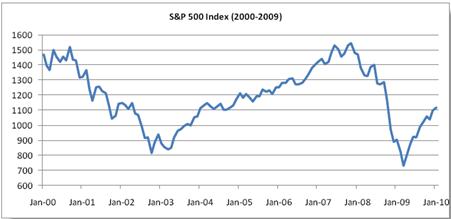
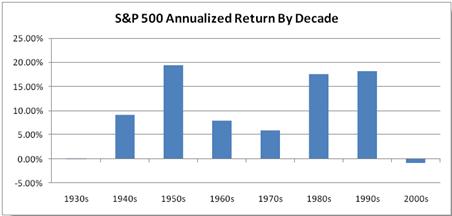
First, the chart completely ignores dividends. Adding the dividends that the S&P 500 companies (and therefore any fund that held those companies) paid improves the return to -9% over the ten year period. Annualized, that’s -0.95% per year with dividends vs. -2.71% without. It’s still not attractive, not even positive, but much better than without dividends. Second, a look at how the last eight decades have performed gives a sense of the volatility of the stock market. The chart below shows the annualized S&P 500 return (including dividends) over each ten-year period. While the 2000’s were the worst of all the decades shown, they’re not far behind the 1930’s. Had one reached the conclusion that long-term investing was dead after 1939, the opportunity to turn $1 into $1,430 over the next 70 years with an investment in the S&P 500 would have been missed.
Finally, the argument above takes a large leap in using the S&P 500 as an approximation for “investing”. Any professional asset manager (including yours truly), incorporates many other asset and sub-asset classes into an overall portfolio allocation. The ultimate selection is of course based on the return that clients need in order to achieve their goals, with the minimum amount of risk that is possible to get there. While the S&P 500 certainly performed poorly during the 2000s, and just about every asset manager would have had some component of client portfolios in large capitalization U.S. stocks (like the S&P 500), the other asset classes performed much better. In fact, a simple indexing of equal components of each asset class shown below would have led to a 6.85% annualized return throughout the 2000’s (94% return over the 10 years!). And, what’s even better is that only two years in the 2000’s would have had negative returns. This shows the impact of having a truly diversified portfolio, as opposed to one that just contains many stocks in the same assets class (as is the case with the S&P 500).
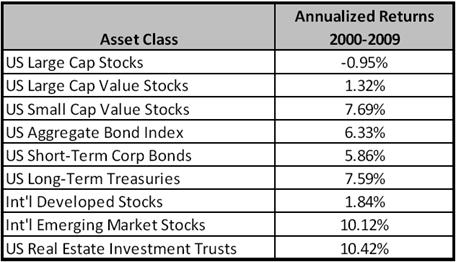
So, while large cap U.S. stocks may have had a really hard time in the 2000’s, the nearly 7% compounded returns that could have been achieved with the combination of assets above would have satisfied the 10-year goals of many investors. In other words, passive investing and goal-based investing focused on diversification seems far from dead.
The keys to success are in choosing the right portfolio for your goals, adjusting as events in your life warrant, and making sure that not only aren’t all your eggs in one basket, but they’re in as many baskets as possible. That worked during the bull market run of the 1990’s, during the more stagnant 2000’s and we continue to believe it is an investor’s best chance at achieving his/her goals in the 2010’s and beyond. ∎
Has The Housing Market Bottomed Yet?
***This post was originally published in PWA’s Newsletter: The Pretirement Press in Q4 2009 and it’s publish date has been edited here to reflect the approximate initial publish date***
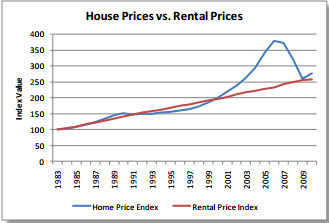
By now we all know we were in the midst of a housing bubble earlier this decade, which peaked in 2006-2007 in most areas. While it’s easy to say in hindsight, one of the clearest depictions of just how dislocated prices were compared to the fundamental value of a home is a comparison of housing prices to rental prices. A house’s value can always be tied back to the cash flows that an owner of that house could earn if she rented the house to a tenant. In other words, a good way of determining if a house is too expensive compared to renting is to determine if you can cover the costs of ownership (mortgage interest, insurance, property taxes, association fees if applicable, maintenance, potential vacancy, management, etc.) with the rental income. If you’re planning to buy a rental property, contact your advisor who can help you project the long-term return on your investment taking all of these factors into account.
The U.S. government tracks average rental prices across the country in an index which is a component into inflation measurements. Industry organizations track median house prices over time and so it’s easy to compare how each trends in relation to the other. Not surprisingly, as the chart below shows, the house price index and the rental price index track each other quite closely in most cases. What can also be seen is the huge spike in the home price index with no accompanying spike in rental prices from 2000 to about 2006-2007. As is usually the case in a bubble, prices have returned to a level that coincides with their fundamental value (measured by rental prices). So, does this mean the market has bottomed? Not necessarily, because there’s nothing to say that prices can’t fall to an extreme on the other side of the rental price index just like they peaked above it, but it does look like market is reasonably priced when compared to historical rents.
Additionally, there have been strong signs of life in the housing market in recent months with existing home sales gaining ground in four consecutive months (Aug-Nov). Not only have sales been increasing month over month, November’s sales are up 44% over November of 2008, showing the people are definitely out there buying. The number of homes for sale has also come down in the past four months, from just over 4 million, to just over 3.5 million. If the pace of sales from November could continue and no additional houses were put on the market, the current inventory of homes for sale would be depleted in 6.5 months. That compares to about 4-5 months of supply in a steady housing market, and a peak of 10-11 months around this time last year during the worst of the downturn.

What about prices? There are two different nationally recognized sources for home prices, the National Association of Realtors (NAR) and the Case-Shiller (CS) Index. CS always runs a month behind NAR, so we only have CS data through October where both sources show about an 7-8% drop in median home price year-over-year, but CS shows no change in month-over-month price vs. a decrease of about 2% from NAR. NAR’s November report shows virtually no change in price compared to October. Both reports show a trough in prices in April of 2009, at a level approximately 5% lower than today. It’s a mish-mosh of data, but it appears there has been some stabilization in prices, and when compared with the increase in sales data, it looks as though a recovery is in progress.
Before concluding that the housing crisis is over however, we have to look at the extraordinary circumstances that are currently affecting buyers as well as the impact of potentially increasing foreclosures. First, the First-Time Homebuyer Tax Credit of $8,000 was set to expire in November which could have
influenced buyers who were planning to buy soon to accelerate their purchase into the last few months. Congress has since extended (to April) and expanded (to include some existing homeowners) the credit, but at some point it will have to end. The extended credit could cause a lull in sales in December/January before spiking again to beat the April deadline.
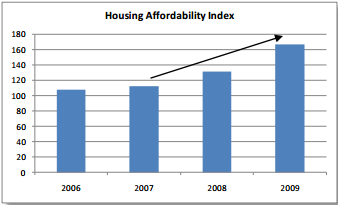
Second, the housing market is still being stimulated by the Federal Reserve as they purchase mortgage backed securities on the open market to keep mortgage rates low. With prices down significantly and historically low interest rates at the same time, home affordability is extremely good. NAR calculates
a housing affordability index based on median income vs. the principal and interest owed monthly on the average mortgage for a home with the median home price. This index has soared as prices and rates have come down, but incomes have remained fairly steady in the past few years. The Fed has indicated that it plans to end its mortgage purchase program in March 2010 which could allow rates to start increasing. Combined with the credit ending in April 2010, this could put pressure on the housing market for a second wave down in prices.
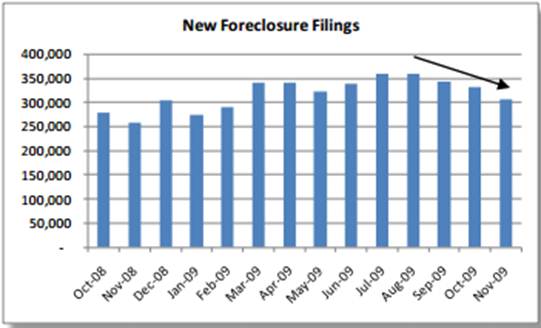
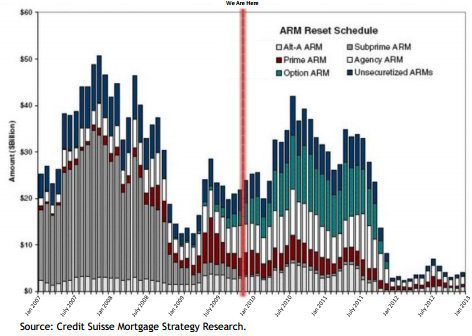
Also potentially impacting prices going forward is the rate of foreclosures. Again, a bit of improvement in recent months as new foreclosure filings have decreased. This is in part due to the moratorium on foreclosures in some states as well as the ramp down in subprime, adjustable rate mortgage (ARM) resets. But, while we’re almost out of the woods on subprime, there is a new wave of ARM resets coming, in the form of option-ARMs. These are adjustable rate mortgages that allow the borrower to choose his monthly payment, sometimes even less than the interest amount, which can result in increasing rather than decreasing mortgage balances. As those rates reset from extremely low teaser rates, more homeowners could find themselves unable to make their payments, just like the subprime situation that peaked in 2008.
Another factor that could restart another wave of foreclosures is the increasing number of homes that have negative equity. As prices continue to fall, more owners find themselves upside-down on their mortgage, owing more than the house is worth. The Wall Street Journal recently published an article with some staggering statistics in it on this point.
· 23 % of homes that have a mortgage are worth less than the mortgage balance
· 50% of under-water homes are more than 20% under-water
· 40% of mortgages started in 2006 are underwater
· 10% of mortgages started this year are already underwater (so much for bargain hunting!)
The lack of equity in many homes contributes to the growing number of foreclosures which in turn puts more pressure on neighboring home values. So, while we have definitely seen recent signs of life in the housing market in terms of sales and prices, there is good reason to suspect another tick up in foreclosures, mortgage rates likely increasing after March, and the homebuyer tax credit expiration slowing down the pace of sales again. For those reasons, it’s too early to feel like the housing market and housing prices have bottomed on a national level. Temporary stability, yes. Recovery, not quite yet.
 PWA Financial Tastings Blog