Monetary Bazooka Fired

The Federal Reserve Open Market Committee (FOMC) today announced a new program of quantitative easing that goes above and beyond all previous actions they’ve taken to stimulate the economy. For the past several years, the Fed has been buying primarily long-term treasuries with essentially newly printed money, in an attempt to inject liquidity into the economy and keep long-term treasury rates (the rates that long-term loans like mortgages rely on) low. The new program announced today, which goes into effect starting tomorrow, has the Fed buying mortgage-backed securities in the amount of ~$40 billion per month with no fixed end date. The purchase of these securities should directly lower mortgage rates (all else being equal) and allow for another wave of refinances for those who qualify. The purchases themselves were mostly expected by the market given lackluster economic growth and an anemic job market. But, the open-ended nature of the purchase program is the bazooka of monetary weapons.

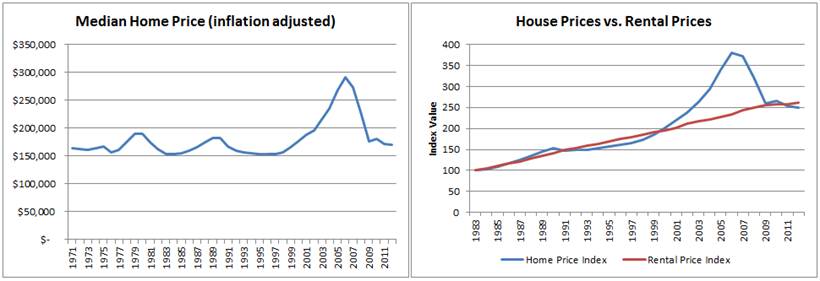
Ben Bernanke, chairman of the Fed, indicated that the Fed will continue the monthly purchases until economic conditions improve. Read another way, that means the Federal Reserve will continue print money until there is enough money to go around. That money will flow into the economy through lower mortgage and other loan payments for borrowers and through the reduced incentive to hold cash savings since interest rates are virtually zero. If $40 billion per month isn’t enough, they’ll do more. If mortgage-purchases aren’t enough, they’ll print money to purchase other assets too. It’s a commitment that essentially puts a floor under the economy and under asset prices, thereby removing the risk of deflation. Without the risk of deflation (think of housing prices falling), the desire to purchase assets can return (think of people in their early 20’s deciding to buy condos again instead of renting). While the ramifications of the commitment will take a while to filter through the economy, they should result in the following:

· Lower mortgage rates for those with good credit attempting to obtain conforming loans (loans for principal residence that are under the FHA loan limits for the county of residence – typically $417k)

· Another wave of refinancing reducing payments for existing borrowers and freeing up more for discretionary spending

· Reduced risk in house price declines leading to more buyer confidence leading to a bottom to the housing market

· Higher business confidence that the economy will not “double dip” back into recession (the Fed simply won’t let it happen)

· A very gradual improvement in the job market

· A continuing erosion in the value of cash (no interest paid and the cost of living will start to increase more rapidly, especially in volatile food and energy prices)

· Higher inflation (virtually a guaranteed byproduct in eliminating the risk of deflation), higher energy prices, higher food prices.

It’s that higher inflation that will be the next big economic problem in my opinion. How fast it happens is unknown, but when it does, the Fed will have to reverse course and start extracting stimulus or face a 1980s-like bout of hyperinflation. Their forecasts are for that to occur beyond 2015 (they currently promise to keep rates low through 2015 and wouldn’t do that if they didn’t think inflation would be in control through at least that year). I’m not so sure, since I think a promise for an unlimited amount of stimulus could very quickly cause inflation expectations to become unanchored. Either way, taking deflation, double-dip recession, and maybe even depression off the table is certain to be a short-term net positive on the economy in aggregate. It’s also virtually certain to make cash have less and less value over time. So, what should you do to take advantage of today’s changes:

1) Only hold enough cash to serve as an emergency fund and to pay for short-term upcoming lump-sum purchases.

2) Avoid long-term fixed-income commitments (long-term bonds, long-term cd’s, fixed annuities without an inflation rider).

3) If you own a house, look into refinancing or re-re-re-refinancing your mortgage.

4) If you’re renting, you live in an area where house prices are reasonable in relation to rent, and you have enough money for a 20% down-payment, consider buying a house. I’ve been very patient in delivering this message but my confidence is now fairly high that affordability (based on the mortgage payment you’d expect given home price and interest rate) will peak by Spring ’13.

Most of all, stay alert and stay flexible. Today’s announcement is unprecedented and therefore at least partially unpredictable. Bazookas are powerful, but they’re not the most precise weapon and they may have some collateral damage. If we’re using imprecise, extremely powerful, and somewhat unpredictable tools to try to control the economy, the result, well, let’s just say this is probably not the final chapter of this economic cycle.

The Marriage Penalty

No, I don’t mean the price of dealing with your spouse on an every-day basis as many sitcoms illustrate (frankly, I don’t consider that a penalty at all in case you’re reading this, honey!). I’m talking about the “features” built into the tax code so that a married working couple pays more tax than the same two working individuals would if they were not married. Few people understand this, but it can have a really big impact on your taxes when you get married and starting in 2013, the impact will be even bigger.

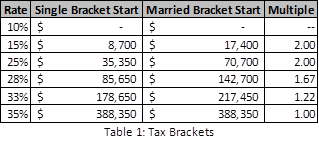
Let’s start with the most basic form of the marriage penalty, the tax brackets. Table 1 shows the starting income level for each 2012 income tax bracket for both the single and joint filer. As I described in Am I Working Too Much, a taxpayer pays tax at the rate indicated in the table for each bracket. For example, a single taxpayer would pay 10% tax on her first $8,700 of taxable income + 15% tax on her next $26,650 of taxable income up to $35,350 + 25% on her next $50,300 of income and so on. A married couple would pay tax in the same manner using the married tax brackets. Notice that while for the lower tax rates, the married bracket is two times the single bracket, the higher your income, the faster the married tax brackets increase vs. the single tax rates. This closes the gap between the married brackets and single brackets slowly until they are identical once reaching the top tax bracket. Let’s use an example to see the impact on two individuals, each with $150k of taxable income who get married. As single filers, they each pay 10% of $8700 + 15% of $26,650 + 25% of $35,350 + 28% of the remaining $64,350 for a total tax bill of $35,461 each or $70,922 in total. As married filers, using the married part of the table and a similar calculation, they’d pay $75,907 in tax. This additional ~$5k of tax is the most basic form of the marriage penalty. Note that electing to file Married Filing Separately does not reduce the marriage penalty since the MFS brackets are not the same as the Single brackets. Instead they are ½ of the Married Filing Jointly brackets. Additionally, it is not legal to file as a single taxpayer if you are legally married so you can’t just choose to file Single. To make things worse, starting in 2013 after the “Bush tax cuts” are eliminated, the multiple for the 25% tax bracket will be 1.67, instead of 2 as it is today. That will compress the 25% tax bracket for married filers down to $58,900 and add another few hundred dollars of tax.

There are other forms of marriage penalty in the tax code as well, some in existence now and others coming back in 2013 after the Bush tax cuts expire:

· For those claiming the standard deduction, the married standard deduction is currently $11,900, exactly twice the single deduction of $5,950. Starting in 2013 though, the old standard deduction marriage penalty kicks in here too with the standard deduction for married filers reverting back to ~1.67 times the single deduction (would have been $8700 for 2012).

· The qualifying income level for the Earned Income Tax Credit for married filers is less than 2x the Single levels.

· The new healthcare reform taxes starting in 2013 on investment income and earned income only impact those single filers with income up to $200k, but hit married filers starting at $250k per year in income).

· For those paying the Alternative Minimum Tax (AMT), the personal exemption for a married couple is less than 2x the Single level.

· The reduction in itemized deductions and personal exemptions which is due to return in 2013 will start at an income level for married couples that is less than twice the single income level.

· The threshold for determining whether a married couple’s social security benefits are taxable is substantially less than 2x that of a single filer.

· Multiple other deductions, credits, and exclusions in the tax code phase-out for married couples at less than 2x the single level including deductible IRA contributions, Roth IRA contributions, the Child Tax Credit, the deduction for capital losses taken in any one year, and the deduction for current year loss on a rental property.

More to come on the marriage penalty in future posts regarding 2013 tax changes.

401k’s: Just Because You’re Not Writing A Check…

Just because you’re not writing a check, doesn’t mean you’re not paying for administration and access to your 401k. I’ve seen recent polls indicating that 50-75% of 401k participants believe they’re not paying anything for their 401k. They couldn’t be more wrong. There are two broad types of fees that plans participants and/or their employers incur: investment fees and administrative fees. All plans incur investment and administrative expenses, most plans pass those expenses onto investors in the plan as fees, and some plans do it in a way that is very difficult for the average investor to notice.

Investment fees are those charged by the investment funds themselves as a ways of generating a profit on their funds as well as offsetting the cost to create, maintain, and distribute the funds. These fees are passed onto investors in the fund (whether it’s through a retirement plan or an individual investment) through the fund’s expense ratio. You can find the fund’s expense ratio in the Fact Sheet or Prospectus for the fund. If the fund is publicly traded with a 5-letter ticker symbol, you can also look it up at Morningstar.com (snip from Morningstar for a particular mutual fund is shown below with the expense ratio highlighted).

If a fund has an expense ratio of 1%, it means that over the course of each year, 1% of the fund’s total holdings are paid to the investment company and eliminated from the fund. Another way of looking at this is that the fund’s investors each pay 1% of their fund assets each year to the investment company (e.g., if you have $100k in the fund, you pay $1k per year to the fund through the expense ratio). Because this payment takes place inside the fund, it doesn’t appear on any statements or in account histories. It simply erodes the value of the fund over time, either creating larger losses than would otherwise have been incurred or reducing gains. All funds have an expense ratio, but many funds have different classes set up with different expense ratios. The more money a retirement plan has to put in the fund, the better the class they have access to and therefore the lower the cost to participants. As will be explained below though, the lowest cost class of a fund, or the lowest cost fund for a particular type of asset (large cap U.S. stocks for example) is not always the one chosen by the plan administrator.

Administrative fees are those fees charged by a third party administrator (i.e. not you and not your employer) to do the plan recordkeeping, fulfill legal requirements, provide disclosures, file government-required forms, accept payroll deposits, payout withdrawal/loan requests, and likely provide a plan website where participants can interact with the plan. Purely administrative fees paid by plan participants as either a flat amount per quarter/year or as a percentage of account value per quarter/year are usually fully disclosed on account statements and in transaction histories. In some cases, these fees are no bourn by the plan participants, but are instead paid directly by the employer. In this case, the fees are not typically disclosed to participants since they don’t directly pay the fees. In many cases, the administrative fees are not paid by the investor directly or by the employer directly, but are instead paid by the investment companies that provide the funds in the plan in the form of a commission. In these cases, the plan administrator typically selects investment funds that have a fairly high expense ratio for participation in the plan (either higher cost classes of certain funds, or higher cost funds of certain asset classes. The investment companies earn more on these funds than they would if lower-fee funds were selected, so they provide a portion of the difference to the administrator to compensate them. In this case, the administrative fees are not shown on participant statements or in account histories. They’re harder to track, and process is more convoluted (reminds me of the healthcare system of payments – but that’s another blog post for another day), but it should still be clear that the investor is paying the administrative costs nonetheless. As an extreme example, one of the worst 401k plans I’ve seen has only investment funds in it with expense ratios well over 2%. Some of the best plans have funds with expense ratios as low as 0.02%. You could argue that this means 1.98%+ of those fund fees are in excess of what they could be and that the investment company and the plan administrator are sharing those profits. If you use that 401k plan and you slowly build assets to over $500k with an average balance of $100k in the plan over 20 years, you are paying 1.98% in excess fees per year * $100k average annual balance * 20 years = $39,600 in excess fees! In many plans, there are good funds from an expense standpoint and there are bad funds. Cherry-picking the good ones and then using other retirement accounts (a spouse’s 401k/403b, IRAs, Roth IRAs, etc.) to fill in the rest of your retirement asset allocation is a good way to minimize the fund/admin expenses that you pay, and something that any good financial advisor should help you do (or do for you as is the case with PWA clients).

Recent law changes by the Department of Labor have increased the disclosures required by 401k plans so that you, as the plan participant, and your employer as the sponsor of the plan, can get a better idea of the fees that are being charged directly and indirectly. These disclosures become mandatory this month for most employers and quarterly statements will include fee information going forward by the end of the year. As part of the process, many plans are introducing new fund selections and/or changing the way they deal with administrative fees in the plan (e.g. billing them directly per participant rather than using the commission method described above). Please communicate any plan changes and send any fee disclosure documents to your PWA advisor so that we can recommend any changes you should make to your plan investments as a result.

Having access to a very diversified set of investment options in a tax advantaged retirement plan is something that is worth paying for. However, you and/or your financial advisor should know how much you’re paying for it and make sure that you’re not getting ripped off and are taking advantage of the best low-cost investment vehicles available to you.

Am I Working Too Much?

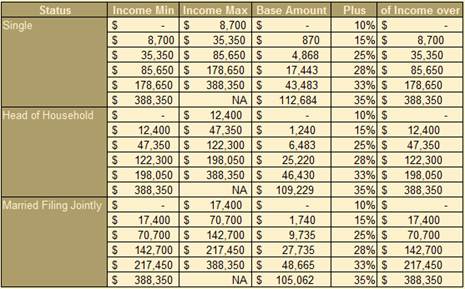
Am I working too much? If you’re like me, the answer is probably "yes". In this particular case though, I’m asking the question from a tax standpoint, specifically referring to a popular misconception about the way we pay income taxes. There are currently six tax Federal tax brackets: 10%, 15%, 25%, 28%, 33%, and 35% as shown in the table below from the Resources section of the PWA webpage.

Your marginal tax bracket increases with your taxable (after exemptions and deductions) income. So, if you’re married and have combined taxable income of $143k, your marginal tax rate is 28%. If your combined taxable income is $142k, your marginal tax rate would be 25%. So, doesn’t this mean that you could save tax more than $1k in tax by earning $1k less at work for the year because 143k * 28% is more than $1k greater than 142k * 25%? That’s where the misconception lies. The answer is no and here’s why. Your entire income is not taxed at your marginal tax rate. You are taxed at each incremental tax rate along the way. So if your taxable income is $143k (and you’re married), you’re taxed 10% on the first $17,400 of taxable income + 15% on the additional income up to $70,700 + 25% on the additional income up to $142,700 + 28% on the last $300. You should be able to see that your tax on the first $142k is exactly the same as if you only made $142k. The only income you pay 28% on is the incremental income which puts you in that bracket. The tax code is created so that you can never make more net (after-tax) income by earning less money. Virtually everyone to whom I’ve explained this over the years, including the students in the CFP® classes I’ve taught have breathed a sigh of relief. It seems that people tend to stress a little bit over the fact that they may be making a little too much income, pushing them into the next tax bracket, and costing them a ton of money when they could have enjoyed a week of unpaid vacation relaxing on the beach and made more after taxes. This can’t happen, so don’t worry that it’s happening to you. Of course that still doesn’t mean you’re working too much, but at least you’re not working so much that it’s actually costing you money.

Re-Re-Refinancing

Mortgage rates are back at historical lows with last week’s national average on a 30-year fixed rate loan (per Freddie Mac’s mortgage survey) at 3.53%.  Even if you just refinanced in the last year, it may be worth your while to explore re-financing again.  In very simplified terms, you can estimate whether refinancing makes sense for you by dividing the closing costs by the amount you’d save on your payment each month and comparing that number, which is frequently called the “payback”, with the amount of time you plan to stay in the home.  I like to call this “broker math” or “refi 101”.  The calculation is quick, easy, and gives a decent first indication of whether the refinance could be worthwhile.  In reality though, there are some additional considerations: 

1)     What are the real closing costs for the loan?  Some lenders quote their origination fee, but leave out third party fees in their initial estimates.  Others quote origination fee, third party fees, and “pre-paids”, which are partial month’s interest and/or an initial deposit to an escrow account of a few month’s property tax and hazard (homeowners) insurance.  Others still will quote “no out-of-pocket closing costs” because they will allow you finance the costs into the loan.  This doesn’t mean you’re not still paying them!  The true costs of the loan include the lender’s fees (origination, application, underwriting, and points) + all third party fees (appraisal, title insurance, taxes, recording, processing, legal, document).  Prepaid items (partial month’s mortgage interest and escrow) are not true costs and should not be factored into the analysis because they are not costs in connection with the loan.  The mortgage interest portion is the interest for the partial month if you close in the middle of the month, but you’ll get to skip one month’s mortgage payment so there’s an offset.  The escrow deposit isn’t a true cost because you’re just pre-paying something you’d have to pay at a later date anyway, and if you have an existing escrow account on your current loan, you’ll receive a refund from that shortly after closing.

2)     What is the real benefit of the lower monthly payment?  Simply looking at the lower payment as a complete benefit to you is not the correct way to view a refinance.  That’s because only a portion of the payment reduction is due to a reduction in interest.  In fact, there are four components to watch out for:

  • (+)True interest reduction – this is your real benefit
  • (-)Tax impact of the true interest reduction – if you itemize, a portion of the lower interest payment means that you’ll have a lower mortgage interest deduction which means you’ll pay higher tax.
  • (-)Principal reduction from extending the term of your loan – not a real benefit because your mortgage is going to last for extra months on the end of the loan to account for this
  • (-)Principal reduction from amortization schedule – not a real benefit because more of each payment will be going toward interest after the refinance, so if you sell the home a few years after the refinance, the principal balance will be higher than it would have been without the refinance.

Calculating all of these impacts is somewhat challenging.  We’ve developed excel models to do the calculations.  Contact your PWA financial advisor if you need help.

3)     Do you have enough equity in the home to avoid needing private mortgage insurance (“PMI”)?  To qualify for a traditional loan with no insurance (assuming good credit), you’ll need a loan-to-value (“LTV”) ratio of no more than 80%.  To calculate your LTV, simply divide your mortgage amount by your estimated home value.  If the result is < .8, you probably won’t need mortgage insurance.  If it’s > .8, you probably will and if you do, there could be other up-front costs in the loan or there will be an ongoing PMI payment which typically equates to an interest rate that’s about 1% higher than the one quoted on the loan.  Be careful.  You probably won’t want to refinance a loan that doesn’t have PMI to a loan that does have PMI unless your interest rate is falling by ~2% or more.

4)     Once you’ve compared the true up-front costs of the loan with the real monthly benefits of the lower payment, you can calculate your payback by dividing the benefits into the cost.  If you plan to remain not only in the home, but also in the loan, for longer than the payback, then the refinance makes sense.  But do you really know for certain that you’re going to be in the home AND in the loan at a certain point in time?  Probably not (especially if you might refinance again).  For this reason, I advise clients to double the payback period and if they’re still confident they’ll be in the home and the loan for that amount of time, then do the refinance.  If the confidence is not there, then refinancing could add cost without enough payback before you exit the loan through a sale or another refinance.

5)     Do you have enough equity to qualify for traditional financing?  There is a chance that you’ll go through the loan process, pay an appraisal and potentially an application fee, and find out that your home is worth less than you thought and your LTV is higher than 80%.  In that case, adding mortgage insurance may be the only way to continue with the refinance.  Doing so will add to the costs and likely will extend the payback period to the point where the loan no longer makes sense.  In this case, you won’t proceed with the refinance, but will still be out the appraisal and application fee.  So, you need to have a fairly good idea in the value of your home and that you’ll have enough equity before you refinance.

6)     Many lenders will quote a standard rate and closing cost combination when you ask for a quote.  But, there are other options in most cases.  For a refinance, especially in the case where you don’t know how long you’ll be in your home or whether rates will fall sharply and you’ll want to refinance again, the best option may be a slightly higher than market rate and a credit that offsets most or all of your closing costs.  In this case, you remove all of the cost by giving up a little of the benefit and make the payback zero (or close to zero) months.  Explore that with your broker/lender before making a decision based on an initial quote.

Determining whether or not to refinance is really an intricate cost / benefit analysis.  Many borrowers look only at the payment reduction and the amount of money they need out-of-pocket to close and may put themselves in a worse position by doing so.  Make sure you think through this decision and talk to your PWA advisor before and during the process.  Once you get this right, and you’re certain you’ll benefit, refinancing really can be a free lunch.  And, there’s no better tasting lunch than a free one.
What’s In A Score

A few people have asked recently about how credit scores are determined, what is a good credit score, what score it required for the best rate on a mortgage, etc.  The following is an article I wrote for the PWA Newsletter back in 2008, updated for the interest rate world we live in today.

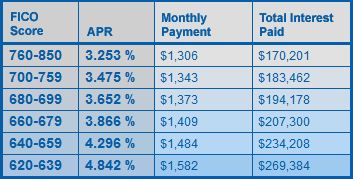
Okay, so you’ve checked your credit report, made sure there are no errors and are satisfied with the result.  Now what?  Now you have to understand what your credit report is used for and how your credit score is determined.  When you apply for a credit card or a loan, the prospective lender gathers your information and attempts to determine your credit risk.  They do that by analyzing the personal data you send them, by examining your credit report, and by reviewing your credit score, AKA your FICO score.  This process ultimately decides whether you get the loan or not and the terms for which you’ll qualify.  As shown below, your credit score can have a dramatic impact on the interest rate you’re offered and will therefore impact your payments and total interest over the course of the loan.


Rate by Score

Based on $300k 30-year mortgage and LTV of 60-80%. As published by MyFico.com

Your FICO score is determined by a complex system that was created by the Fair Issac Company (hence the name FICO).  To our knowledge, the actual formula has never been released, but the general algorithm has, and that’s really all you need to know to improve your score.  It is based on:

  • Payment History (35%) – do you pay your bills on-time, have you ever filed bankruptcy, are you currently or have you ever been in default.
  • Amounts Owed (30%) – what portion of your available credit are you using, how big are the balances (esp. on revolving debt), how many accounts (and of what type) are active and/or have balances.
  • Length of Credit History / New Credit (25%) – time since your oldest account was opened, age of all active accounts, number of recent applications for accounts and new accounts, time since last application and new account
  • Types of Credit Used (10%) – prior and current use of different types of credit (mortgage, installment, revolving, etc.)

There are many standards of what constitutes a “good” FICO score.  Some say higher than 720, others say higher than 750, and still others say higher than 780.  Because each lender will use the information in their own way, all we really know is that the higher your score is, the better off you’ll be. The median score is around 720 and the 90th percentile score is just over 800 according to estimates published by myFico.com and bankrate.com.  To estimate your FICO score, you can use the free calculator at: http://www.bankrate.com/brm/fico/calc.asp or register for a free site like www.creditkarma.com which tracks an estimate of your score over time.  To see the real thing, when you obtain your free annual credit report from one of the reporting agencies, purchase your score from them for a nominal fee (<$10). 

Healthcare Reform Taxes Starting in 2013

I’ll have several upcoming posts on tax changes for 2013 including what’s going to happen if nothing changes, what’s likely to happen (IMHO), and what’s not going to happen.  Here though is a quick list of changes that will take place as part of the new healthcare laws…  I’d label these as almost certainly going to happen, with the only possible exception being if Republicans win majorities in the House and Senate and win the Presidency in November (17% chance of all three happening based on Intrade.com’s betting odds) and pass a repeal of some or part of the Act.  For now, it’s safe to say these are happening:

  • A 0.9% additional tax to employees on wages over $200k per year ($250k if married filing jointly, hereafter abbreviated “MFJ”).  As we understand it, this would be part of employee’s payroll tax, known by many as FICA. This is the 6.2% social security tax that’s capped at $110,100 of income in 2012 and 1.45% Medicare tax that is uncapped.  It’s the Medicare tax that will rise by 0.9% to 2.35% of income and will remain uncapped starting in 2013.  Since this is a payroll tax, it will by withheld from paychecks of employees.  This means that even if you pay the Alternative Minimum Tax (AMT), you’ll still pay this new tax through payroll.
  • A 3.8% new tax on unearned income by those earning at least $200k per year ($250k MFJ).  If you earn less than $200k or $250k but have unearned income that puts you over those thresholds when added to your earned income, you’d pay the 3.8% tax on the excess over $200k or $250k.  The types of income to which this applies are: interest, dividends, capital gains, annuity income, royalty income and passive rental income.  It does not apply to tax-free interest or retirement plan distributions.  This tax is generally paid at the time of filing or via estimated tax payments through the year.
  • Healthcare flexible spending accounts will be capped at $2500 (reducing the amount of tax that can be saved by deferring income into these accounts).
  • Medical expenses paid out of pocket will only be deductible for those under age 65 if they exceed 10% of income (a hike from the current 7.5% floor).
  • A 2.3% tax on the sale of medical devices (except those commonly sold at retail like glasses, contacts, and hearing aids).

Additional taxes begin in 2014, including the tax penalty to individuals without health insurance (AKA the “Individual Mandate”) and businesses who have at least 50 employees but either don’t offer coverage, or offer sub-par coverage that leads employees to buy insurance on one of the newly created healthcare insurance exchanges (AKA the “Employer Mandate”).  More on these changes in a future post.

Bi-Weekly Mortgage Payment “Opportunity”

I received an offer from my mortgage lender today, to participate in a special plan that would allow me to “Pay off [my] mortgage sooner”, “Save thousands in interest”, “Build valuable equity”, and “Achieve financial freedom”.  Wow!    

The program involves signing up to make half of my mortgage payment every 2 weeks instead of once per month.  This results in 13 payments per year, which reduces the principal balance on the loan faster, and would allow me to payoff the mortgage faster.  Using some sample numbers, if I had a $300k mortgage at 4% with 25 years remaining, instead of paying ~$175k in interest over the next 25 years, the program would have me paying ~$150k in interest over just under 22 years.  Sounds like a great deal…  on the surface.

The catch is that the lender wants to charge me $3 per payment ($78) per year, for the opportunity to do something that I can do on my own and in an even simpler way.  Without getting into the fact that paying off a tax deductible 4% mortgage early probably doesn’t make sense for most people, if I did want to pay the mortgage off early, I could simply make one extra full payment per year (say double every January) and leave everything else the same.  Not only would I avoid paying $78 per year, but I’d pay $1000 less interest over the life of the loan and still pay it off in just under 22 years.

Why pay $78 for something I can do better myself in a simpler manner with the flexibility to change my mind if I need or want that extra payment for something else?  Come on [lender who shall remain nameless].  You can do better than that if you want to earn an extra $78 out of consumer’s pockets each year.

Moral of the story: be skeptical of bank “offers”, and avoid special mortgage payment plans that have a fee involved.

Market Update 7/5/2012

*** We believe communicating with our clients is of utmost importance, especially during turbulent times in the market. While we don’t claim to have a crystal ball on the future of any financial market at a given point in time, we do believe that keeping clients informed on why things are happening increases their comfort level and understanding. This post contains a message initially sent to clients just after the start of Q3 2012 as part of that communication effort***

Q2 2012 proved to be yet another roller coaster quarter in the financial markets led mostly by continuing debt problems plaguing European governments & banks, and the economic slowdown driven in part by fear and in part by the austerity measures that are being put in place to try to rectify the debt overhang. After losing much of the Q1 gains through the month of May, markets rallied back in June on hopes of progress in Europe following the latest Greek elections (a win for the party that wants to stay in the Euro), a hint that Germany may be willing to concede to a cross-country banking union of some sort, and the extension of Operation Twist by the U.S. Federal Reserve (thereby also extending hope of more easing in the future). US stocks a whole lost just over 3% for the quarter, with international stocks losing just over 7%. U.S. interest rates continued to fall with short-term rates pinned near zero and long-term rates plunging to historic lows (U.S. 10-year yields just under 1.6% as I type this note). This helped bond funds to perform fairly well in aggregate, up about 2% for the quarter. Commodities fell on global growth concerns, down 4.5% for the quarter with energy components leading the way down. While investments in commodities lost value, the economy as a whole likely felt some relief from declining energy prices which helps consumer confidence and more importantly, consumer budgets. As we noted in our Q1 update, we expect risk assets like stocks and commodities to continue to remain volatile, both up and down, for the short-term, with bonds in aggregate generating fairly constant, albeit low returns. Interestingly, the national average rate on a savings account is now 0.12%. While it doesn’t get much safer than an FDIC-insured savings account, with year over year inflation running close to 2%, that’s a guaranteed loss of almost 2% per year by keeping money in cash.

While much has been blamed on Europe over the last two years, the U.S. faces its own issues heading into 2013. At current pace, we borrow approximately fifty cents of every dollar we spend as a government. This completely unsustainable way of running of the country will take its toll at some point in the future. The good news is that we seem to know that we have a problem. The bad news is that the method by which we fix it is heavily debated by our two political parties, each seeming to move toward a more extreme position as time goes by. It would be difficult to call them deadlines, but at least strong milestones loom in the not too distant future with the major credit ratings agencies noting that if the U.S. doesn’t come up with a credible plan for reducing the deficit by the start of 2013, another rating downgrade will follow. As current law stands, three dramatic changes are scheduled to be implemented in 2013. These have become known in aggregate as “The Fiscal Cliff”. They include the sequestration of defense spending budgets, the repeal of the 2001 & 2003 tax cuts which will increase tax rates on everyone who pays U.S. taxes, and the next steps in the implementation of the new healthcare laws which will institute a new Medicare surtax on certain individuals. If these changes go into effect, they combine spending cuts with tax increases in a slowing economy that is plagued by high unemployment already. This dramatically increases the possibility of another sharp recession. If the changes don’t go into effect and no other credible plan is put into place to balance the budget over time, the credit worthiness of the U.S. will come into question. If/when that happens, borrowing costs will start rise, putting more pressure on the budget (higher interest payments) and that spiral of debt that is all too familiar in southern Europe could attack the U.S. in much the same way. The answer to this problem in our opinion is one that Congress will get to eventually. That is, easing the Fiscal Cliff for the short-term and simultaneously publishing a credible plan for the long-term, likely through an overhaul of the tax system and a review of programs like Social Security and Medicare that are growing to levels we can’t support over the long-term. What’s not clear is whether the will exists to accomplish this before sharp and severe economic realities hit.

Led by the election in November, we believe the issues in the U.S. will come to the forefront over the next few months. It is likely that the stock market will gyrate, perhaps wildly at times, as solutions are brought forward and political power for the next 2-4 years is revealed. Further stimulus by the Federal Reserve, possibly in a coordinated effort with central banks around the world, will become more likely if economic conditions deteriorate. Monetary stimulus would continue to provide a temporary floor to the economy and to asset prices by simply pumping more money into the banking system. If the Fed does this, cash is one of the worst places to be as interest rates will continue to near zero while inflation would likely pick up as more money enters the financial system.

What all of this means is that we’re unfortunately stuck in the middle of a potentially deflationary bout of economic deterioration (where we’d want to hold cash and bonds and avoid stocks and commodities) and a potentially inflationary move by the Federal Reserve and other central banks to offset that economic deterioration (where we’d want to avoid cash and bonds and own stocks and commodities). The market in aggregate continues to do a very good job of pricing the risks to both sides. The current best course of action is to maintain asset allocation targets and continue to take advantage of volatility through portfolio rebalancing. We are monitoring the economic landscape closely and are prepared to take action if risk/reward does come out of balance in the coming months. If the market rally significantly from here on a perception that the world’s problems are solved, we will likely move toward more conservative portfolios by adjusting all models and using hedging positions where appropriate. For now though, we believe the inflation/deflation scenario is well-balanced and that stocks, especially in comparison to other asset classes, remain well-priced.

More on the fiscal cliff, stock valuations, Europe, and a host of investment and other personal finance topics will be presented on the new PWA blog which is officially live as of today (blog.perpetualwealthadvisors.com). In future quarters, rather than sending you emails like this, we’ll be posting shorter, more easily digested ruminations on the blog. You can subscribe to receive emails on new blog posts if you prefer to receive the content in your inbox rather than on the sites. Our Facebook and Twitter pages are also live, though with each still under construction and notably light on content (as is the case for all new pages). We’ll rectify that shortly. Feel free to provide encouragement by “Liking” & “Following” us. You can find links to all the pages via the icons in the signature below. For those of you who have made it this far into reading this email, you’ll be receiving a second notice about the blog, Facebook, and twitter pages in the coming days specifically because I’m guessing only a few of you made it this far (which I find as solid confirmation that a blog will be more useful than long emails each quarter). You have my apologies in advance for the double notice. As a reward however, reply to this message with a suggestion for a future blog post topic and you’ll be entered into a drawing to receive a gift card at the end of the quarter. As always, if you have any questions or comments about this message or anything else, please don’t hesitate to ask. Thanks for reading and enjoy the rest of the summer.

About This Blog

The PWA (Perpetual Wealth Advisors) Financial Tastings Blog is intended to provide our clients and other interested readers with bite-sized, easily digestible information on personal finance topics.  We used to publish a quarterly newsletter with similar information and will be archiving some of those topics here.  Instead of continuing with a publication that was akin to a seven-course meal every three months, we have found that the fast-paced, mobile-driven world required smaller amounts of information, communicated more frequently.  We’ve turned to the blogging concept to provide it.  Topics will include both original content and links to other articles of interest.  They will span key areas of personal finance including planning, goal setting, budgeting, cash flow management, debt management, risk management, employee benefits, tax, investments, retirement planning, and estate planning.  We’ll try to keep posts brief, simplify where possible, and answer as many questions as we can.  Speaking of questions, feel free to send them to blog@perpetualwealthadvisors.com.  We’ll occasionally open up the mailbag for a Q&A post.  Bon appetit!