My Take On Tariffs

Just because tariffs aren’t another reason to panic doesn’t mean they aren’t going to cause angst. To be clear, I think they are a policy error and the way they have been implemented is a huge (trying hard not to do Trump voice in my head as I type that) policy error. I try to stay out of discussing politics, esp. in large audiences, because no seems to have an open mind and 50% of that audience will almost certainly hate whatever I’m saying (probably more like 90% since I consider myself politically homeless… not aligned with either of our two choices in political party). I will preface this post by stating that if you believe Trump is the United States’s savior and that he can do no wrong, you should probably not read the rest of this post. If you believe everything Trump has ever said or done or will ever say or do is wrong, evil, etc. you should probably not read the rest of this post. If you’re somewhere in the middle, and have an open mind, this post is for you! There won’t be any facts, figures, and charts in this one. I’m just going to try to explain what’s going from my point of view, because more than one client has recently asked my opinion. I suspect that means more of you are wondering what I think. If you’re not, feel free to skip past this one. There isn’t any financial advice here… just some plain English ‘splaining. I’ll try to stop before it turns into a pure ramble.

Last week, the administration announced “reciprocal” tariffs on just about every country in the world. (Aside: I don’t really care that they included an uninhabited island… it’s dumb, who cares, it has no impact on anything). They call the tariffs reciprocal because they believe those countries have unfair practices in place that disadvantage the US on trade. It’s hard to argue against that point en masse. At least in some cases, some countries have disadvantaged some vendor, product, or sector of the US. A common large scale example is the intellectual property theft in which China has engaged for decades. A more specific one might be the very high tariffs (as high as 110%) that India imposes on foreign made autos. It would be hard work to research each and every unfair trade practice from the bottom up and quantify how to reciprocate in a fair way. So, the administration has chosen a different approach. They’ve decided not to target unfair trade practices, but instead to define unfair as running a trade deficit with the US. That is, if a country exports more goods to the US than it imports from us, there must be something fundamentally unfair there! To “fix” the unfairness, we’re going to impose a tariff equal to the other country’s trade surplus with us divided by their exports to us, minimum 10%. That is, (exports – imports) / exports… in their view it’s the unfairness ratio. To be nice (/sarcasm), we’ll actually only make the tariff rate half this amount.

Calculations aside, I think the president and his team have a fundamental misunderstanding of the economic order of the world. If you were to rank all the countries in the world In terms of wealth and opportunity for wealth, it seems to me that the US would be pretty high in those rankings. To threaten the world economy with extreme “reciprocal tariffs” as a way of equalizing trade imbalances just makes no sense to me. Have the third world nations where the average person lives on the equivalent of a few dollars per day really stolen our wealth and opportunity? Trade imbalances imply specialization and the movement of resources to their optimal locations to make production efficient. I have a trade imbalance with my grocery store because I’m not good at farming and they are good at stocking their shelves with food. They can specialize in running a grocery store and get things cheaper and more efficiently than if I had to do it myself. I’m happy to pay them for that and free up my time for more productive things which I can do better when I’m not hungry. Allowing specialization and removing trade barriers makes things more efficient. We should be working with other countries to eliminate all tariffs (slowly, over time, so as to not shock any particular portion of the global market) and other trade barriers to establish free and fair trade around the globe. All economies will benefit from that and the global economy will grow as a result.

Targeted tariffs or subsidies, esp. as part of negotiation for fair trade deals makes sense to me. Even the threat of escalating tariffs for countries that refuse to negotiate or be more fair on their end could have a place. Financial markets seemed mostly ok with this as well. Life could go on with a few tariff snipers taking aim at unfair practices and the threat of a tariff bomb if those unfair practices continued. Thinking that we could, or that we’d even want to, eliminate all trade deficits, is not a solution. To make matters worse, massive tariffs imposed all at once, will shock global trade. While the importer pays the tariff, it’s likely that some of it gets passed on to the American consumer, some of it is eaten by the importer, and some of it is negotiated through to the exporter in a lower price on their end. All three components feel some pain there. That’s fine with surgically applied specific/strategic tariffs. With globally applied tariffs at high rates, there will be demand destruction on top of the pain. That is, fewer goods are going to be sold pretty much everywhere in the world because of dramatically higher prices. Strategic sourcing or product substitution isn’t available if the tariffs are everywhere and on almost everything. Fewer goods sold means lower profits, on top of the squeeze that tariffs already put on profits. Lower profits means less global employment. It would be hard to envision massive job creation in the US if global jobs are shrinking. In other words, we’re trying to make our slice of the pie bigger at the expense of the size of the pie. Now multiply all of that by an unknown amount of retaliatory tariffs from other countries, which Trump has already said will be met with more reciprocal tariffs from the US.

If all of the above sounds unstable, imagine how it sounds to a CEO trying to plan where to build a new factory that will be completed in 5 years time. Not only does forecasting demand and pricing become more difficult, but they know that these newly announced policies are unsustainable. A trade war isn’t going to last forever. Where does the world land in terms of trade deals? What’s the impact on currencies? What happens after the next election cycle around the world? What will be the terms of imports and exports if they build a new factory in location A vs. location B? Can they even really afford to build a factory in such uncertainty? It sure does sound hard for all the manufacturing jobs to come back to the US in that scenario.

That brings me to my last issue with all of this. Do we really have an appetite for massive increases in factory work in the US? Where will the people come from to do these jobs, even if they are fairly paid? We won’t even let people come in from Mexico on a seasonal basis to pick fruit. And if they are fairly paid, are we ready to pay 5x and 10x the price for goods? It seems we’d be better off focusing on advancing technology (robotics, manufacturing processes, etc.) than trying to force clothes and electronics to be made domestically. Highly educated engineers using robotics to make something better than an iphone in a way that is even cheaper than offshore labor could built… that sounds like a better way to drive some manufacturing back to the US. Or maybe the manufacturing should never come back. Unemployment is 4%. Almost everyone who wants a job has a job. We buy other countries’ goods with our dollars and they take those dollars and invest them back in our companies and our treasuries. As Bloomberg’s Matt Levine recently wrote: “… a world in which the US gives people finance and gets back inexpensive goods strikes me as good for the US. We give them entries in computer databases, they give us back food and clothing: That is a magical deal for us!” Maybe, just maybe, our goal shouldn’t be to emulate the third world economies to try make our slice bigger, but rather to let goods, services, and capital flow freely so that it can continue to expand the pie.

The current policy is so egregiously bad that it just can’t stay put. I don’t think it’s malicious. I think it’s dumb and lazy. Either the Trump administration will shift to negotiating and ultimately say this was a negotiating tactic all along but they couldn’t tell other countries that… art of the deal sort of stuff OR Congress will take back the power to impose tariffs from the President and reverse this (they gave it to the President after all) OR Trump will throw someone under the bus, blame them for poor implementation, say “you’re fired” a la The Apprentice, and modify the approach to “what I really wanted to do from the beginning”. Trump has been talking for decades about the trade imbalance and now has set out to fix the problem. The problem though, isn’t the trade imbalance. It’s his understanding of economics.

In the short-term, financial markets price assets and liabilities on emotions, running through the fear and greed cycle, which determines current supply and demand for the assets. In the long-term, they price assets and liabilities based on future cash flows. If poor economic policy disturbs global trade for a few weeks or even months, it will eventually get back to normal. I mean, it did with covid when almost the entire world shut down for a few months. People are still going to fly in airplanes. We’re still going to eat. We’re still going to buy clothing. We’ll still need cars. Kids will be born and raised. And all the while the smart folks will be inventing new things and moving the world forward so it can be more productive. I’m confident that the terrible, horrible, no good, very bad, tariff policy isn’t going to end the economic world. In fact, the worse financial markets get, the more pressure builds on the administration, the closer we are to de-escalation. It didn’t have to be this way, but the good news is that it won’t always be this way.

Election Warning

This is a Q&A-style primer for the 2024 election.  I went with a potentially triggering title intentionally, because that’s what we’re used to on anything election-focused.  Rest assured, I’m not warning about anything financially dreadful that is likely to occur as a result of the upcoming election.

Q: What is the “Election Warning” about then?

A: It’s a warning about possible emotional reactions to the results, delays in the results, or financial market volatility around the results of the election.  We’re all human.  We all panic sometimes.  We all make decisions in the midst of a panic.  My hope is that by acknowledging this in advance, we can invite logic and calm to the part of the brain that feeds off anxiety.  We’re one day out from what the candidates and the media would have you believe is THE MOST IMPORTANT ELECTION OF ALL-TIME.  That very well may be the case, especially if things you highly value are at risk of changing or things you’re strongly against are at risk of not changing.  I would just note that virtually every presidential election and many mid-term elections are presented as THE MOST IMPORTANT ELECTION OF ALL-TIME.  The candidates want you involved to increase the odds that you will donate and ultimately vote.  The media wants you interested to increase the odds that you tune in, read, or click (which leads to advertising or subscription revenue).  The entire process is designed to put you on edge, especially if you live in a “battleground state” like I do, where we are beaten over the head with divisive, ugly messages for months in advance of the election.  There is much at stake that is not financial in nature.  I acknowledge that and don’t want to minimize it.  But, the anxiety over those non-financial issues can carry over into personal finance, especially if we see markets gyrating due to the same stress-inducing election.  A recent poll conducted by the Certified Financial Planning (CFP®) Board, showed that a staggering ~80% of Americans expect their personal finances to deteriorate if their preferred candidate loses the 2024 presidential election.  It always feels bad if the other side wins.  It’s important to acknowledge that our biases play more of a role in feeling that an election will be financially negative than historical facts do.  Here’s another example:

Regardless of your party affiliation, if the President comes from the party that you lean toward, you’re much more likely to have a positive view of economic conditions than if the other party is in power.  The effect takes hold very shortly after election day, so it’s not the impact of actual policy changes or legislation driving this result.  It’s our biased view of what’s to come.

Q: Isn’t it better for the stock market if one side wins than the other?

A: I haven’t seen any evidence that would lead me to a conclusion one way or the other. 

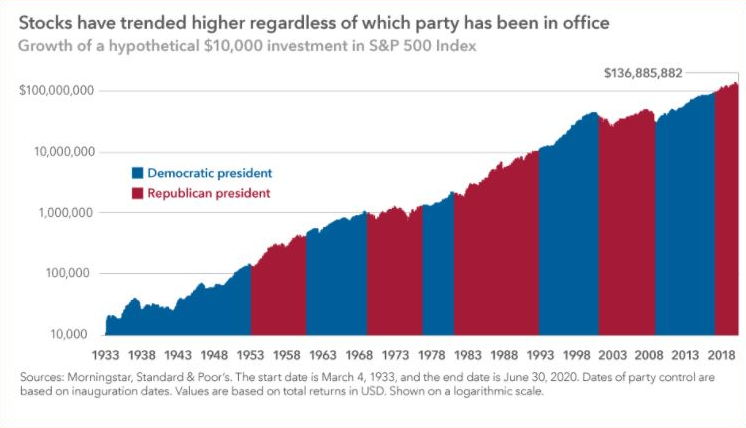
The one thing that is very clear is that stocks tend to go up and the economy tends to grow over the long-term, regardless of who is in the White House. 

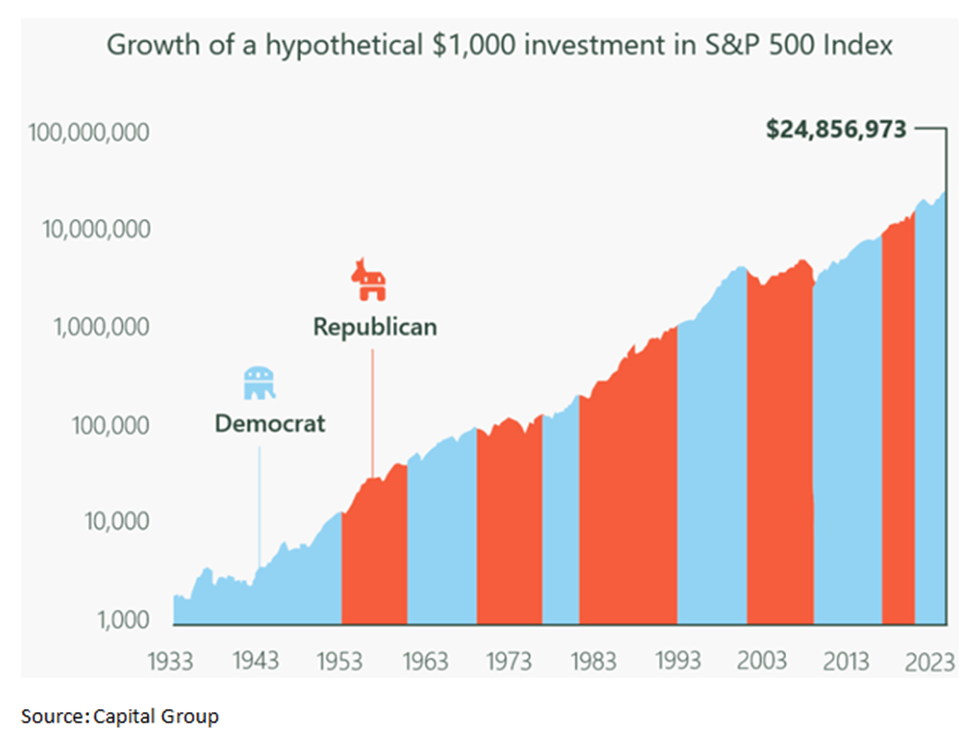
Note the scale on the left of the chart is not linear.  Sure, there are dips here and there, but the takeaway should be clear…  over 90 years and through multiple presidents from both parties, a $1000 investment in the S&P 500 grew almost 25,000x to nearly $25M.  I went back and checked that because it seemed like maybe a typo. It’s not. It’s the stunning power of compound growth over a long period of time. Instead of worrying about the relatively small dips in the rollercoaster, we just need to zoom out and focus on the extreme upward-sloping ride. 

Q: That chart starts just after the Great Depression though.  Wouldn’t including that change things?

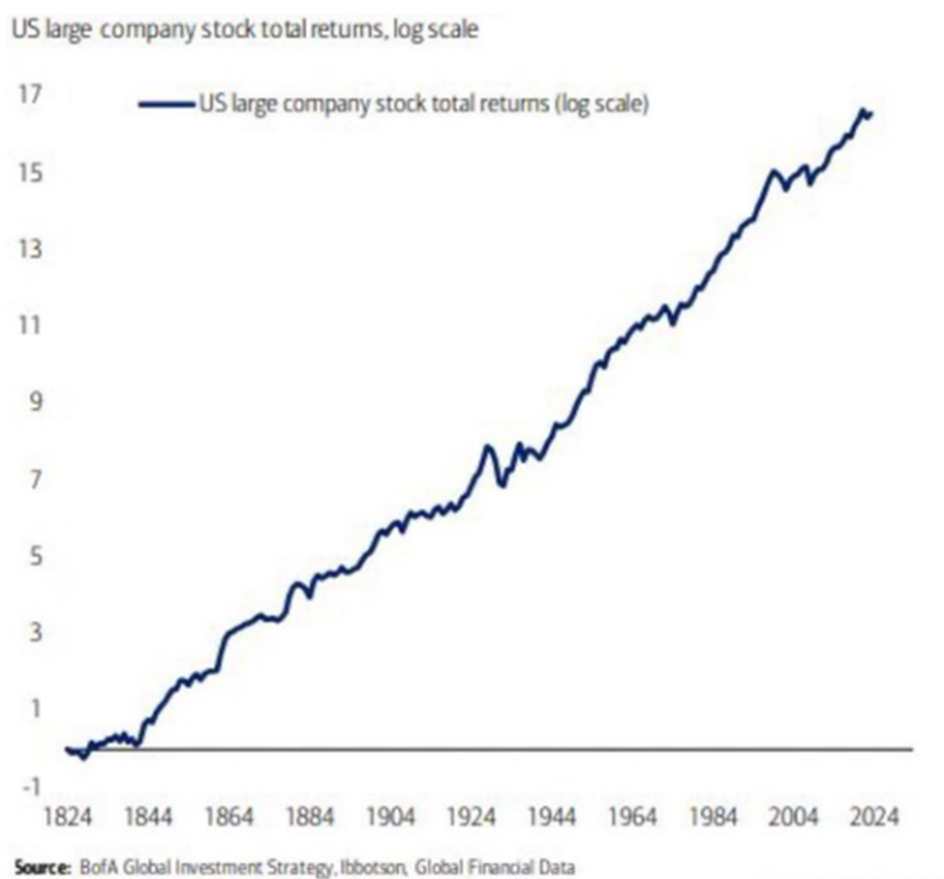
A: Thanks to Ibbotson Global Financial Data and BofA, we can take this data back to pre-Civil War times and it’s even more impressive.  The chart below shows the growth of large US companies for 200 years on a logarithmic scale.  That means the values didn’t grow from 0 to 17x over that period.  They grew 10^17th times, or 1,000,000,000,000,000,000x!  Population growth, productivity growth, and inflation just simply swamp all the minutia over time. You can see the Great Depression on the chart. Notably, you can also see that it mostly just brought growth back in line with the historical trend.

Q: What about the short-term?

A: If you’re invested in stocks for the short-term, you’re just gambling.  That doesn’t make sense.  Either money is needed for the short-term and shouldn’t be primarily invested in stocks or money isn’t needed for the short-term and the short-term doesn’t matter.  It is fair to guess that the stock and bond markets will be volatile as election results come in, especially if election results are delayed.  There is an old market adage that states that markets hate uncertainty.  Peak uncertainty, from a political perspective, will take place just as polls are closing on election night.  Slowly, the uncertainty will be drained from the system and the market will price in victory for one of the candidates, with their likely policy platform, probability adjusted for the odds that it can move through Congress.

Even sector-based predictions are tough to make based on who is president.  Richard Berstein recently pointed out that Energy has been the best-performing sector during Biden’s presidency and the Emerging Markets outperformed US Small Caps during Trump’s.  Pundits would typically forecast the exact opposite.

Q: How slowly will that uncertainty be drained?  When should we expect election results:

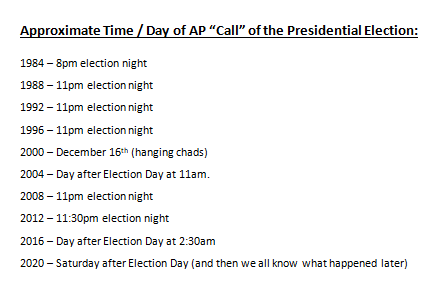
A: We can look back at previous presidential elections for clues:

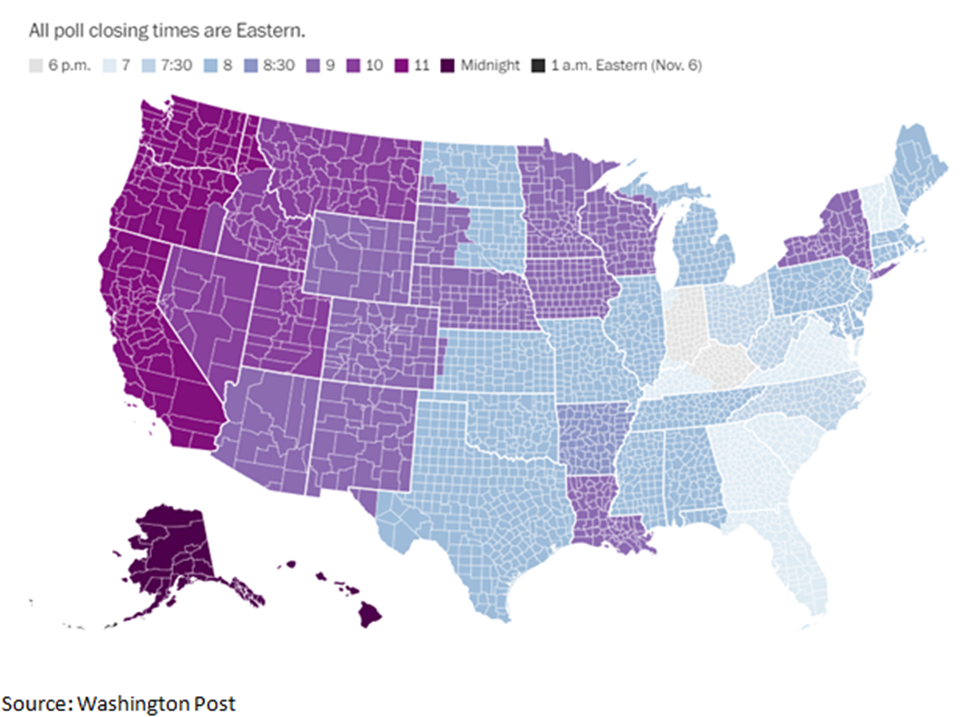
We can also look at how states count ballots, when polls close, and what the news outlets expect in the battleground states:

My notes on ballot counting, by state:

  • Arizona – multiple referendums, long ballot, lots of manual counting likely needed.  Delay could be several days.
  • Georgia – fairly quick count, but possibly misleading start.  Mail-in ballot counting starts at 7am on election day, so the first report will be mostly those ballots, which have historically skewed Democratic.  That means a Harris early lead, with Trump closing the gap as more ballots are counted is likely.
  • Michigan – counted about 45% of the vote by midnight in 2020.  Likely to be a close race, so almost definitely won’t be decided election night.  Most of the vote should be counted by Wednesday (~95% per NBC News)
  • Nevada – mails ballots to all active voters.  Allows mail-in ballots to be received and counted up to Nov 9.  In a close race, results will be delayed at least a few days.
  • North Carolina – usually a quick count, but storm damage may slow that a bit this year.  In 2020, 99% of votes were counted by midnight.  Like GA, starts count of mail ballots early in the day, so early results may show a skewed count.  Nash County should be the first of ten counties in battleground states that flipped from Trump in 2016 to Biden in 2020 to complete their count around 10pm on election night.  Some will view this an early indicator of the 2024 trend.  New Hanover is another flip county, expected to complete its count around 10:30pm.
  • Pennsylvania – can’t start counting mail-in ballots until the polls close.  Almost 25% of the votes were mail-in in 2022.  However, a lot of investment through the state in making the process better than in 2020 (new machines, more workers, etc.).  NBC News expects 98-99% of the vote counted by Wednesday morning.
  • Wisconsin – fast in the small counties, slower in the large ones which means a possible skewed early lead for Trump given the big city votes should skew Democratic.  ~70% of the 2020 vote was in by midnight.  Most should be counted by Wednesday (~99% expected per NBC News).

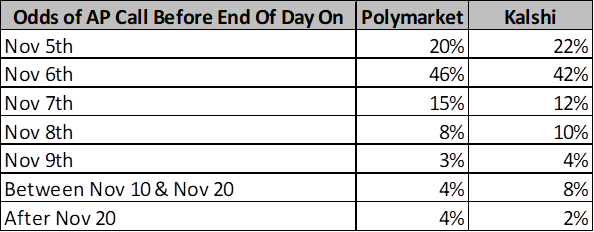
Finally, we can look at prediction markets where real people have real money on the expected result.  Here are the odds of when the race will be called:

While I suppose anything can happen, especially after having lived through 2020, Mid-December seems to be the latest possible date of certainty.  Under electoral reforms passed after the 2020 election, individual states need to resolve disputes about their results by Dec. 11.  If they can’t, the Supreme Court will settle them instead.  The Electoral College is scheduled to vote on Dec. 17, which will formalize the result.  My opinion: if it’s a blowout, election night is possible, but that seems unlikely given how close the race is (see below).  If not, Wed, 11/6 seems most likely.  There is potential for it to take several more days, if the race is close and battleground states need recounts or exact counts of all absentee ballots.  I think we’ll be pretty certain who won by the end of day on Wednesday, even if the AP hasn’t officially called the race.

Q: You mentioned the market probability adjusts the odds that the winner’s platform can move through Congress.  What are the chances the President will be able to do anything at all?

A: The odds are obviously highest if one party controls the presidency and both chambers of Congress.  In an atmosphere as divisive as we currently have, it’s unlikely that much will change from current law, at least not without a lot of compromise, if there is a power split.  Currently, prediction markets give the following odds:

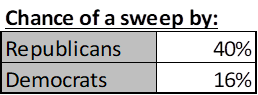
Results are likely to be correlated though.  For example, if Democrats outperformed expectations and won the Senate despite only a 21% chance of doing so, it’s almost certain that they also won the presidency and the House.  So, the overall chance of full control by each party is somewhat unintuitive from the results above. Since Kalshi has this market available, we can see what’s expected:

Q: What are the differences between the two candidates’ policy positions that might impact the economy, financial markets, and taxes?

A: A lot of this comes down to the expiration of most of the provisions of the Tax Cuts & Jobs Act (“TCJA”) at the end of 2025.  That will happen as the default, i.e. if no new legislation is passed.  Notably, the one major provision of TCJA that will not expire in 2025 is the corporate tax rate, currently set to 21%.  It would take new legislation to change that. 

If Republicans sweep, we may see an extension of the full TCJA, perhaps with even lower individual tax rates, and some provisions made permanent.  We would likely see more tariffs on foreign goods as a partial Federal revenue raiser, but overall, we’d likely run higher deficits.  If deportations of those who entered the country illegally take place on a mass scale, we may see a labor shortage.  Combined with tariffs, this could lead to another bout of inflation.  Trump has also suggested no income tax on tips, a deduction for auto loan payments, tax-free overtime and Social Security, ending income tax on citizens living abroad, and a host of other nearly impossible-to-pass and administer provisions, even with full control.  The corporate tax rate would almost definitely not increase and could decrease further. 

If Democrats sweep, we’d almost definitely see many provisions of the TCJA expire.  That means higher tax rates, at least on middle-to-upper-income families ($400k/yr in income seems to be the dividing line).  It probably means higher taxes on capital gains, higher investment income taxes (Medicare Surtax), and possibly a change that would make death a capital gains realization event, with some exemption.  The corporate tax rate would likely increase as well.  The higher taxes would help somewhat with deficits, but there would also be an expansion of the Child Tax Credit and possibly more incentives to move toward alternate energy.  Overall, the package is likely to be closer to revenue-neutral, meaning the existing deficit might not grow, but it would still exist and drive additional debt. 

If power is split, the corporate tax rate would probably stay where it is since a new law to change it would be difficult to pass.  Compromise would be needed to prevent TCJA expiration and so we’d wind up with some mix of higher tax rates, and an expanded child tax credit, but probably no changes to capital gains or investment income tax. 

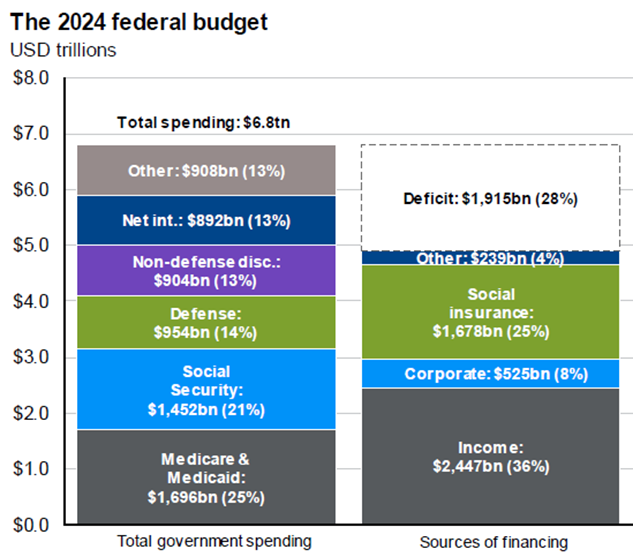
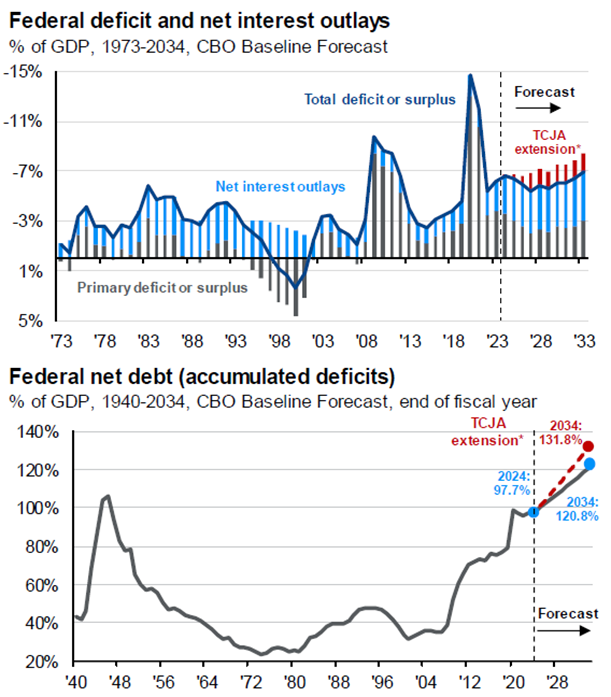
As you can see from the above, there are pluses and minuses in all cases.  The only consistent theme is that we’re likely to continue to borrow a lot of money to fund the Federal government.

Q: Who is going to win?

A: I’ve never been more confident in my conclusion in any previous election.  That conclusion: “I don’t know.”  On the polling side, things are really close and there are a lot of reasons one could infer that polls are undercounting voters on both sides. 

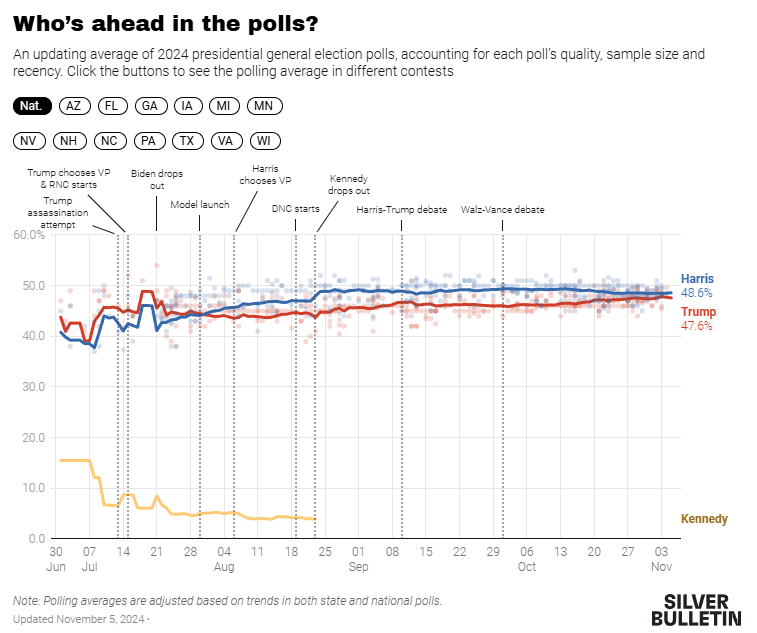
Nate Silver’s “Silver Bulletin” does a rigorous aggregation of the various polls, weighting by previous accuracy, by likely vs. registered voters, and by reported margin of error.  He then runs a model that simulates different results based on the polling aggregates as well as economic and demographic data and uses the simulation to determine the probability of each possible result.  His conclusion, as of 12:30am on Election Day Morning, after pouring through an insane amount of statistical data, was that Harris had a 50.015% chance of winning the election to Trump’s 49.985%. We can’t get much closer than that.

Prediction markets have Trump further ahead, but with some wild gyrations over the past several days.  His lead on Polymarket has been as high as 67-33, but currently sits at 59.7-40.3.  Kalshi favors Harris slightly more, with Trump ahead 57-43.  PredictIt, an older prediction market that imposes fairly small position limits, has a 50-50 tie.

I’ve been following an aggregator called The Super Model, which attempts to put this all together and come up with a weighted total forecast. They have Trump up 56-44.

My take: this is just too close to call.  That doesn’t necessarily mean the election will be won by a small margin.  It just means that the predictive data we have available doesn’t reveal a conclusion with any level of confidence.  The probability margins we’re talking about are equivalent to a 1.5 point spread in a football game.  It doesn’t mean the score is necessarily going to be that close, but that’s how close fair odds would be going in.

In summary, we’ll know a lot more in a couple of days about the politics of the next four years.  Regardless of the stock market’s short-term reaction, none of it is likely to outweigh the long-term economic growth potential of the US economy.  If you feel any election-induced anxiety about financial markets or your financial plan, try to zoom out to the big picture and the long-term.  There isn’t a result I can forecast that would lead to me issuing an “Election Warning” for your finances.  The 2024 Election will come and go like all the previous ones.  And then we’ll start hearing about the MOST IMPORTANT ELECTIONS OF ALL TIME to come in 2026 and 2028.

Election Blues (And Reds)

Given the market volatility around the 2016 election results and election day tomorrow, I thought it would be a good idea to do a Q&A-style post about the election and its potential impacts.

Q: Who’s going to win the presidential election?

A: There’s no way to know for sure at this point, and it’s pretty likely that we won’t know tomorrow night either. But, if you believe the polls and the work of statisticians such as Nate Silver (fivethirtyeight), Biden has about a 90% chance of winning. If you believe the betting markets, Biden has about a 60% chance of winning. These are two very different ways of analyzing the election probabilities. Analyzing the polls is essentially using the estimated margin of error in each poll and weighting the polls by their likely accuracy to determine the mathematical chance of the overall margin of error being big enough for Biden to lose and Trump to win despite the polling averages showing a lead for Biden on average. The betting markets on the other hand are showing the odds that a bettor on Biden would be willing to take (betting $3 for a chance to win $2 more) vs. what a Trump better would be willing to take (betting $2 for a chance to win $3 more). The betting is purely opinion-based and is an average of what all bettors think is going to happen in aggregate. It’s possible that both are somewhat skewed. I don’t really believe the hype around Trump supporters lying to polls, but it’s possible that they’re harder to reach to poll. It’s also well known that the betting markets are male-dominated and that Biden’s lead over Trump is much lower among men than women. Since people often bet in a way that favors what they’d like to see happen, that could skew the odds toward Trump’s side. If I had to guess, I would go somewhere in between and say that Trump has about a 30% chance of winning. That means I’d be willing to bet $3 to win at least $7 on him, or be willing to bet no more than $7 to win at least $3 on Biden. 30% is not zero. The favorite doesn’t always win, as we saw in 2016. A good baseball hitter gets a hit about 30% of the time. There are lots of hits in baseball. There are more outs though.

Q: What about the Senate?

A: 538 gives the Democrats about a 75% chance of taking control of the Senate (including a 50-50 split with a Democratic president), with the most likely scenario being 51-49. Betting markets. again, have the race closer with Democrats having a 60-65% chance of winning. The closest races are in GA (2), NC, IA, ME, and MT. Interestingly, the second GA senate seat is a special election to fill a vacant seat and has multiple candidates from both parties. If a majority isn’t reached, a runoff will take place on January 5, 2021. That could be the seat that decides control of the Senate and a runoff has a decent chance of happening at this point.

Q: What impact will the election results have on the stock market?

A: I don’t think that answer would be clear even if we knew today exactly how every race would turn out. That’s because there are so many potentially offsetting impacts. Here are some of the possible scenarios:

  • Biden wins, the Democrats take control of the Senate by several seats, and the Democrats keep decisive control of the House – corporate tax rates likely increase (clearly bad for stocks), taxes on higher income individuals likely increase (probably bad for stocks, at least short-term), higher regulation (probably bad for stocks, at least short-term), large stimulus package gets passed (probably good for stocks, at least short-term), more certainty (probably good for stocks), less pressure on global trade (probably good for stocks) less political angst (impeachment, oversight inquiries, etc… probably good for stocks).
  • Biden wins and the Democrats control the Senate and the House by a small margin – tax picture a little more blurry, regulation still likely to increase, still likely to get a large stimulus package, but allocation to state/local may be a bit smaller, still a boost to global trade, a little less certainty, still less political angst.
  • Biden wins and the Dems & Republicans each control one chamber – tax changes are unlikely (probably good for stocks as a relief to the alternative), smaller stimulus likely (probably bad or less good for stocks at least short-term), still a boost to global trade, more political angst.
  • Trump wins and the Dems control both chambers – tax changes very unlikely, large stimulus likely, much more political angst, and global trade challenges continue (worsen?).
  • Trump wins, the Republicans hold the Senate, and Democrats hold the House (status quo) – tax changes unlikely, stimulus likely smaller with less support for state/local and maybe a big battle to get it done at all, political angst steady, and global trade challenges continue (worsen?).

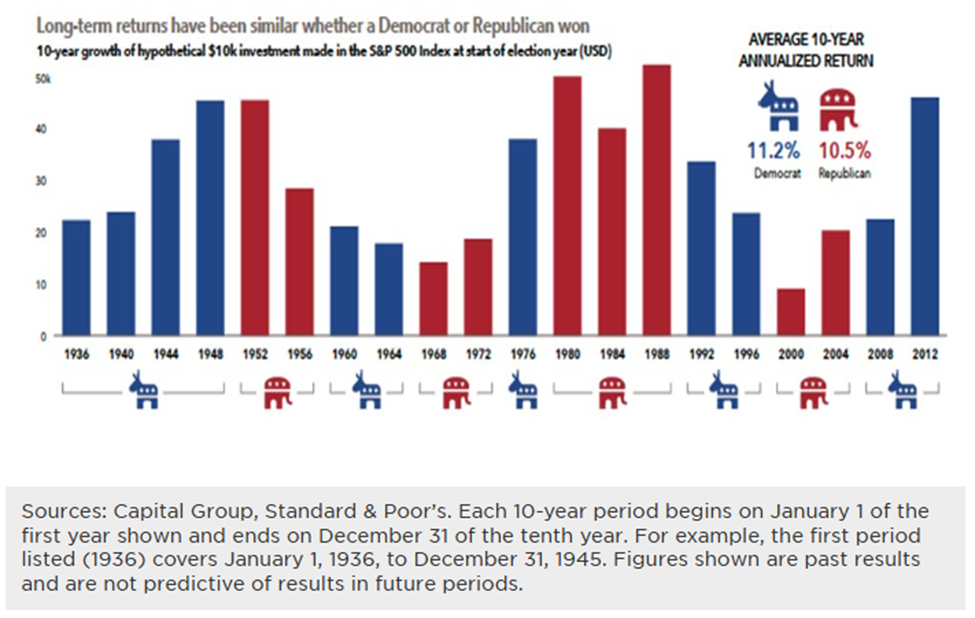
Longer-term, I really don’t think it matters who wins. Take a look at the chart below from Capital Group:

Sure, there are some dips in that chart, but for the most part it’s a steady upsloping line for 87 years regardless of party. By the way, I don’t think one can make any conclusions about which party is better for the market from that chart because the market prices in election results prior to the election and certainly prices in likely policy changes between election and inauguration. The takeaway should be that from a purely stock market perspective, if you zoom out far enough, it doesn’t really matter who wins a single presidential election.

Q: You said that we probably won’t know the result of the election tomorrow. Why not? When will we know?

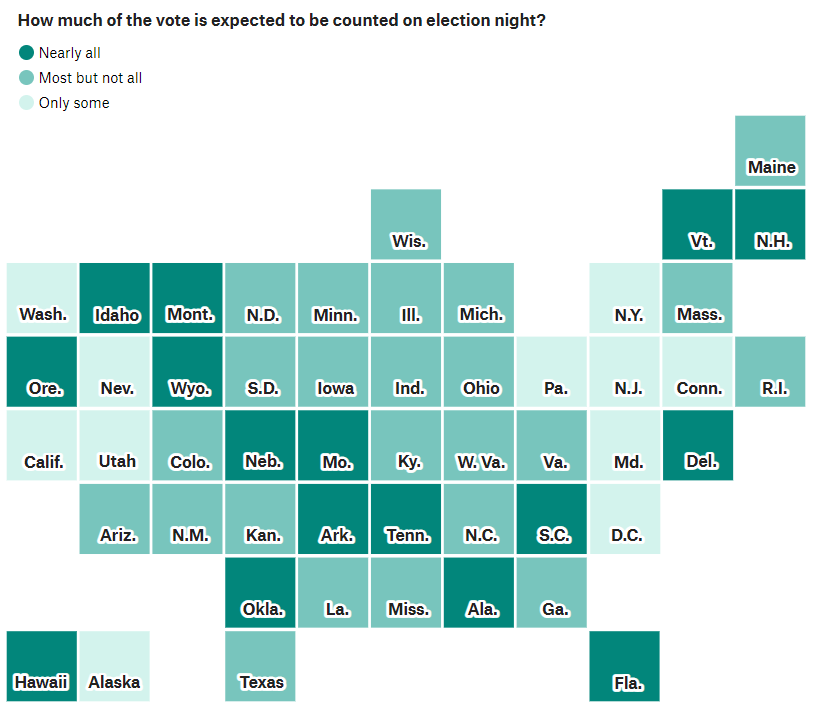
A: Each state has their own method of counting ballots. The NY Times recently attempted to summarize those methods. The battleground states have some significant differences. Florida, for example, has already counted many ballots received by mail and will release those counts along with in-person early voting by 8:30pm eastern. Election Day ballots will be counted through the night, but no additional mail-in ballots are allowed after 11/3. So we’ll know who won FL by 11/4 morning barring a 2000-like “hanging-chad” incident. Ohio also plans to release pre-election day votes 11/3 evening (by 8pm) and will count election day votes through the night. But, in stark contrast to FL, they will allow ballots postmarked by 11/3 and received by 11/13 to count, and then won’t provide updated results as those ballots come in. As of 11/2, officials say that full statewide results may not be known until the election is certified by the state on 11/28. Since the state knows how many mail-in ballots were sent out, it will know the maximum that could be received, but if neither candidate leads by enough to make it statistically impossible for the mail-in ballots to swing the results, it sounds like Ohio can’t be called until 11/28! 538 recently published a graphic with their opinion of the state-by-state portion of the vote that should be counted on election night:

There is a chance that one of the candidates will have enough of a lead in battleground states, that that ballots received and counted after 11/3 won’t matter and the election results could be known on 11/3 or 11/4. Again, we can rely somewhat on betting markets to gauge opinion of the probability. PredictIt has a wager on when the election will be “called” by both CNN and Fox News. That wager shows the odds of being called on:

  • Election Day = ~23%
  • November 4th = ~31%
  • November 5th = ~7%
  • November 6th or 7th = ~6%
  • Later in November = ~18%
  • December or later = ~15%

Personally, if I were a betting man, I like the combination of after 11/4 for better than even odds. Maybe that’s more of an emotional hedge though. I certainly hope for a result by the 4th!

Q: What’s the market going to do if we don’t know who won or if the election is contested?

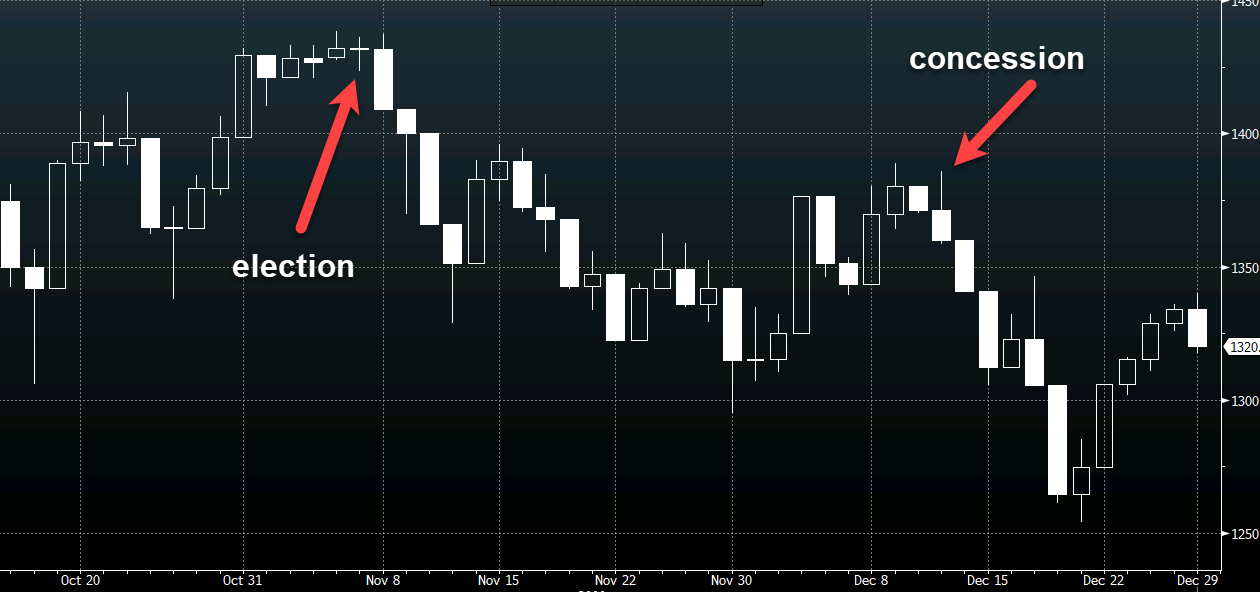
A: We know the stock market didn’t like the 2000 election result process (the FL “hanging chad” election), but it wasn’t exactly catastrophic, as the chart of the S&P 500 shows. It also wasn’t long-lasting.

A contested election that results in not only recounts, but lawsuits that potential swing a result from one candidate to another, etc., could be temporarily much worse. But it’s unlikely that an election with a large margin of victory would be contested and even lower chance that it would reverse the result. So, a very close election with no clear result, that leads to social unrest could certainly hurt financial markets temporarily. Some unrest is likely no matter what the result given current political polarization. The less clear the result is and the more it seems to change, the higher the risk of extreme volatility. I have a high degree of confidence that the next president will be inaugurated on January 20th, regardless of how the election goes. With all of that said, the stock market does a very good job of factoring-in event probabilities and their impacts (including support by the Federal Reserve if things really go off the rails). That means the market is likely to respond very positively, all else being equal, to a clear winner. There’s no way to game the system without a crystal ball or time machine.

Q: Give it to me straight, all-in-all is tomorrow night going to be a mess for the stock market?

A: If you define mess as volatile (bouncing sharply in either/both directions), I’d say that’s much more likely than on an average night. If you define mess as the market falling sharply, I don’t think anyone knows in advance. The better question though is whether what happens tomorrow night matters. I made this short post at about 11pm on election night 2016. Stock futures were down 4.5% at the time and got slightly worse as the result became clear. By 8am, futures were barely down. By the close on 11/9, stocks closed up a little over 1% from the election day close, completely reversing the overnight pullback. By the end of 2016, they were up almost 10% from the day of the election and even now, mid-pandemic, they’re still up over 50% (S&P500) from that election. People are on edge over the election for reasons that far outweigh finance. I get it. The moral of the story here is that there’s little/no reason to let predictions of, or even actual, stock market volatility add to your anxiety.

To summarize:

  • For the markets, the election is all about probabilities. While Biden is favored to win and the Democrats are favored to narrowly take the Senate, neither is anywhere near a sure thing.
  • There are dramatic, offsetting impacts to the economy and financial markets, at least short-term, in every possible scenario. Each is currently priced in, probability-weighted.
  • It may take a while for election results to unfold with certainty.
  • It may be chaotic in the markets for a while and that could include big down or up moves as a clearer picture of the future arrives.
  • Long-term, the 2020 election barely matters from a financial point of view. If you’re feeling anxious, try to zoom out for perspective. Stick to your plan. Things are going to be ok.

Note: Many of the links in this post are being updated periodically with new information as election information evolves (538, NY Times, etc.).

DC Crisis Averted

I don’t usually like to call the result of a game before it’s over.  But in this case I’m confident saying that the deal reached in the Senate today, which does nothing other than re-open the government through 1/15/14 and extend the debt limit to around 2/7/14, is a done deal.  The Senate is expected to vote around 6pm tonight (80+ will vote yes) and the House will vote a few hours later (I’d guess at least 65% will vote yes).  The President will likely sign the bill tonight, reopening the government by morning.

The crisis that never really was a crisis has been averted, miraculously (HA!), one day from the reported deadline.  Fear-mongering, yet again, served no purpose other than ratings and scaring people into making terrible financial decisions.  As I’ve been saying all along, there was a 0% chance of default or any permanent damage to the economy that would result from it.  Minor, temporary damage has been done though shaking the confidence of businesses and consumers, but we’ll recover from that.  However, nothing has been done to pass a budget and make the country’s long-term fiscal situation sustainable.  Over the next 3 months, which will include time off for holidays, Congress has to make some progress, or we’ll be right back in the same situation again with another “crisis” to start 2014.  We’ll see what they come up with.

For now, back to business as usual with the hopes that the last few days don’t become the new business as usual.

***Update, 11pm eastern time***

Senate passed bill 81-19 (I predicted 80+).  House passed bill 285-144 (66.4% vs. my 65%+ prediction).  Obama to sign momentarily.  Government will be open in the morning.  Debt limit extended to 2/7.  25 hours to spare from their 10/17 deadline.  Congress is getting better at this!

Quick Update On Debt Ceiling

For those not following via Twitter, here’s what I posted today:

4pm: The storm before the calm is building in DC. Gotta take the country to the brink so they can be heroes in bringing it back.

4pm: I’d say we’re two plans away from having a plan to pass a bill that sets guidelines for developing a plan before the next deadline #cankick

7pm: Another failed plan in the House. I think we’re one away from real deal now (with little substance but will avert the “crisis”)

Still confident a deal will come right before it has to (and that’s not 10/17 as is being reported), and the US will not default on its debts.  As I’ve been saying, the result would be so catastrophic, that no one in Congress will let it go that far and the President / Treasury will use all possible measures to make sure it doesn’t happen.  Fitch ratings agency put the US on credit watch negative meaning there’s risk that they would downgrade the US Debt in the future.  Immediately after, the orchestrated response was released by Treasury explaining how Fitch’s actions demonstrate the gravity of the situation.  Everyone knows this will get resolved, but the fear-mongering will continue in the press for the next few days.

What happens beyond the agreement is a potential issue.  Further short-term agreements, followed by a “crisis”, a shutdown, a threat of default, and then a kicking of the can again in another short-term agreement, will cause a broad loss of confidence in the US government and financial system.  If we keep managing “crisis” to “crisis”, we will eventually be faced with a CRISIS.  We’re not there yet, but it’s not that far off if this continues.

If you’re not following via Twitter, I encourage you to do so as I’ll post short bursts of relevant news or a quick thought here and there.  @TomAtPWA.

US Debt Default

More political posturing today as President Obama and House Speaker John Boehner both had press conferences to say pretty much exactly what they’ve said for the past two weeks. They’re saying it louder and more sternly each time, giving it full grandstanding effect. Obama won’t negotiate unless Republicans pass a Continuing Resolution and raise the Debt Ceiling, which is like asking them to leave all their chips outside of the poker game. Boehner won’t allow a clean Continuing Resolution or Debt Ceiling bill to be voted on in the House, even though they would almost certainly pass, without some negotiation on spending reductions or Obamacare concessions attached to it. In other words, they have a complete standoff.

I expect more of the same for another week or so, but I don’t think the sands running out of the hourglass come with a proportional increase in the chance of a US debt default. Since there is virtually no chance that a resolution will be reached until the last minute (likely a few minutes after the last minute), the probability of non-resolution should not increase as time passes. Financial markets don’t believe there will be a debt default. Countries, companies, and individuals continue to lend money to the United States at absurdly low rates (essentially 0% for a year, 1.4% for 5 years, 2.6% for 10 years, and 3.7% for 30-years!!). The chart below shows credit default swaps (CDS) on five-year treasuries in basis points. CDS pay out in full in the event of a default. 41 basis points means that people are paying 41 cents for protection on $100 of treasuries implying a four tenths of one percent (e.g. negligible) chance of default over the next five years. While slightly elevated from a few weeks ago, 41 basis points is actually about the average over the last four years, and still substantially lower than the 65 basis points during the 2011 debt ceiling “crisis”. Today, even after the grandstanding, those same CDS actually traded down to 37 basis points.

I’m not worried about a default, just like financial markets aren’t worried about it. I’m not worried about 11:59pm on October 17th either, because that is not the exact moment that a debt default would happen if the Debt Ceiling isn’t raised (ironically, the govt. shutdown has slowed spending for the last week, so there should be a bit more wiggle room). I’m confident the debt ceiling will be raised just before it needs to be raised. I really only worry about self-fulfilling feedback loops that occur in a negative direction (like the death spiral that occurs when businesses layoff workers in mass which results in less spending in aggregate in the economy which results in lower profits which results in more layoffs). I don’t worry about those things that provide a self-regulating effect. In this case, any increase in the probability of default would lead to an increase in the probability of politicians being held directly responsible for another deep recession, which leads to the sudden ability to be rational, compromise, and save their future jobs.

The stock market will continue to be jittery as program trading, momentum trading, and day trading dominate day-to-day volume and direction of movement. I have full faith that there will be no default and no permanent damage to the economy. When that becomes certain, the economy in aggregate, the actions of the Federal Reserve, and the profitability of individual companies will once again dominate the way the market is valued. I’m not making any changes to client portfolios or asset allocation models in general as result of the debt ceiling / continuing resolution “crisis”. As the old proverb states, this too shall pass.

Here We Go Again… But Not Quite

As you all know by now, there’s a chance that the Federal government will be shut down as of midnight tonight due to lack of authority to fund it. This lack of authority comes from the fact that there is no budget and the law that allows Congress to temporarily continue to spend without a budget (known as the Continuing Resolution) is expiring. Just to be clear, markets continue to provide the Federal government with virtually any amount of financing they want/need to run the country. Obtaining money IS NOT an issue. This shutdown would be strictly due to Congress’s inability to pass a law to permit themselves to continue to spend money. It really is silly, no matter what side of the aisle one supports, but it’s the way our country works.

I’m not as confident in this getting resolved in time as I was in the Fiscal Cliff getting resolved at the 11th hour last year. However, here we’re not talking about laws that would dramatically change without action as we were with the Fiscal Cliff. We’re talking about the Federal government’s ability to perform its non-essential tasks temporarily. They’ve already indicated that all essential tasks, including those related to public safety, will go on even without a Continuing Resolution. The government has shut down numerous times in the past with negligible impact (to the point that most people don’t even remember the prior shutdowns). As long as a Continuing Resolution is passed at some point in the next few days or even weeks, there will be little to no lasting impact beyond the clear demonstration to the world, to businesses, and to individuals that our government has become inept.

Coming up shortly after this Continuing Resolution debate will be the Debt Ceiling debate. On or around October 17th, the Treasury will hit the current legal debt limit and will be unable to borrow money to fund the operation of the government and, more importantly, to make interest payments on its outstanding debt. Again, a government shutdown probably wouldn’t have a big impact as long as it only temporarily impacts non-essential services. Missing an interest payment, however, would have serious ramifications to the economy and global financial markets. In the order of increasing impact hitting the Debt Ceiling would:

  • Threaten the full faith and credit of the United States as lenders may consider the fact that we don’t make timely payments on our debt and may hesitate to lend us money in the future or demand higher interest rates in order to lend that money. I’d say this is a fairly small issue overall, as the U.S. Dollar / U.S. Treasuries are still going to be considered the strongest and safest place to put money.
  • Indicate how dysfunctional our government has become when it comes to problem solving, perhaps threatening confidence in U.S. growth and long-term solvency, especially considering the fiscal issues that need to get resolved in the coming years (Social Security and Medicare for example). This could definitely has some impact over our ability to borrow at low rates in the future.
  • Mean a technical default on our debt. While this seems the most trivial of all, especially knowing that it would only be temporary, this is the biggest issue because of all the derivative securities like credit default swaps (CDS) that are outstanding on U.S. debt. CDS are essentially insurance contracts that state that if a particular debt instrument defaults, the CDS would pay out a fixed amount as insurance against that default. A default on US Treasuries that is caused by a missed interest payment, no matter how temporary and technical in nature, would likely trigger at least some of those contracts to pay out. CDS are a highly unregulated part of the financial markets and there’s no telling how many of these contracts have been written and who’s on the hook for making payments in the event of a default. It is highly likely that some financial institutions would have to make large enough payments that they could fail. This is virtually the same problem that occurred with the ’07-’08 financial crisis and could result in a repeat of fallout we saw from Bear Sterns, Lehman, and AIG falling apart at that time.

Because of the severity of the impact of hitting the debt ceiling, it’s obviously a much bigger issue than the government shutdown that may begin tomorrow. Markets have started to react. They are pricing in the fair probability but relatively small effect of a government shutdown. They’re also starting to price in the very low (but not zero) possibility of hitting the Debt Ceiling in a few weeks (if we can’t solve the simple issue of the Continuing Resolution, it must mean that there’s an increased chance of not being able to solve something more complicated like the debt limit… that’s how the markets look at this). Regardless of what happens tonight, tomorrow, and in the coming days around keeping the government running, I’m very confident that the debt ceiling issue will be resolved in some manner without a default. Market will be volatile (down and up) over the next few weeks. A game of chicken in Congress will develop. Nothing will get resolved until it absolutely has too. Those are virtual certainties. What’s also certain, despite what the media will present over the next several hours, is that life will go on tomorrow with or without non-essential services from the Federal government.

Congress needs to get its act together. However, it doesn’t need to do it tonight. That lack of urgency, despite media representations, is what very well might prevent them from getting it together tonight. High media interest in something that really isn’t a crisis is the perfect opportunity for grandstanding and that’s what it looks like we’re getting.

Market Update (07-26-2011)

*** We believe communicating with our clients is of utmost importance, especially during turbulent times in the market. While we don’t claim to have a crystal ball on the future of any financial market at a given point in time, we do believe that keeping clients informed on why things are happening increases their comfort level and understanding. This post contains a message initially sent to clients with the debt ceiling fiasco on the horizon as part of that communication effort***

Given the press coverage around the debt limit issue, I thought it would be useful for you if I gave a quick update as to what’s going on. Long-time clients will remember messages like this one that I sent frequently during the post-Lehman Brother’s bankruptcy era and around Congress’s shenanigans regarding the passage of what eventually became known as TARP. Even though no change or action is required by you, I think staying informed helps people sleep better at night during a potential crisis. So here goes…

We’ve all heard August 2nd is the deadline for raising the debt ceiling or the U.S. will not be able to pay its bills. At the same time, politicians seems to be getting further from an agreement on how to raise the debt ceiling instead of getting closer to one. Much of the press will have you believe that if the debt ceiling is not raised by August 2nd, life as we know it, will not go on and yet the urgency to raise the ceiling doesn’t seem to be there given that 8/2 is a week away. There are three things wrong with that presentation.

First, August 2nd is not the date at which the U.S. will stop paying its debts and run out of money. It is a date that the treasury secretary estimated several weeks ago based on the pace of expenditures and tax revenues. As it turns out, revenues have been higher than projected and the real date appears to be closer to August 10th. Congress is supposed to take their next recess (read: vacation) starting August 6th, so the 2nd was a much more convenient political deadline. There are also Social Security payments which need to go out on August 3rd, debt principal payments that need to go out shortly thereafter, and interest payments that need to be made to Treasury holders later in the month so that crisis is real and important. It’s just not as urgent as the talking heads would make it seem and so the lack of urgency in resolving the crisis is because there is more time that most people realize, even if it is only another week.

Which brings me to point number two. When you’re playing a game of chicken, and by all means that’s what we have here between the politicians, you always have to seem more confident in your path as you get closer to the end game. “I’m not going to move.” “I’m not going to move either… you’ll realize you’re going to move”. All the back and forth as the two get closer to a head-on high-speed collision. It’s not until the very last second that one or both parties are actually ready to move. Therefore, I expect little movement and the appearance of no chance of a deal up until the last few days of the debate. As of yesterday, both parties have put their stake in the ground followed by a stomping of their feet and a “take it or leave it” statement. The soap opera couldn’t be written any better. One or both parties will move as the threat of collision becomes imminent.

Finally, and most importantly, if the U.S. were insolvent and unable to pay its bills, a global financial catastrophe would take place well in advance of the last few cents coming out of the piggy bank. I won’t go into the goriest of details, but basically it would start a panic that U.S. Treasury Bonds were worthless (i.e. those who lent to the U.S. government would permanently stop getting their interest payments and lose their principal). This would make all of the banks and other financial institutions across the world that hold Treasuries potentially insolvent. Within days if not hours of this realization, there would be no more ATMs, no open banks, most money would be worthless, and the world economy would cease to exist. OK, maybe that is pretty gory…. Deep breath… Let’s look around though. We’re a couple of weeks away from potentially not paying our bills and none of this is happening. The U.S. Treasury today auctioned off $35 billion of 2-year notes. The annual interest rate demanded by the auction was 0.417%. That means investors were willing to lend the U.S. government $35 billion dollars today for less than a half penny of interest on every dollar each year for the next two years. Would they really do that if there were any chance of not being paid back? The answer is “no” and the reason is that the U.S. is not insolvent. People, institutions, and countries are scrambling to try to lend us money because we are the safest place in the world to put money. At that same auction, there were bidders for over $100 billion of that $35 billion in debt. The point is that even if lawmakers on both sides don’t give in (and that won’t happen) and the debt ceiling is reached (and that won’t happen) and all other avenues for paying bills are exhausted (and that won’t happen) and we really do legally run out of money because of the debt ceiling (and that won’t happen), the ramifications will be so huge, so fast, that both sides will scramble to save the day almost instantly with a simple act of raising the debt ceiling. One vote, 5 minutes to end the end of the world and this crisis is over. The U.S. is not insolvent and will pay its bills.

The bigger issue, which I’ll save for another update is far more important. We’re on a fiscal path to insolvency and unless that trajectory is corrected, our debt will no longer be the safest instrument in the world. Our borrowing costs will rise, rapidly, and the impact on the economy will be severe. Imagine the value of your house today if someone had to pay 10% for a mortgage to buy it. That has to be corrected and in principal, tackling the beginning of that correction as part of the agreement with ourselves that we’ll increase the debt limit makes some sense. But in the end, whether it happens or not, the debt limit will be raised and life will go on. Unfortunately, politics and the media’s over-dramatic reporting of those politics will go on with it.

If anything changes over the next few weeks that warrants action on your part, I’ll be sure to let you know. As always, if you have questions or comment, please feel free to contact me.