Dec 2020 COVID Relief

This one hasn’t gotten a fancy name yet (that I know of) like the CARES Act since it is attached to the 2021 Consolidated Appropriations Act (the “2021 spending bill” that funds the government), so I’m just referring to it as the Dec 2020 COVID Relief Bill. It was signed into law on 12/27/2020 and consists of ~$900B of funding, not to be confused with the $1.4T in general “keep the lights on” type funding in the rest of the Act. The full Consolidated Appropriations Act is 5,593 pages. I cannot claim to have read the whole thing. However, I’ve skimmed through it and read enough summaries now to feel comfortable calling out the top line virus-related items and the key tax and personal financial planning items for you. This list below includes the COVID Relief Bill portions, the relevant tax and financial planning-related items from the rest of the Act, and a few other callouts. Here goes:

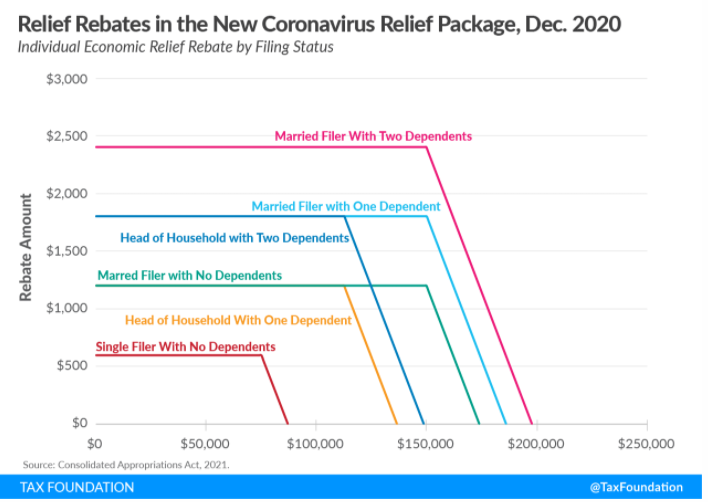
  • Direct Payments (“stimulus checks”) – ~$170B for direct payments to taxpayers. $600 per individual earning $75k or less, or $1200 per couple earning $150k or less, +$600 per dependent child under age 17 (e.g. $2400 for a family of 4 earning $150k or less). Above the $75k/150k threshold, the payment amount drops by $5 for every $100 of income until it is completely phased out. Income used is the lower of 2019 or 2020. Payments will be sent out by direct deposit or check based on 2019 income, but can be trued up on the 2020 tax return if income was lower or more children were born. For more details, see this fantastic article from Forbes, and this nifty chart from the Tax Foundation
  • Unemployment Benefits – $120B. extends emergency Federally funded benefits (including that for self-employed) for 11 weeks and provides a $300/week Federal amount in addition to existing state-provided benefits.
  • Paycheck Protection Program (“PPP”) – $284B extends PPP v 1.0 and issues a new round of funding for PPP v2.0 Additionally, reverses the IRS interpretation that business expenses used to qualify for PPP forgiveness were not deductible. They clarified that those expenses are deductible. It also broadens the list of qualifying expenses for forgiveness to include operating expenses, supplier costs, property damage costs, and PPE expenses, still subject to the limitation that non-payroll expenses cannot exceed 40% of the forgiven loan amount. Not exactly auto-forgiveness for small loans (many were calling for this), but the Act does tell SBA to create a one-page form to apply for auto-forgiveness (*smacks my head*) for loans < $150k. Side note: Auto-forgiveness = Ease of use as the main course, but with a large side of increased fraud. I think this auto-forgiveness means that an applicant would get forgiveness even if payroll was reduced during the covered period, so long as the PPP money wasn’t used improperly and no fraud was involved. PPP v 2.0 is for businesses w/ < 300 employees (<500 if accommodation or food service) and that had at least one quarter of 2020 with revenue at least 25% lower than the same quarter in 2019. Max loan is $2M or 2.5x avg monthly payroll whichever is less, (3.5x for accommodation or food service).
  • Vaccines, Testing, Health – $63 billion for vaccine distribution, testing and tracing, and other health-care initiatives, most of which will be administered by the states.
  • Transportation – $45 billion for transit agencies, airlines ($15B specifically allocated for airline payroll support), airports, state departments of transportation, and rail service.
  • Education & Childcare & Broadband Support – $82B in funding for colleges and schools, including support for HVAC upgrades to mitigate virus transmission + $10 billion for child care assistance + $7B for enhanced broadband access.
  • Nutrition & Agriculture – $26B for food stamps, food banks, school/daycare feeding programs, and payments, purchases, and loans to farmers and ranchers impacted by covid-related losses.
  • Rental Assistance – the eviction moratorium is extended through 1/31/2021 (for now). $25B is authorized to help troubled renters and landlords by paying future rent and utilities as well as back rent owed or existing utility bills.
  • SBA Loan Relief – The CARES Act authorized SBA to pay up to six months of principal and interest on existing Section 7 SBA Loans for impacted borrowers. This Act extends that by another three months.
  • Economic Injury Disaster Loans (EIDL) – $20B in additional funding for businesses in low-income communities + $15B of dedicated funding is set aside for live venues, independent movie theatres, and cultural institutions.
  • Credit for Paid Sick + Family Leave – this was created by the Families First Act and is now extended through 3/31/2021 (was 12/31/2020).
  • Employee Retention Tax Credit – created under the CARES Act, is extended through 6/30/2021 and improved. It’s now up to 70% of wages capped at $10k of wages per employee per quarter, instead of 50% capped at $10k in total. Business qualifies if revenue for the quarter was down at least 20% from the same quarter in 2019. Important: it appears this credit is now allowed along with a PPP Loan (under the CARES Act, it was one or the other), though you still can’t double count the same wages for the credit and PPP forgiveness.
  • Payroll Tax Deferral – the president signed an executive order in September allowing employers to opt in to a payroll tax deferral for employees. Almost no one did (except the government) because it was too risky on the employer and deferral for a few months was pretty meaningless. Those that did were supposed to repay the deferral by 4/30/2021. That has now been extended to 12/31/2021, giving more time to spread out the payback.
  • Lookback for Earned Income Tax Credit and Refundable Child Care Credit – taxpayers can, but don’t have to, use 2019 income instead of 2020 income to qualify for these in 2020.
  • Residential Solar Tax Credit – this was reduced to 26% of the cost of the project in 2020, scheduled to drop to 22% in 2021, and then eliminated after 2021. The Act extends the 26% credit for 2021 and 2022, dropping to 22% for 2023. It is now eliminated in 2024, unless additional legislation is passed.
  • Employer Paid Student Loans – Employers can continue to give up to $5250 per year tax-free to employees for student loan principal and interest repayment (either direct to the loan or to the employee to pay the loan). This is extended through 2025 (was set to expire at the end of 2020).
  • Tuition Deduction / Lifetime Learning Credit – The tuition deduction, unless extended in other legislation, is gone. Instead, there is now a higher income threshold for the Lifetime Learning Credit, now sync’d up with the American Opportunity Credit phaseout ($80-90k single / $160-180k married).
  • Student Loan Payment Forbearance – this WAS NOT extended in the Act. Student loan payments resume 1/1/2021.
  • Retirement Plan Distributions / Loans – The CARES Act allowed up to $100k of distributions from retirement plans for covid-impacted individuals, waiving the 10% penalty, and allowing the amounts to be repaid over 3 years such that no net tax would be owed. It also raised the 401k loan amount to the minimum of $100k or 100% of the balance (from $50k or 50%). These were effective through 12/30/2020. This treatment is now extended to non-covid-related Federally declared disaster areas between 1/1/2020 and 2/25/2021 where the individual has their principal place of residence and is economically impacted by the disaster.
  • Retirement Plan Required Minimum Distributions – these were waived by the CARES Act for 2020. This WAS NOT extended by the new Act. RMDs will be required for 2021 unless additional legislation is passed.
  • Medical Expenses Deduction – the deduction for medical expenses has been bouncing back and forth between a 7.5% AGI floor and a 10% AGI floor for years. It’s 7.5% for 2020 and was supposed to revert back to 10% for 2021. The Act sets this to 7.5% PERMANENTLY. One thing I can stop writing about every year!
  • Mortgage insurance premiums – remain deductible for another year through 2021.
  • The taxability of forgiven housing debt (foreclosure/short-sale) – is extended to 2025, but the amount is reduced to $375k single / $750k married.
  • Charitable Giving – The $300 charitable contribution deduction for those who don’t itemize is sticking around for 2021 now and joint filers will get $600 instead of $300 for 2021. Remember this is for cash donations only and donations to a Donor Advised Fund don’t count. And, the cap on the portion of your income you can give via a cash donation (other than to a Donor Advised Fund) and deduct stays at 100% for 2021.
  • Healthcare & Dependent Care Flexible Spending Account (FSA) flexibility – The Act allows plans to allow 2020 unused amounts can carryover to 2021 and 2021 can carryover to 2022. Additionally, the Act allows 2021 elections to be modified even though benefits enrollment is now closed for most employees. However, this only updates what the law will allow employer plans to do. The plans themselves would have to adopt the change in order for employees to be able to use the increased flexibility. Check with your benefits rep to see if your plan is adopting / has adopted the change.
  • Educator’s Deduction – this is the $250 per year that teachers get to deduct for money spent on school supplies for their classrooms (as if that’s all teacher’s spend on their classrooms). PPE and cleaning supplies now qualify for that $250.
  • Business Meals – for business owners, restaurant meals are 100% deductible for 2021 and 2022 (formerly only 50% deductible) as long as they meet the requirements of the previous 50% deduction (i.e. non-lavish, taxpayer is present, etc.). Note that this still does not include employee expenses, only schedule C filers. Applies to dine-in or take-out.
  • Surprise Billing Fix – an attempt to reduce the amount of “surprise billing”, which typically occurs when a patient goes to an in-network facility and uses an in-network doctor, but is provided services by an out-of-network provider along the way (e.g. anesthesiology, transportation, etc.). There are lots of carve outs and exceptions, so I’m skeptical of how much this really fixes, but it’s a start at least, going into effect in 2022. I’m sure much more will be written on the implications here soon.
  • Financial Aid Changes – Student Loan Application (FAFSA) simplification – lots of changes here, but they don’t go into effect until 2023. In the interest of time, I’ll table this one for now. Just know there are changes coming. Additionally, the number of Pell Grants will be increased.

In order to reach a bipartisan agreement, both of the following WERE NOT INCLUDED in the Act:

  • Business liability protection (i.e. can’t sue if you get covid at a business as long as they were following CDC guidelines), which Republicans wanted
  • State and Local Aid above and beyond that specifically budgeted for the items in the Act, which Democrats wanted.

I suspect there will be more to come, though the type of relief/stimulus likely depends on the outcome of the GA Senate run-offs. There is already a proposal to increase the $600 direct payments to $2000, supported by the House and the President, but that will have a difficult time in the Senate. We’ll have to wait and see what happens.

Coronavirus Aid, Relief, and Economic Security (“CARES”) Act

This week Congress passed and the president signed into law the CARES Act. This 335-page (840 under bill format), $2 trillion dollar piece of legislation contains a LOT of complicated provisions. I’ve skimmed through it and read multiple commentaries in detail to try to create a summary of the financial pieces that are most important to PWA clients. As always, there will be a lot of interpretations, details, and guidance that will follow from the IRS, the Dept. of Labor, the Treasury, SBA, etc. Here’s what I understand at this point:

· Direct Payments to Individuals – $1200 for individuals ($2400 for joint taxpayers) that are not dependents of another taxpayer + $500 for each child under age 17. The payments are reduced if income exceeds $75k (single), $112,500 (head of household), or $150k (joint), by $5 for every $1k in excess of the threshold (see the Tax Foundation’s excellent graphic on how this will work). For threshold income, the IRS will use 2019 adjusted gross income (AGI) for the initial payment. If you haven’t filed your 2019 return by the time the payment is calculated, they’ll use 2018 instead. The amounts you receive with then be reconciled against income on your 2020 tax return. If you should have received a payment based on 2020 income but did not, you’ll get the excess as a credit on your 2020 return. If you received more than you should have based on 2020 income, my understanding is that you will not have to repay the difference. Because of this, it may be best to make sure you get your 2019 tax return in ASAP if you’d qualify based on 2019 income, but not 2018 income, or to delay 2019 if you’d qualify based on 2018 but not 2019. These direct payments will be made by 4/6/2020 via direct deposit on file with the IRS as of the latest filed tax returns, or along with Social Security payments if you receive Social Security, or by check if you don’t receive Social Security and there is no direct deposit information on file or if the direct deposit information cannot be used for some other reason. The IRS is going to provide a phone number for issues around payments that aren’t received but should have been received. If you just cringed/laughed at the idea of millions of people potentially calling one IRS number and sitting on hold for days, so did I. It is what it is.

· Expanded Unemployment Benefits – $600 / week increase in benefits + 13 more weeks of benefit available + an expansion of benefits to those who normally don’t qualify (self-employed, independent contractors, and those with limited work history) + elimination of the one-week waiting period. Note that the average unemployment compensation amount prior to this expansion was only $372 / week nationwide, so an additional $600 / week is significant. For some workers, it may even be more than they were earning while working.

· Partially Forgivable Small Business Loans – The “Paycheck Protection Program”. $350 billion authorized. Businesses (including sole-proprietors and independent contractors) with 500 employees (full or part-time) or less, can borrow up to the lower of $10M or 2.5x monthly payroll (avg of the last year), excluding any amount over $100k per year for each individual. Self-employment income supposedly counts as payroll. I would venture to guess that S-Corp profits do not, since they don’t pay payroll taxes. Loan proceeds can be used for payroll support, employee salaries, mortgage payments, rent, utilities, and any other debt obligations incurred before the covered period. Loans are non-recourse (no personal guarantee or collateral needed) unless the proceeds are used for a non-approved purpose. Interest can’t exceed 4%. Loans can be for up to 10 years. Borrowers will be eligible for loan forgiveness for an amount equaling payroll (max $100k per employee) and operating costs for the first 8 weeks after the loan is issued. However, the loan forgiveness is subject to maintaining the same number of employee equivalents (FTEs) from 2/15/2020 to 6/30/2020 as it had in 2019 or from 1/1/2020 to 2/15/2020 and not cutting salaries/wages for those earning $100k or less by more than 25%. If you don’t maintain payroll, loan forgiveness is reduced / eliminated by a very complicated formula that isn’t clear to me. Please see this brochure produced by the Chamber of Commerce with more details on these loans. More great information is available in this Forbes article from 3/28, including some of the unanswered questions, specifically around how all of this works for businesses with no employees (like independent contractors). There are lots of open questions. If you own a small business, stay tuned for more info soon from the SBA, along with a list of eligible lenders that will facilitate the loan. These loans are going to be administered by the SBA which currently has nowhere near the manpower to handle what’s being asked of them (my opinion). The CARES Act recommends that SBA direct lenders to “prioritize small business concerns and entities in underserved and rural markets, including veterans and members of the military community, small business concerns owned and controlled by socially and economically disadvantaged individuals, women, and businesses in operation for less than 2 years.” I suspect there will be a lot of “first-come-first-served” prioritization as well, so getting to the front of the line once lenders are ready to accept applications could mean a lot if your business is dependent on this program for survival. You must apply by 6/30/2020 to be eligible for one of these loans. Keep in mind that there is an existing program via the SBA that has nothing to do with the CARES Act which is already available to provide loans up to $2M to small businesses impacted by covid-19. You can find more information at https://www.sba.gov/page/coronavirus-covid-19-small-business-guidance-loan-resources, under the topic for Economic Injury Disaster Loan Program. The CARES Act also provides funding to lenders who agree to forbearance on existing SBA loans during the covid-19 emergency.

· Larger Business Loans – $500 billion authorized. Direct loans to corporations or via purchase in primary or secondary markets. Directed by Treasury with oversight from a bipartisan congressional oversight committee. A limited portion is made available for airlines, air cargo carriers and businesses critical to maintaining national security. Borrowers must be created, organized and have a significant presence in the United States. All loans are supposed to be secured and are intended for businesses that don’t have reasonable access to other credit. Borrowers can’t buy back their own stock, issue dividends, or reduce their workforce during the term of the loans. There are also compensation caps for highly-paid employees during the term of the loan. While the terms of the loan are at the discretion of Treasury, they must come along with a warrant (long-term term right to purchase stock at a fixed price), equity interest, or senior debt instrument. These are intended to compensate the government for the loan. Proceeds pay for the program, with any excess going to Social Security. Any company where a controlling interest (defined as over 20 percent of controlling stock) is held by president, the vice president, executive department head, or Member of Congress or their families is rendered ineligible for financial assistance in the form of loans or investments provided under the CARES Act.

· Employee Retention Tax Credit – Credit for businesses that were impacted by covid-19 (government stay-at-home orders, restrictions on operations, or at least a 50% decline in year-over-year revenue for at least one quarter). The credit is for 50% of the first $10k of qualified wages paid to employees between 3/12/2020 and 12/31/2020. For businesses with more than 100 employees, qualifying wages are those paid to employees while they’re unable to do their job. For those with 100 employees or less, qualifying wages are all wages paid. Employers who receive a loan under the “Paycheck Protection Program” are not eligible for this credit.

· Employer Payroll Tax Delay – employers can delay paying their half of payroll tax on wages for the remainder of 2020 to 2021 and 2022 (half each). Does not apply if the employer receives forgiveness of any loan made under the “Paycheck Protection Program” provisions described above.

· Retirement Plan Early Distributions – new hardship withdrawals up to $100k allowed for those with covid-19-related needs. The 10% penalty is waived. Tax is still due, but it can be spread over three years (it will be spread over three years by default, unless you elect out). You can also recontribute the amounts that were withdrawn within three years and face no additional tax. The re-contributions are not subject to the IRS contribution limits for any given year. To qualify, you have to get the virus, a spouse or dependent does, or you have to have virus-related financial difficulty which is pretty liberally defined (laid off, furloughed, hours reduced, income reduced, can’t work due to childcare needs, etc.).

· Retirement Plan Loans – increases the size of allowed loan to 100% or $100k, whichever is less from the current 50% or $50k, whichever is less. Loan payments due between 3/27/2020 and 12/31/2020 can be delayed for up to a year.

· Retirement Plan Required Minimum Distributions – these are suspended for all retirement plans and inherited retirement plans for 2020.

· Employer Payments For Student Loans – Up to $5250 of employer payments toward employee student loans would not be considered taxable to the employee.

· Individual Student Loan Payments – Federal student loan payments can be suspended, interest-free, through Sep 2020. Borrowers may need to take action though to stop any scheduled recurring payments (if desired). They may not be stopped automatically. No credit reporting impact.

· Mortgage Forbearance – individuals/families impacted by covid-19, with Federally-backed mortgages (FHA, Fannie, Freddie, VA, etc.) can request forbearance (no payments) for up to 180-days. If necessary, this can be extended by an additional 180-days. No penalties apply during forbearance, though interest continues to apply as scheduled.

· HSA/HRA/FSA Qualified Expenses – modified to allow over-the-counter drugs, not just prescription drugs, as qualified medical expenses. Also adds various feminine products to the allowed list of eligible expenses. I’m not sure that the broad inclusion of over-the-counter drugs was intended, but based on the changes made to the tax code by the CARES Act, it seems like that’s what happened. More to come on this as clarification emerges.

· Charitable Contributions – previously only allowed for those who itemize, a new, seemingly permanent tax deduction has been added for up to $300 of charitable contributions for those who don’t itemize. It’s what is known as an “above the line” deduction.

· Net Operating Loss (NOL) – losses in 2018, 2019, or 2020 can be carried back 5 years (have to elect out of that treatment if you don’t want it). TCJA previously eliminated carrybacks of two years so that all losses had to be carried forward. For individuals, losses can offset up to 100% of income vs. TCJA’s 80% limitation.

There are many other provisions providing funding for and modifying regulations dealing with health (including requiring that insurers cover all covid-19 treatments and vaccine and make all testing free to individuals, funding for hospitals, telehealth, drug development and access, the CDC, the VA and the building/rebuilding of the strategic national stockpile of medical supplies), education, state & local government, the arts, and banking.

Families First Coronavirus Response Act

The Families First Coronavirus Response Act (Act) was passed this week and signed into law on 3/18/2020. This is the first of what looks to be many rounds of legislation aiming to provide fiscal stimulus and relief for individuals and businesses during the Covid-19-related slowdown of the economy. This particular piece was intended to provide expanded paid leave for sick workers and workers who need to miss work to care for family, if they work for a business with fewer than 500 employees, via emergency expansion of the Family Medical Leave Act (FMLA) and a new federal paid sick leave law. Details are below as released by the IRS. Full text of the law and summaries from Congress can be found on congress.gov (https://www.congress.gov/bill/116th-congress/house-bill/6201). I hesitate to link to an external source for interpretation of the details in here, but Fisher Phillips LLP seems to have a great write-up on this. They are employment attorneys and I have no prior experience with them, no knowledge of their bias or business practices, and am not making a recommendation that anyone should contact them. They just specialize in this area and so their write up seems more valuable than what I could put together with limited expertise. Please consider this un-fact-checked, but believed to be reliable, summary of the Act.

There’s a lot in here and it was passed in a hurry, which will undoubtedly lead to implementation questions and a need for further guidance. I don’t have a lot of answers and these bills are going to be coming fast and furious over the next few weeks so I’ll be doing my best to keep you informed without a ton of my own commentary for now. I’m sure there will be more to come on this…

***Copying directly from the IRS***

WASHINGTON – Today the U.S. Treasury Department, Internal Revenue Service (IRS), and the U.S. Department of Labor (Labor) announced that small and midsize employers can begin taking advantage of two new refundable payroll tax credits, designed to immediately and fully reimburse them, dollar-for-dollar, for the cost of providing Coronavirus-related leave to their employees. This relief to employees and small and midsize businesses is provided under the Families First Coronavirus Response Act (Act), signed by President Trump on March 18, 2020.

The Act will help the United States combat and defeat COVID-19 by giving all American businesses with fewer than 500 employees funds to provide employees with paid leave, either for the employee’s own health needs or to care for family members. The legislation will enable employers to keep their workers on their payrolls, while at the same time ensuring that workers are not forced to choose between their paychecks and the public health measures needed to combat the virus.

Key Takeaways

  • Paid Sick Leave for Workers
  • For COVID-19 related reasons, employees receive up to 80 hours of paid sick leave and expanded paid child care leave when employees’ children’s schools are closed or child care providers are unavailable.

Complete Coverage

  • Health insurance costs are also included in the credit.
  • Employers face no payroll tax liability.
  • Self-employed individuals receive an equivalent credit.

Employers receive 100% reimbursement for paid leave pursuant to the Act. Fast Funds

  • An immediate dollar-for-dollar tax offset against payroll taxes will be provided
  • Where a refund is owed, the IRS will send the refund as quickly as possible.
  • Reimbursement will be quick and easy to obtain.

Small Business Protection Employers with fewer than 50 employees are eligible for an exemption from the requirements to provide leave to care for a child whose school is closed, or child care is unavailable in cases where the viability of the business is threatened.

  • Easing Compliance
  • Requirements subject to 30-day non-enforcement period for good faith compliance efforts.

To take immediate advantage of the paid leave credits, businesses can retain and access funds that they would otherwise pay to the IRS in payroll taxes. If those amounts are not sufficient to cover the cost of paid leave, employers can seek an expedited advance from the IRS by submitting a streamlined claim form that will be released next week.

Background

The Act provided paid sick leave and expanded family and medical leave for COVID-19 related reasons and created the refundable paid sick leave credit and the paid child care leave credit for eligible employers. Eligible employers are businesses and tax-exempt organizations with fewer than 500 employees that are required to provide emergency paid sick leave and emergency paid family and medical leave under the Act. Eligible employers will be able to claim these credits based on qualifying leave they provide between the effective date and Dec. 31, 2020. Equivalent credits are available to self-employed individuals based on similar circumstances.

Paid Leave

The Act provides that employees of eligible employers can receive two weeks (up to 80 hours) of paid sick leave at 100% of the employee’s pay where the employee is unable to work because the employee is quarantined, and/or experiencing COVID-19 symptoms, and seeking a medical diagnosis. An employee who is unable to work because of a need to care for an individual subject to quarantine, to care for a child whose school is closed or child care provider is unavailable for reasons related to COVID-19, and/or the employee is experiencing substantially similar conditions as specified by the U.S. Department of Health and Human Services can receive two weeks (up to 80 hours) of paid sick leave at 2/3 the employee’s pay. An employee who is unable to work due to a need to care for a child whose school is closed, or child care provider is unavailable for reasons related to COVID-19, may in some instances receive up to an additional 10 weeks of expanded paid family and medical leave at 2/3 the employee’s pay.

Paid Sick Leave Credit

For an employee who is unable to work because of Coronavirus quarantine or self-quarantine or has Coronavirus symptoms and is seeking a medical diagnosis, eligible employers may receive a refundable sick leave credit for sick leave at the employee’s regular rate of pay, up to $511 per day and $5,110 in the aggregate, for a total of 10 days.

For an employee who is caring for someone with Coronavirus, or is caring for a child because the child’s school or child care facility is closed, or the child care provider is unavailable due to the Coronavirus, eligible employers may claim a credit for two-thirds of the employee’s regular rate of pay, up to $200 per day and $2,000 in the aggregate, for up to 10 days. Eligible employers are entitled to an additional tax credit determined based on costs to maintain health insurance coverage for the eligible employee during the leave period.

Child Care Leave Credit

In addition to the sick leave credit, for an employee who is unable to work because of a need to care for a child whose school or child care facility is closed or whose child care provider is unavailable due to the Coronavirus, eligible employers may receive a refundable child care leave credit. This credit is equal to two-thirds of the employee’s regular pay, capped at $200 per day or $10,000 in the aggregate. Up to 10 weeks of qualifying leave can be counted towards the child care leave credit. Eligible employers are entitled to an additional tax credit determined based on costs to maintain health insurance coverage for the eligible employee during the leave period.

Prompt Payment for the Cost of Providing Leave

When employers pay their employees, they are required to withhold from their employees’ paychecks federal income taxes and the employees’ share of Social Security and Medicare taxes. The employers then are required to deposit these federal taxes, along with their share of Social Security and Medicare taxes, with the IRS and file quarterly payroll tax returns (Form 941 series) with the IRS.

Under guidance that will be released next week, eligible employers who pay qualifying sick or child care leave will be able to retain an amount of the payroll taxes equal to the amount of qualifying sick and child care leave that they paid, rather than deposit them with the IRS.

The payroll taxes that are available for retention include withheld federal income taxes, the employee share of Social Security and Medicare taxes, and the employer share of Social Security and Medicare taxes with respect to all employees.

If there are not sufficient payroll taxes to cover the cost of qualified sick and child care leave paid, employers will be able file a request for an accelerated payment from the IRS. The IRS expects to process these requests in two weeks or less. The details of this new, expedited procedure will be announced next week.

Examples

If an eligible employer paid $5,000 in sick leave and is otherwise required to deposit $8,000 in payroll taxes, including taxes withheld from all its employees, the employer could use up to $5,000 of the $8,000 of taxes it was going to deposit for making qualified leave payments. The employer would only be required under the law to deposit the remaining $3,000 on its next regular deposit date.

If an eligible employer paid $10,000 in sick leave and was required to deposit $8,000 in taxes, the employer could use the entire $8,000 of taxes in order to make qualified leave payments and file a request for an accelerated credit for the remaining $2,000.

Equivalent child care leave and sick leave credit amounts are available to self-employed individuals under similar circumstances. These credits will be claimed on their income tax return and will reduce estimated tax payments.

Small Business Exemption

Small businesses with fewer than 50 employees will be eligible for an exemption from the leave requirements relating to school closings or child care unavailability where the requirements would jeopardize the ability of the business to continue. The exemption will be available on the basis of simple and clear criteria that make it available in circumstances involving jeopardy to the viability of an employer’s business as a going concern. Labor will provide emergency guidance and rulemaking to clearly articulate this standard.

Non-Enforcement Period

Labor will be issuing a temporary non-enforcement policy that provides a period of time for employers to come into compliance with the Act. Under this policy, Labor will not bring an enforcement action against any employer for violations of the Act so long as the employer has acted reasonably and in good faith to comply with the Act. Labor will instead focus on compliance assistance during the 30-day period.

For More Information

For more information about these credits and other relief, visit Coronavirus Tax Relief on IRS.gov. Information regarding the process to receive an advance payment of the credit will be posted next week.

***End of copy from IRS***

Market Update & More (3/15/2020)

Q. How about that stock market rally on Friday? It has to mean Thursday was the bottom right and this was that quick turn you’ve talked about before?

A. Honestly, I doubt it. And I don’t mean that stocks are going to immediately just give that all back, though they certainly could. What I mean is that the stock market is constantly adjusting to price in all known current information and all opinions of those who are invested in it. If the average investor thinks that prices for a company, sector, asset class, country, index, or the market as a whole are too high, then that average investor will be buying less at the current price than selling. That makes prices fall, sometimes rapidly, to a lower point where equilibrium is established again. The reverse of course is true as well. If the average investor, known all they know, thinks prices are too low, then there will be more buying than selling at the current price, thereby pushing prices up. Right now, markets are getting lots of new information daily, sometimes minute-ly (don’t think that’s a word, but let’s go with it anyway). Opinions form, sometimes overreacting, sometimes underreacting, though we never know when that’s the case. Friday’s snap back from Thursday’s ~10% move down is more shifting opinions, more new information, and more projecting the future beyond covid-19 and an oil price war. The odds are good that the market is still fairly priced and if it’s not, we don’t know whether it’s overpriced (near term shock will be worse than expected, recovery longer, long-term impacts) or underpriced (near term shock will be better than expected, recovery shorter, few/no long-term impacts). The key part of that last sentence is “than expected”. We can’t simply read the news, say that covid-19 cases and deaths increased, and think that would cause stocks to lose value. What causes stocks to lose value is when things are worse “than expected”, in aggregate, and that worse than expected result is validly projected into the long-term future. No one can tell you when the stock market is going to bottom or has bottomed, just like they can’t tell you when it is going to top-out or has topped-out. It would be much wiser to say that the best guess is that the market is fairly priced, is most likely to produce average returns from here, but that the likelihood of a wild swing in one direction or the other remains.

Q. Well, that’s disappointing. Everything’s so depressing right now… can you give me a few positives as a result of what’s happening?

A. Absolutely.

  1. Long-term interest rates are extremely low. That’s not just great for refinancing personal debt (e.g. mortgages), but it also means something important about asset prices. A company’s value today is determined by a projection of its future profits, but typically the short-term profits are weighted much higher than long-term profits because of the interest rate you can earn on those profits each year as they’re collected. If interest rates are high, say 10%, you’d rather have a dividend right now and reinvest it at 10% than get it five years from now. That makes the short-term much important relative to the long-term in determining current value. When interest rates are as low as they are now, the value of the next year’s profits is a much smaller portion of a company’s total value. This is extremely important in the sort of scenario we’re living in now where the disruption to profits seems temporary. Losing year one of profits with minimal/no impact on years 2 thru infinity should not change current value by that much, at least not in aggregate (individual company’s might have debt which forces them out of business if they can’t make payments, but then another company that survives takes their revenue going forward). Warren Buffett invested in an airline yesterday. I suspect, he’s using this kind logic in buying the worst possible investment for news flow (ex-cruise lines), at exactly the worst possible time looking at near term profits.
  2. Gas prices will likely be in the ~$1.50 range nationwide in the next couple of weeks. Most people aren’t doing a lot of commuting / traveling right now, but when they do, those cheaper prices at the pump add up to more money in consumer pockets.
  3. More on interest rates… I don’t know if we’ll do this, but the country has an opportunity to extend the maturity of short-term debt to the very long-term without paying much higher (and sometimes even lower) interest rates. Some countries have 50-year and 100-year bonds. For some reason, we don’t go beyond 30. If we could refinance our national debt at low, fixed, long-term rates, it will give some leeway to fixing our fiscal issues.
  4. We’re going to be able to refill the strategic petroleum reserve for the US at prices that seemed unimaginable 10 years ago. The next time there is an oil supply shock, we’ll be much better positioned as a result. (Aside: shouldn’t we also have a strategic medical supply reserve? *sigh*).
  5. For those who are still adding to their portfolios, which are generally the ones that will take the biggest hit from stocks falling in value since retirees don’t have all their money in stocks, the opportunity is substantial. I don’t mean that stocks are a fantastic opportunity now and they should pour money in at current prices. But, investing steadily through the rollercoaster will get you to a higher ending portfolio value than investing the same way in a market that just moves steadily upward. See https://blog.perpetualwealthadvisors.com/2013/06/20/the-value-of-volatility/ for examples.
  6. The worldwide fiscal and monetary response to our current challenges is going to be enormous. This has some long-long-term consequences, but for the medium term, it can’t be anything but a positive. The last decade has also made it much more commonplace and acceptable for the Federal Reserve to pump money into the economy to replace a lower velocity of money due to forced deleveraging. Quantitative Easing (QE) takes a lot of credit for keeping us out of Great Depression II following the financial crisis. There’s a fair chance an even stronger response could come this time if things get dire. Did you know that Japan’s equivalent of the Federal Reserve purchases equity ETFs (i.e. stocks)? Our Fed doesn’t have that mandate from Congress, but I wonder what happens when a national emergency is declared and the president has broader executive order powers? Hmmm…

Q. I feel a little better. Still though, from a financial standpoint, there are tons of people on CNBC and other stations saying they don’t want to be in stocks right now and haven’t been in stocks while this was happening. What do they know that we don’t know?

A. There are lot of doomsayers out in the press right now, taking victory laps because the market is down, even though many haven’t been bullish since before the great financial crisis. Maybe some of you reading this fall into that camp internally as well, feeling like you knew this was going to happen, but thinking back, you’ve felt that for so long that if you had acted at that point, you would have missed out on much more growth than you have lost in the last month. Still others may have nailed their “top” call at exactly the right moment. Surely you will be hearing from them at times like this. There are a lot of people in the world making predictions though and if you frequently make bold ones, you’re bound to be correct and may even find yourself on TV celebrating it. CNBC presents cheerleaders when markets are doing well, calling on people to buy hand-over-fist and perma-bears proclaiming the end of the financial world during a crisis. It’s what gets ratings. It’s also the people who are willing to come on their shows since they’ve been recently correct. It’s not hard to find people who are correct, even several times in a row… If you flip 10,000 coins 10 times, odds are that about 10 of them will come up heads every time. It doesn’t mean the coin has an advantage over the other coins. It means you’re not hearing from the other 9,990.

Q. How do you stay calm about all this? Aren’t you worried at all?

A. In all honesty I have my moments of personal freaking out at times like these, just like many of you that are reading this. Like the old Hair Club For Men commercials for those of you who remember them, I’m not only an advisor, I’m also a client. It’s ok to let yourself feel emotion. It’s just not ok to act on that emotion and do something that you planned specifically not to do exactly in a case like this. I know I signed up for riding a long, upward-sloping roller-coaster the first time I invested. I know with almost certainty that there will be dips of 50% on this ride, with the possibility of more from time to time. I know that it won’t look upward sloping during those dips. I also know that investing in aggregate in the ingenuity of humans and the ever-rising productivity and technological growth of our society is the best way to build long-term wealth. It is the reason why the roller-coaster slopes upward over the long-term. I also know that money I may need in the short-term isn’t invested all in stocks and in matching that return/risk profile with my family’s goals, there’s really nothing to worry about over the short-term. I still worry because I’m human, but my plan gives me comfort. I also sometimes feel like I know what the stock market is going to do (especially in hindsight!!!). During the financial crisis, I convinced myself I knew it was going to happen (in truth, I knew real estate couldn’t rise 15% forever, but I had no idea the depths that we’d be going to in early ’09). I knew after the sharp rise in stocks in spring of ’09, that we were going to revisit those lows again (we didn’t). I knew that the Fiscal Cliff disaster was going to crash the market (it didn’t). I knew that the financial system was going to crack when Europe ex-Germany was inching closer and closer to defaulting on their government debt (it didn’t, and not only didn’t it, but that government debt turned out to be one of the best investments ever for those who bought at the brink of disaster). Now, I’ve had good internal calls as well over the years, but I remind myself frequently about that coin flipping that I mentioned above. In short, I give myself time to freak out, I moan and groan, I remind myself of the futility of market-timing, I pull myself together, and I get back to regularly scheduled life. If any of you, my clients, find yourself stuck between freaking out and getting back to regularly scheduled life, please call me. I’m also a client and I know what it feels like. It’s the reason I write these posts when times are tough. I’m talking to me as much as I am to you. And, I’m listening.

Market Update (3/11/2020)

Continuing the new Q&A format…

Q. I heard the stock market is now down 20%+, so we’re officially in a bear market. That means stocks are going down, right?

A. No. It means stocks have gone down. There is no magic switch that flips when stocks go from down 19.99% to 20.00% that tells everyone that stocks will now fall for some time period. Rather a “bear market” is a description of the past, telling us that the value for a particular asset or index has fallen 20% from it’s high. It is like describing a losing streak when a sports team has lost several games in a row. It doesn’t tell you about the next game. By the way, while the most well-known indices just marked 20% down, other asset classes have been down more than 20% for much longer. The Russell 2000 (US small caps) is down more than 25% from its all-time high and the Russell 2000 Value (US value small caps) is down more than 30%. You’re just hearing about the “bear market” now because the Dow and S&P500 have joined in.

Q. Is this all due to the coronavirus (covid-19)?

A. No. Last weekend, disagreements among OPEC members and between OPEC and Russia led to the kickoff an oil price war. Oil prices, which were already down sharply from levels of a year ago, crashed on Monday to below $30 per barrel. While low oil prices means lower prices at the pump, lower energy costs for consumers, businesses, and energy importing countries in general, falling oil prices now hurt the US due to the abundance of oil we produce. Much of that oil is costlier to obtain than middle eastern oil and while we can do quite well (we’ve actually become a net exporter of oil in recent years) with prices in the $50+ range, down near $30 essentially puts our shale oil companies out of business. There are over 6M jobs in the US directly related to energy and due to the capital investment required to get new oil extraction started, most oil companies have a large amount of debt. Debt with little or no revenue spells bankruptcy. The surviving companies will gobble of the assets of those that fail, and will be well-positioned if there’s ever an oil boom again, but many jobs will be lost in aggregate and the holders of all the bad debt will take losses.

Q. Will the price war go on long-term?

A. No one knows. Saudi Arabia started the war with massive price cuts to try to increase demand for their oil after other OPEC countries and Russia would not agree to supply cuts to try to keep oil prices stable in the midst of falling demand as covid-19 slows down world economies. All sides remain open to talks and there is pain for Saudi Arabia with oil at these prices as well. So it is plausible they will reach an agreement that will return prices to previous levels and potentially cut supply. But the damage to US shale may already be done. As I noted above, it takes major capital investment to start the extraction process and knowing that Saudi Arabia can drop the price of oil at their whim may prevent that capital investments and/or the financing needed for it in the future, even if prices do rise from here. The energy sector of the stock market and the high-yield debt markets both immediately reflected the new reality on Monday will many stocks down near 50% that day alone. An agreement to cut global supply and thereby boost prices worldwide will obviously help on the margin, but job losses and defaults are likely no matter what and that will hurt the US economy somewhat.

Q. Speaking of hurting the US economy, things seem to be getting pretty bad with the coronavirus impact. How bad is this going to get?

A. Like I said in my last message, the fear of the fear of the unknown is the biggest issue. We still don’t have mass testing available in the US, so it’s hard to track places trending toward an outbreak level and take action to curb the spread. Until today, not much action was being taken nationwide. Now we’re seeing large cancellations and postponements including the suspension of the NBA season, travel restrictions from Europe, etc. Work must continue and critical services have to be maintained, but luxuries, hobbies, sports, and leisure travel really have to be restricted. This makes total sense.  With an incubation period of 5-14 days, we’re looking at the past right now, so taking immediate action to stop mass gatherings and travel is necessary, but will take a while to slow the spread. Meanwhile, the economy will suffer from the loss of all that activity. This is what the stock market sees and why it has fallen. Remember though that as the infection count rises (based on per capita cases from other countries, we’re likely in the 10-20k range already… just not counting them yet) , the death toll rises, the economic activity slows, and the news flow worsens, those are all items that the stock market already knows is coming. No one believes the US has 1100 cases of covid-19 infection right now. No one believes this is just going to miraculously go away tomorrow. The stock market is a realist and reflects the best guess at the future news from everyone who buys and sells. That’s why it’s impossible to know when stocks have bottomed. We’ll all see terrible news flow and suddenly the market’s participants in aggregate will begin to see past the pandemic and into the future. Stocks will turn well in advance of the worst times, just as they have in past crises. Because fear & despair usually cause the market to overshoot to the downside (as it did in 2009), when the market turns, it often turns quickly right as the news is hitting its worst.

Q. So you’re saying that selling into the downturn due to the news flow won’t work?

A. I’m saying that selling at any time guessing that the market is going down short-term vs. going up short-term is about a 50/50 bet. Even if you get it right though and sell at the right time, you then have to win another 50/50 bet in the right time to reinvest. Many learned that lesson the hard way selling toward the bottom of the financial crisis in early 2009 and then waited for the news flow to turn to want to buy back in, but by then the market had already moved up past where they sold. We want to avoid that whipsaw and instead do the reverse. Use your target asset allocation (the one that reflects your goals and risk tolerance) as a literal target for your portfolio. As I’ve said previously, that means that if stocks fall, we sell bonds and buy stocks to rebalance back to the target percentages. When stocks rise, as they did strongly in 2019, we did the reverse, selling stocks and buying bonds. There is no guessing or betting or predicting involved. It’s systematic and emotionless.

Q. Ok, so long-term, odds favor a return to recent highs?

A. Of course, though we never know how long that will take. It’s already a distant memory for most, but in Q4 2018, the S&P 500 fell nearly 20% with small caps and international stocks down even more. Over the course of the last 7 days of 2018 and Q1 of 2019, the S&P had recovered almost all of its Q4 losses. By the end of 2019, the S&P 500 was up 30%+ for the year. Other times, 20% losses have been just the beginning of a much bigger, longer slide. We never know the depth of a pullback or the length of time to return to recent highs in advance. But, unless there is a major decline in world population (and even the worst estimates of covid-19 come nowhere near projecting such a thing), then when this is behind us, the world will return to normal, as it always has after a traumatic event. There will be bankruptcies, there will be defaults, and there will be financial dislocations for a while. But ultimately, if there is the same number of people and the same aggregate demand for goods and services, the same technology, the same capacity, the same real assets (even if financial assets are worth less temporarily), how would we not get back to business as usual? That’s what the stock market will eventually see ahead of the turn in the news flow.

Q. Should I then be investing some of my cash emergency fund to take advantage of the temporary lower prices?

A. Absolutely not. An emergency fund is there for emergencies and especially in uncertain times, emergencies like a job loss, medical need, family need, etc. could come up at any time. We never advocate investing the cash that you’ve set aside for emergencies due to the recent movement of financial markets.

Q. What about taking on leverage (loans) via a home equity line of credit and investing that to try to catch the rebound?

A. We don’t recommend investing on leverage whether via a margin loan, a HELOC, or leveraged investment products. Again, we don’t know how long this will last or how deep the downturn will go. If you have $100k and borrow $100k to invest $200k in total into stocks and stocks fall 50%, you have lost all of your $100k. There is no coming back from a 100% loss. Even 1000% returns don’t increase a zero-balance portfolio.

Q. Any other general words of advice for times like this?

A. First off, do what you need to do to keep yourself and your family safe especially if any of you are in poor health or are elderly. You have to stay tuned to the news in some way to know what’s developing and what’s required of you as policies change. Try to tune out the financial part of it as much as possible. Think of all the times your financial advisor has told you that at some point, stocks will again lose 50% of their value. I’m not saying that will happen now, but you, your portfolio, and your plan were then, and are now, prepared for it to happen.  Put the energy you’d spend worrying about it toward better uses in your health, your job, and your family, as much as possible.

Coronavirus

Switching to a new Q&A format for most blog posts as I think it makes them easier to read and allows me to include questions that clients have asked. If you have more questions on a related (or really any topic), please let me know and I will try to include them in future posts.

Q. What is this post about?

A. The economic, financial market, and personal finance impact of the “coronavirus” (covid-19).

Q. Aren’t there more important impacts from a viral outbreak than those related to finance?

A. Yes. It’s not lost on me that there are much greater concerns in public health than in finance when a viral outbreak hits. I am sensitive to the tens of thousands of people who are sick and the thousands who have or will die. My job is in finance though, so I will leave the health and social issues to the experts in those fields and focus here on my scope of knowledge and understanding.

Q. How has covid-19 impacted financial markets?

A. The impact of the Coronavirus (covid-19) on financial markets over the past week has been sharp and swift. Long-term interest rates have fallen sharply (US 10-year treasury hit an all-time low today of 1.243%) causing bond values to increase, while stocks around the globe have fallen. On average, stocks are down about 10% over the last week around the world, with some areas, sectors, and asset classes down much more than that.

Q. We were just at all-time highs though, right? So 10% from all-time high isn’t so bad is it?

A: The well-publicized S&P 500 was recently at an all-time high, after a year with very high returns in 2019, so 10% down only puts the index back to where it was last fall. But in other areas of the market the impact is worse, even in the US. Small cap stocks still hadn’t exceeded their highs from August 2018, even with the great 2019 year, because of how sharply they were down in Q4 2018. They are now down 14% from their all-time high. Small-cap value stocks are down 21% from their high in Aug 2018. Outside the US, stocks peaked in Jan 2018. Developed markets are down 16%, while emerging markets are down 20% from their all-time highs. Perhaps this correction will finally end the perception that all stocks have been moving straight up since 2009, which was simply not true, even before the covid-19 impact.

Q. Why is this virus having such an impact on stocks?

A. It’s mostly fear of the fear of what’s to come. That is, fear of a sharp economic downturn led by public fear of the virus. If people stop traveling, eating out, shopping, etc., due to worries about catching the virus then those part of the economy grind to a halt. If people can’t work in jobs that require physical presence, then those businesses will be impacted as well. If aggregate demand for products falls, then manufacturing is also impacted. Slowly, a population that is afraid to leave their houses, causes widespread economic distress. That leads to layoffs, less spending, and the usual downward spiral that comes with economic recession. Again, it’s the fear of fear that is causing the stock market to panic and price in lower earnings and an economic downturn. For the most part, it is not that those things are actually happening (at least not to a large degree inside the US). There are also overseas manufacturing issues, predominantly in China where the virus seems to have originated back in December and where 78k of the 82k currently confirmed cases exist. Those manufacturing issues cause inventory dislocations (shortages of some things, too much of other things) which also hurt businesses and can cause product shortages and other supply chain disruptions.

Q. Wouldn’t all of that be temporary though?

A. Likely yes. Though we don’t know how long “temporary” is. Unless the virus is so bad that it kills a significant portion of the world’s population, it’s hard to believe there will be long-term economic impact. But, there is a lot that is unknown about the virus at this point. Even if its death rate isn’t high (currently running at 1.65% outside the China with 55 deaths out of 3,332 confirmed cases), it could become a constant part of society like the flu, which could cause some drop in overall productivity. What makes temporary economic downturns dangerous are the massive debt levels that exist in both the public and private sector around the world. Debt payments continue to be due even if revenue (tax collections for government, sales for businesses, wages for individuals) declines or stops. That risks default or bankruptcy, layoffs, reduction in government services, lower consumer spending, etc. Still, over the long-term aggregate demand would return. While individual businesses may fail, when aggregate demand returns, businesses that survive + new businesses pick up that slack, hire those people who were laid off, and return to growth. Take the airlines for example. Their stocks are getting pummeled by fear of virus impacts. If those impacts are bad enough, it’s possible that debt-ridden companies could have a liquidity or solvency crisis and be forced into bankruptcy or out of business. But the airlines in aggregate, likely have to fly the same number of people from point A to point B once aggregate demand returns. So you’ll have winners and losers, but in total, no long-term impact. That makes massive, industry-wide stock declines seem irrational. Better said, if the long-term outlook for earnings remains unchanged, then even if earnings temporarily fall and a few companies fail, true value of the industry as a whole remains unchanged. On a larger scale, this is why PWA uses extremely diversified portfolios rather than picking individual stocks. We don’t know the future winners or losers (covid-19 didn’t even exist 3 months ago) so we don’t bet on individual companies. Instead we invest in the global economy as a whole, which has a very high probability of growth over the long-term.

Q. Aren’t stock prices already high? Couldn’t this drop just be because prices were overvalued before the virus hit and were just looking for a reason to correct?

A. While some sectors and individual company valuations seem high, the stock market, even at its peak, was not excessively valued in my opinion. To value a stock, you have to look at future earnings and interest rates. With interest rates near historic lows even before the virus impact, stock valuations were fair. The S&P 500 for example was priced at about 18x 2020 projected earnings (which were high given the virus, but again, virus impacts are highly likely to be temporary). That’s a 5.55% earnings yield. In other words, if you put $100 into the S&P 500, its companies in aggregate give back $5.55 of earnings per year. Some of that gets paid out to you in dividends and some of it gets reinvested in the company to produce growth for the future. In contrast, the US 10-yr treasury was yielding ~1.5%, and cash was yielding even less than that. Would you rather have 5.5% per year in something with growth over the long-term (even if comes via a rollercoaster ride of ups and downs) or 1-2% of year steady?

Q. What about the Federal Reserve? What are they likely to do if there is a temporary economic shock due to the virus?

A. The Fed says they’re monitoring and stand ready to act. The market has gone from forecasting a moderate chance of one 0.25% rate cut in 2020, to a likely chance of two and maybe even three. Lower rates help to support the economy, ease debt burdens, provide more borrowing opportunities, and push more people toward investment rather than savings, all of which stimulate the economy. I’ve heard people say that rate cuts can’t cure the virus so they won’t help, but that’s not logical. Rate cuts stimulate economic activity. If the economy is depressed, regardless of the cause, then rates cuts will help offset that depression somewhat.

Q. How bad is this virus?

A. No one knows for sure, and certainly not me. I’m not a doctor or virologist (didn’t even sleep in a Holiday Inn last night), so I’ll stay away from the health impact. We also don’t know the real number of infections, though the reported number is about 82.5k worldwide, mostly in China, but with a rapidly growing number of cases outside China (453 two weeks ago, 1200 cases a week ago, 3332 today). We’re told that the virus has a 10-14 day incubation period, though some people may present sooner after exposure, and that it’s possible people might be contagious even during the incubation period (before symptoms present). If that incubation period is 14 days and the number of cases outside China has increased almost 10x in the last two weeks, it feels like a safe bet that 14 days from now there will be a lot more cases worldwide. In the US, there are currently 60 confirmed cases, with the majority coming from those who have been repatriated from overseas. Your guess on whether the other cases have been contained or not is as good as mine, but in a deeply interconnected world and cases multiplying in places like Europe and Japan, the probability of seeing more cases in the US seems high, whether they come from domestic or foreign exposure. Symptoms reportedly range from virtually nothing, to flu-like symptoms, to much more severe breathing issues and complications due to immune response. I haven’t seen any reporting on what those infections in the US have looked like. We do know that the time to recover varies widely, ranging from a couple of days to several weeks. Maybe the only upside to more cases in the US will be more understanding of the virus actual does, how it works, how it spreads, and how long it takes to get better if you catch it.

Q. Ok, so it’s likely to spread, we don’t know how bad it is, it has killed people, the mere fear of it might cause a recession, and company earnings are likely to take a hit… Are you selling everything?

A. Definitely not. The right answer in this case is to stick to your financial plan. I’ve said numerous times on this blog and in conversations with clients that stocks will almost certainly fall 50% from their highs at some point in our lifetimes (it happed twice from 2000-2009). I’ve also said that we will not know what the cause is or that it’s going to happen, until after it begins. And, we’ll never know when the market is down 10% or 20% whether the correction is over and we’ll get a sharp bounce back up (like in Q4 2018), or if it is just beginning of a 50% downturn (like in early 2008). The ideal strategy is not to try to predict the impact of the unpredictable. It’s to invest in a way that you don’t need to make predictions to be successful in achieving your goals. If you are in a place in your life where you need most of your available money soon (retirement funds if retired, education funds as your children near college age, or liquid funds for whatever reason), then that money shouldn’t be invested all in the stock market. On the flipside, if what happens over the short-term doesn’t matter, then you are far better off ignoring short-term impacts and invest aggressively, in stocks, for the long-term. Both of these are emotionally difficult, but it is how PWA manages portfolios for our clients. If a 10% market correction concerns you, then you’re either invested too aggressively for your goals or you’re letting emotion get in the way of rational thought. PWA is not selling any stocks in client portfolios due to covid-19. On the contrary, we will be selling bonds and buying stocks as the value of stocks fall. We did the opposite as stocks rose and this rebalancing provides a natural buy-low-sell-high rhythm over time.

Q. You always say that unless the world ends, everything will be ok over the long-term. What if this virus is, in some sense, the end of the world?

A. At the risk of waxing too philosophical, we can’t live life preparing for the end of the world. If the world ends and you’re the most prepared for it, do you get anything out of that? Similarly, we can’t invest for the end of the world. He who dies with the most money does not win. Given the infinitesimally small chance that this becomes a cataclysmic event and the fact that your assets won’t have value in a post-cataclysm world anyway, it seems to make a lot more sense to plan for life to continue in its current state for many more generations. Remember also that the intersection of your sphere of concern and your sphere of control is where you should spend your time. Epidemics and doomsday predictions (as well as stock market performance) may be something that worry you, but they are most certainly not things you can influence. If you disagree with this answer, let’s discuss. There are definitely ways to plan for the end of the world, irrational as it may seem. It’s just far from my baseline strategy.

Q. So what should I be doing at the intersection of concern and control?

A.

· Interest rates have fallen pretty sharply. Mortgage rates are at all-time lows. If you own a home and haven’t refinanced recently, check with your lender, another bank, and/or a mortgage broker to see what you can do. Often, taking a slightly above market rate (but still below your current rate) lets your lender give a credit that covers most/all closing costs. That makes the benefit of refinancing happen almost instantly, rather than having to wait for the lower interest payments to offset a high amount of closing costs. Optimizing this is dependent on your individual situation.

· If you’ve been sitting on cash waiting for the market to fall to deploy it to more useful investments than a savings account, here’s a 10% pullback. It doesn’t mean it won’t go to 20% or even 50%. It just means it’s 10% cheaper than a week ago. If you’re not ready to pull the trigger, put a plan in place to pull the trigger based on something certain so you keep emotion out of it (e.g. I will add 20% of my excess cash to my portfolio every 5% down in the market). Don’t get me wrong… having your money always invested is a better mathematical answer, even if it means investing a large lump sum. But if you just cannot get yourself to do that, investing something slowly is better than nothing at all.

· On the flipside, make sure you have an emergency fund of 3-6 months of expenses in cash plus any short-term spending that is needed and won’t be covered by income. People tend to let this slip in the good times because they’re always getting bonuses, commissions, etc. and there’s not need to pay attention to cash levels. Be wary of the not-so-good-times.

· Some temporary economic damage is highly likely. There will almost certainly be job losses. We haven’t lived through that in a decade. Unless you can afford the job loss, make yourself indispensable at work.

· I know I said I’d stay out of the health-related advice, but I can’t resist this one. Stay informed, but from factual sources. Listen to the CDC. (You can also find infection statistics, updated daily, from John Hopkins CSSE). Wash your hands. Try not to touch your face. Be wary of misinformation or fear mongering from those who profit by keeping your attention (i.e. anyone who sells ads). And, I hate to say this, but It’s an election year and while we hope our leaders put politics aside, their careers depend on your feelings. Incumbents have a bias toward making the situation seem better than it is. Challengers have an bias toward making the situation seem worse than it is. Keep that in mind and try to listen to more than one source of information before reacting to anything.