Am I Working Too Much?

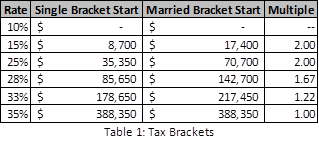
Am I working too much? If you’re like me, the answer is probably "yes". In this particular case though, I’m asking the question from a tax standpoint, specifically referring to a popular misconception about the way we pay income taxes. There are currently six tax Federal tax brackets: 10%, 15%, 25%, 28%, 33%, and 35% as shown in the table below from the Resources section of the PWA webpage.

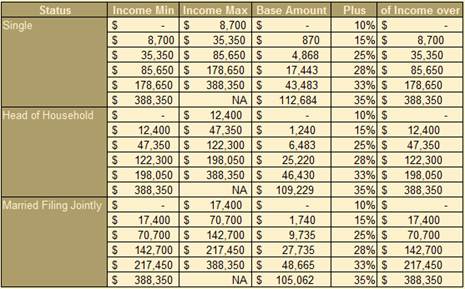
Your marginal tax bracket increases with your taxable (after exemptions and deductions) income. So, if you’re married and have combined taxable income of $143k, your marginal tax rate is 28%. If your combined taxable income is $142k, your marginal tax rate would be 25%. So, doesn’t this mean that you could save tax more than $1k in tax by earning $1k less at work for the year because 143k * 28% is more than $1k greater than 142k * 25%? That’s where the misconception lies. The answer is no and here’s why. Your entire income is not taxed at your marginal tax rate. You are taxed at each incremental tax rate along the way. So if your taxable income is $143k (and you’re married), you’re taxed 10% on the first $17,400 of taxable income + 15% on the additional income up to $70,700 + 25% on the additional income up to $142,700 + 28% on the last $300. You should be able to see that your tax on the first $142k is exactly the same as if you only made $142k. The only income you pay 28% on is the incremental income which puts you in that bracket. The tax code is created so that you can never make more net (after-tax) income by earning less money. Virtually everyone to whom I’ve explained this over the years, including the students in the CFP® classes I’ve taught have breathed a sigh of relief. It seems that people tend to stress a little bit over the fact that they may be making a little too much income, pushing them into the next tax bracket, and costing them a ton of money when they could have enjoyed a week of unpaid vacation relaxing on the beach and made more after taxes. This can’t happen, so don’t worry that it’s happening to you. Of course that still doesn’t mean you’re working too much, but at least you’re not working so much that it’s actually costing you money.

Re-Re-Refinancing

Mortgage rates are back at historical lows with last week’s national average on a 30-year fixed rate loan (per Freddie Mac’s mortgage survey) at 3.53%.  Even if you just refinanced in the last year, it may be worth your while to explore re-financing again.  In very simplified terms, you can estimate whether refinancing makes sense for you by dividing the closing costs by the amount you’d save on your payment each month and comparing that number, which is frequently called the “payback”, with the amount of time you plan to stay in the home.  I like to call this “broker math” or “refi 101”.  The calculation is quick, easy, and gives a decent first indication of whether the refinance could be worthwhile.  In reality though, there are some additional considerations: 

1)     What are the real closing costs for the loan?  Some lenders quote their origination fee, but leave out third party fees in their initial estimates.  Others quote origination fee, third party fees, and “pre-paids”, which are partial month’s interest and/or an initial deposit to an escrow account of a few month’s property tax and hazard (homeowners) insurance.  Others still will quote “no out-of-pocket closing costs” because they will allow you finance the costs into the loan.  This doesn’t mean you’re not still paying them!  The true costs of the loan include the lender’s fees (origination, application, underwriting, and points) + all third party fees (appraisal, title insurance, taxes, recording, processing, legal, document).  Prepaid items (partial month’s mortgage interest and escrow) are not true costs and should not be factored into the analysis because they are not costs in connection with the loan.  The mortgage interest portion is the interest for the partial month if you close in the middle of the month, but you’ll get to skip one month’s mortgage payment so there’s an offset.  The escrow deposit isn’t a true cost because you’re just pre-paying something you’d have to pay at a later date anyway, and if you have an existing escrow account on your current loan, you’ll receive a refund from that shortly after closing.

2)     What is the real benefit of the lower monthly payment?  Simply looking at the lower payment as a complete benefit to you is not the correct way to view a refinance.  That’s because only a portion of the payment reduction is due to a reduction in interest.  In fact, there are four components to watch out for:

  • (+)True interest reduction – this is your real benefit
  • (-)Tax impact of the true interest reduction – if you itemize, a portion of the lower interest payment means that you’ll have a lower mortgage interest deduction which means you’ll pay higher tax.
  • (-)Principal reduction from extending the term of your loan – not a real benefit because your mortgage is going to last for extra months on the end of the loan to account for this
  • (-)Principal reduction from amortization schedule – not a real benefit because more of each payment will be going toward interest after the refinance, so if you sell the home a few years after the refinance, the principal balance will be higher than it would have been without the refinance.

Calculating all of these impacts is somewhat challenging.  We’ve developed excel models to do the calculations.  Contact your PWA financial advisor if you need help.

3)     Do you have enough equity in the home to avoid needing private mortgage insurance (“PMI”)?  To qualify for a traditional loan with no insurance (assuming good credit), you’ll need a loan-to-value (“LTV”) ratio of no more than 80%.  To calculate your LTV, simply divide your mortgage amount by your estimated home value.  If the result is < .8, you probably won’t need mortgage insurance.  If it’s > .8, you probably will and if you do, there could be other up-front costs in the loan or there will be an ongoing PMI payment which typically equates to an interest rate that’s about 1% higher than the one quoted on the loan.  Be careful.  You probably won’t want to refinance a loan that doesn’t have PMI to a loan that does have PMI unless your interest rate is falling by ~2% or more.

4)     Once you’ve compared the true up-front costs of the loan with the real monthly benefits of the lower payment, you can calculate your payback by dividing the benefits into the cost.  If you plan to remain not only in the home, but also in the loan, for longer than the payback, then the refinance makes sense.  But do you really know for certain that you’re going to be in the home AND in the loan at a certain point in time?  Probably not (especially if you might refinance again).  For this reason, I advise clients to double the payback period and if they’re still confident they’ll be in the home and the loan for that amount of time, then do the refinance.  If the confidence is not there, then refinancing could add cost without enough payback before you exit the loan through a sale or another refinance.

5)     Do you have enough equity to qualify for traditional financing?  There is a chance that you’ll go through the loan process, pay an appraisal and potentially an application fee, and find out that your home is worth less than you thought and your LTV is higher than 80%.  In that case, adding mortgage insurance may be the only way to continue with the refinance.  Doing so will add to the costs and likely will extend the payback period to the point where the loan no longer makes sense.  In this case, you won’t proceed with the refinance, but will still be out the appraisal and application fee.  So, you need to have a fairly good idea in the value of your home and that you’ll have enough equity before you refinance.

6)     Many lenders will quote a standard rate and closing cost combination when you ask for a quote.  But, there are other options in most cases.  For a refinance, especially in the case where you don’t know how long you’ll be in your home or whether rates will fall sharply and you’ll want to refinance again, the best option may be a slightly higher than market rate and a credit that offsets most or all of your closing costs.  In this case, you remove all of the cost by giving up a little of the benefit and make the payback zero (or close to zero) months.  Explore that with your broker/lender before making a decision based on an initial quote.

Determining whether or not to refinance is really an intricate cost / benefit analysis.  Many borrowers look only at the payment reduction and the amount of money they need out-of-pocket to close and may put themselves in a worse position by doing so.  Make sure you think through this decision and talk to your PWA advisor before and during the process.  Once you get this right, and you’re certain you’ll benefit, refinancing really can be a free lunch.  And, there’s no better tasting lunch than a free one.

What’s In A Score

A few people have asked recently about how credit scores are determined, what is a good credit score, what score it required for the best rate on a mortgage, etc.  The following is an article I wrote for the PWA Newsletter back in 2008, updated for the interest rate world we live in today.

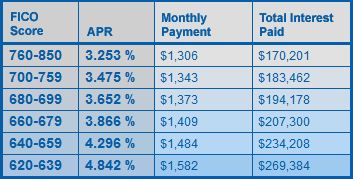
Okay, so you’ve checked your credit report, made sure there are no errors and are satisfied with the result.  Now what?  Now you have to understand what your credit report is used for and how your credit score is determined.  When you apply for a credit card or a loan, the prospective lender gathers your information and attempts to determine your credit risk.  They do that by analyzing the personal data you send them, by examining your credit report, and by reviewing your credit score, AKA your FICO score.  This process ultimately decides whether you get the loan or not and the terms for which you’ll qualify.  As shown below, your credit score can have a dramatic impact on the interest rate you’re offered and will therefore impact your payments and total interest over the course of the loan.


Rate by Score

Based on $300k 30-year mortgage and LTV of 60-80%. As published by MyFico.com

Your FICO score is determined by a complex system that was created by the Fair Issac Company (hence the name FICO).  To our knowledge, the actual formula has never been released, but the general algorithm has, and that’s really all you need to know to improve your score.  It is based on:

  • Payment History (35%) – do you pay your bills on-time, have you ever filed bankruptcy, are you currently or have you ever been in default.
  • Amounts Owed (30%) – what portion of your available credit are you using, how big are the balances (esp. on revolving debt), how many accounts (and of what type) are active and/or have balances.
  • Length of Credit History / New Credit (25%) – time since your oldest account was opened, age of all active accounts, number of recent applications for accounts and new accounts, time since last application and new account
  • Types of Credit Used (10%) – prior and current use of different types of credit (mortgage, installment, revolving, etc.)

There are many standards of what constitutes a “good” FICO score.  Some say higher than 720, others say higher than 750, and still others say higher than 780.  Because each lender will use the information in their own way, all we really know is that the higher your score is, the better off you’ll be. The median score is around 720 and the 90th percentile score is just over 800 according to estimates published by myFico.com and bankrate.com.  To estimate your FICO score, you can use the free calculator at: http://www.bankrate.com/brm/fico/calc.asp or register for a free site like www.creditkarma.com which tracks an estimate of your score over time.  To see the real thing, when you obtain your free annual credit report from one of the reporting agencies, purchase your score from them for a nominal fee (<$10). 

Healthcare Reform Taxes Starting in 2013

I’ll have several upcoming posts on tax changes for 2013 including what’s going to happen if nothing changes, what’s likely to happen (IMHO), and what’s not going to happen.  Here though is a quick list of changes that will take place as part of the new healthcare laws…  I’d label these as almost certainly going to happen, with the only possible exception being if Republicans win majorities in the House and Senate and win the Presidency in November (17% chance of all three happening based on Intrade.com’s betting odds) and pass a repeal of some or part of the Act.  For now, it’s safe to say these are happening:

  • A 0.9% additional tax to employees on wages over $200k per year ($250k if married filing jointly, hereafter abbreviated “MFJ”).  As we understand it, this would be part of employee’s payroll tax, known by many as FICA. This is the 6.2% social security tax that’s capped at $110,100 of income in 2012 and 1.45% Medicare tax that is uncapped.  It’s the Medicare tax that will rise by 0.9% to 2.35% of income and will remain uncapped starting in 2013.  Since this is a payroll tax, it will by withheld from paychecks of employees.  This means that even if you pay the Alternative Minimum Tax (AMT), you’ll still pay this new tax through payroll.
  • A 3.8% new tax on unearned income by those earning at least $200k per year ($250k MFJ).  If you earn less than $200k or $250k but have unearned income that puts you over those thresholds when added to your earned income, you’d pay the 3.8% tax on the excess over $200k or $250k.  The types of income to which this applies are: interest, dividends, capital gains, annuity income, royalty income and passive rental income.  It does not apply to tax-free interest or retirement plan distributions.  This tax is generally paid at the time of filing or via estimated tax payments through the year.
  • Healthcare flexible spending accounts will be capped at $2500 (reducing the amount of tax that can be saved by deferring income into these accounts).
  • Medical expenses paid out of pocket will only be deductible for those under age 65 if they exceed 10% of income (a hike from the current 7.5% floor).
  • A 2.3% tax on the sale of medical devices (except those commonly sold at retail like glasses, contacts, and hearing aids).

Additional taxes begin in 2014, including the tax penalty to individuals without health insurance (AKA the “Individual Mandate”) and businesses who have at least 50 employees but either don’t offer coverage, or offer sub-par coverage that leads employees to buy insurance on one of the newly created healthcare insurance exchanges (AKA the “Employer Mandate”).  More on these changes in a future post.

Bi-Weekly Mortgage Payment “Opportunity”

I received an offer from my mortgage lender today, to participate in a special plan that would allow me to “Pay off [my] mortgage sooner”, “Save thousands in interest”, “Build valuable equity”, and “Achieve financial freedom”.  Wow!    

The program involves signing up to make half of my mortgage payment every 2 weeks instead of once per month.  This results in 13 payments per year, which reduces the principal balance on the loan faster, and would allow me to payoff the mortgage faster.  Using some sample numbers, if I had a $300k mortgage at 4% with 25 years remaining, instead of paying ~$175k in interest over the next 25 years, the program would have me paying ~$150k in interest over just under 22 years.  Sounds like a great deal…  on the surface.

The catch is that the lender wants to charge me $3 per payment ($78) per year, for the opportunity to do something that I can do on my own and in an even simpler way.  Without getting into the fact that paying off a tax deductible 4% mortgage early probably doesn’t make sense for most people, if I did want to pay the mortgage off early, I could simply make one extra full payment per year (say double every January) and leave everything else the same.  Not only would I avoid paying $78 per year, but I’d pay $1000 less interest over the life of the loan and still pay it off in just under 22 years.

Why pay $78 for something I can do better myself in a simpler manner with the flexibility to change my mind if I need or want that extra payment for something else?  Come on [lender who shall remain nameless].  You can do better than that if you want to earn an extra $78 out of consumer’s pockets each year.

Moral of the story: be skeptical of bank “offers”, and avoid special mortgage payment plans that have a fee involved.

About This Blog

The PWA (Perpetual Wealth Advisors) Financial Tastings Blog is intended to provide our clients and other interested readers with bite-sized, easily digestible information on personal finance topics.  We used to publish a quarterly newsletter with similar information and will be archiving some of those topics here.  Instead of continuing with a publication that was akin to a seven-course meal every three months, we have found that the fast-paced, mobile-driven world required smaller amounts of information, communicated more frequently.  We’ve turned to the blogging concept to provide it.  Topics will include both original content and links to other articles of interest.  They will span key areas of personal finance including planning, goal setting, budgeting, cash flow management, debt management, risk management, employee benefits, tax, investments, retirement planning, and estate planning.  We’ll try to keep posts brief, simplify where possible, and answer as many questions as we can.  Speaking of questions, feel free to send them to blog@perpetualwealthadvisors.com.  We’ll occasionally open up the mailbag for a Q&A post.  Bon appetit!

Market Update 4/10/2012

*** We believe communicating with our clients is of utmost importance, especially during turbulent times in the market. While we don’t claim to have a crystal ball on the future of any financial market at a given point in time, we do believe that keeping clients informed on why things are happening increases their comfort level and understanding. This post contains a message initially sent to clients just after the start of Q2 2012 as part of that communication effort***

Let’s take a look at a few things that occurred / conditions that existed during Q1:

· One of the biggest fears of the financial markets over the past year was fulfilled as Greece defaulted on some of its government debt, triggering Credit Default Swaps associated that debt.

· Gasoline prices hit $4.00 per gallon in many parts of the country (well north of $4.00 in some parts).

· Tensions in the middle east, especially between Iran & Israel and Iran and most of the rest of the world escalated to threats of war and the imposition of extreme economic sanctions

· The US National Debt topped $15 trillion dollars for the first time ever, now exceeding US GDP, and would take $50,000 per citizen to pay it off. The Federal government is also spending $1.50 for every $1 in tax it collects so that debt is still increasing very rapidly.

· The unemployment rate closed the quarter at 8.2% (~1 in 12 people country wide out of work who are looking for it) and the underemployment rate closed at 17.8% (more than 1 in 6 people out of work and looking, out of work and gave up, or working reduced hours due to economic conditions).

· A handful of major banks failed the latest Federal Reserve stress test. Another 15 smaller U.S. banks failed completely and were closed by the FDIC.

· Median home prices fell to new lows (surpassing the 2009 lows) and the Case-Shiller home price index now has average home prices nationwide a full one-third lower than they were 5 years ago.

I point all this out because despite all the bad news, Q1 2012 was a fantastic quarter for risk-based asset classes. In fact, for the S&P 500, it was the best calendar quarter since 1998. That doesn’t seem to make much sense though, does it? Since the lows in March of 2009, when it looked like we were on the brink of the Great Depression v2.0, the stock market has returned ~120%. 120% over three of the worst economic years we’ve seen in a century. Well, it does make sense if you realize that the short-term whims of the stock market don’t synchronize themselves perfectly with the long-term movements and trends of the overall economy. You simply can’t win by selling stocks when times are bad and buying them when times are good. People keep trying it, but they keep buying high and selling low and losing money in the process. The stock market priced in the years of bad news to come, and priced it in way worse than what has actually happened, all the way back in 2008/2009. That means that even a terrible economy still turned out better than what markets were expecting and therefore, prices had to move up accordingly. Of course there was no way to know that we were at the bottom when we were at the bottom or that economic conditions ultimately would be less terrible than the market was forecasting. This is why I continue to coach clients to focus not on “winning” the stock market game and trying to outperform an arbitrary benchmark, but instead to focus on achieving their own financial goals. Instead of predicting the short-term future, we can spend the time matching a portfolio to the needs of the client. Need $100k for a house downpayment in 2 years and have $95k today? We make sure most of that money is not in the stock market. There are short and medium term bonds that offer less reward potential, but substantially less risk. It’s better to miss out on a big up move and still be able to buy your house than to gamble it and maybe wind up with 150k or maybe only 50k. Need $4M for retirement in 30 years and have $100k today? We make sure most of that money is in the stock market. You really need the growth over the long-term and if you lose 50% of that $100k over the short term, it means you get to accumulate the other $3,950,000 starting from a lower level, likely with higher returns for the future as a result (see 2008/2009).

The moral of the story is that there are only two predictions that I’m confident in and that you should be confident in as well. First, the stock market will continue to be unpredictable (that’s right, predictably unpredictable) over the short-term and will almost certainly have ups and downs. Second, if you have a well-thought-out plan, incorporate flexibility to react to those things that don’t go according to plan, and actually take the time to react when the plan needs an adjustment, you will achieve your goals.

As you look through your account statements this quarter, try to keep both predictions in mind. If you saw large gains in Q1, you have an aggressive portfolio (very dependent on the stock market). Can you handle even bigger losses in a quarter to come? If yes, hang on and enjoy the ride. If not, please contact me. If you didn’t see huge gains in Q1, you have a more conservative portfolio (less dependent on the stock market). Are you still moving toward achieving your goals? If yes, try not to be jealous of your neighbor who has all his money in a leveraged stock fund and made 50% in Q1 because you don’t need that kind of risk to achieve your goals. If not, please contact me.

As always, if you have any questions, comments, or just want to chat, please feel free to send me an email or give me a call. For those of you who use Skype, I’ve even started to incorporate video chat and screen sharing where it makes sense. Technology keeps making the world seem smaller, but time seems to be moving faster than ever. As much as I can’t wait for the end of tax and allergy season (no better time to be trapped in my office for two months of the year), I can’t believe it’s already mid-April. Enjoy the great weather while we have it!

Market Update 1/13/2012

*** We believe communicating with our clients is of utmost importance, especially during turbulent times in the market. While we don’t claim to have a crystal ball on the future of any financial market at a given point in time, we do believe that keeping clients informed on why things are happening increases their comfort level and understanding. This post contains a message initially sent to clients just after the start of 2012 as part of that communication effort***

Those of you who review your quarterly reports will notice that much of the downturn in Q3 was reversed in Q4 as markets calmed and fears of a Europe-led global financial meltdown were at least temporarily eased. As we stated in previous updates, as the probability of a European meltdown is reduced, the value of all risk-based assets tends to increase. That certainly held true in Q4.

In my view, the primary reason for this is a new loan facility put in place by the European Central Bank (ECB) by which member banks can borrow money at low rates from the ECB, using virtually any types of assets as collateral, for a term of up to three years. This is a much broader loan program than is typically in place, both in the ECB’s acceptance of risky assets as collateral and also in the length of time that the banks can utilize the loans. This facility, known as the Long-Term Refinancing Operation (“LTRO”) essentially removes the possibility of a major European bank failure in the next three years because the banks know they can access cheap money from the ECB, even if no one else will lend to them. That in turn instills confidence in the inter-bank lending markets because if no banks are going to go bust, then loaning money to each other at reasonable rates suddenly has little risk associated with it. Additionally, because the ECB is willing to accept risky assets as collateral for the loans, the banks can borrow money cheaply from the ECB and they can purchase the debt of European governments (which have much higher interest rates than the ECB charges, due to the recent increased risk of government defaults). The banks can earn the spread on the interest of the debt they purchase and the low-interest they pay to the ECB to borrow the money used for the purchase. In this sense, the ECB has provided a way for governments like Italy, Spain, and Portugal to borrow money without having to lend large amounts to them directly (which would violate the treaties that created the ECB and the Euro). While the LTRO is a bit of a shell game that moves risky government debt to the balance sheet of the ECB, and therefore to the responsibility of the stronger countries in the Euro-zone like Germany and France, it is much more politically acceptable than Germany and France funding those other nations more directly. So, if we know banks aren’t going to fail anytime soon, and we know that European governments aren’t going default anytime soon (with the exception of Greece which is too far down that road to help), much of the financial catastrophic risk is off the table for the time being. Don’t read this to say that Europe’s problems are behind them, but the urgency to resolve them before the financial world ends has eased. That’s the primary reason why stock markets are improving, volatility is decreasing (for now), and credit markets are normalizing.

Along with improvements in Europe, the U.S. economy has been showing mild signs of life. Recent economic readings show mild expansion in both the manufacturing and services sectors of the U.S. economy. Jobs are being created (albeit at a slow pace and it should not be forgotten that we’re still down six million jobs from the peak in 2007). Housing is showing some signs of stabilizing as the inventory of homes available for sale has fallen to more balanced supply/demand levels over the last few months (though prices and sales are still falling in many areas). It remains to be seen whether this is an emerging trend that instills confidence in consumers and corporations to trigger more spending, more investment, more hiring, higher wages, and the virtuous cycle that follows. I’m skeptical that we can quickly return to the old-normal of 5% unemployment and 3-4% real annual GDP growth while the government is focused on cutting deficits and the consumer is focused on cutting debt and facing higher taxes. But, I do believe there is room for slow to moderate growth through productivity and population growth. There are certainly opportunities for both government and the private sector to be more efficient in our use of resources and in the way we create economic incentives for people to work hard, innovate, and deliver value back to the economy. That efficiency can drive growth for years to come even during an aggregate deleveraging cycle.

Speaking of economic incentives, there are some rather large changes to the tax code that will take effect in 2013 and will have an impact on all of you in their current form. In the coming months, look for a summary from me of what is headed your way from these changes (hint: it’s not lower taxes). We’re in a somewhat strange situation where the changes are already legislated because they come from expiring temporary changes to the tax code. So, the only way to stop them would be to pass new laws that prevent the old laws from returning. Given the political situation in Washington… let’s just say that I think it’s prudent to plan for higher taxes starting next year and that the higher up you are on the income scale, the more dramatic that increase is likely to be. More to come on that. We’ll also be formally kicking off 2011 tax season shortly with a blast message indicating what you need to do if PWA is preparing your taxes this year.

I hope you all had a wonderful holiday, that your 2012 is off to a great start, and that you continue to move closer to achieving all your personal and financial goals. As always, if you have any questions, please feel free to contact me.

Market Update (10-07-2011)

*** We believe communicating with our clients is of utmost importance, especially during turbulent times in the market. While we don’t claim to have a crystal ball on the future of any financial market at a given point in time, we do believe that keeping clients informed on why things are happening increases their comfort level and understanding. This post contains a message initially sent to clients after a terrible September 2011 and in the escalation of the European sovereign debt crisis as part of that communication effort***

Many of you will remember my messages at the beginning of Q3 which indicated that the Fed-provided updraft in financial markets was likely behind us with the end of their Quantitative Easing program as well as my fears about what seemed to be a troubling situation in European government debt (specifically Greece). I pointed out that despite 7-8 consecutive quarters of seeing account balances move up, you should be prepared for more typical up-and-down quarters to come. Those issues in Europe have intensified and put pressure on markets around the world as you’ve undoubtedly heard and noticed by now. U.S. stocks, as measured by the S&P 500 were down almost 14% for the quarter. Small-cap U.S. stocks and international stocks were down over 20% for the quarter with some sectors and emerging markets fairing even worse. Consequently, you will see that your account balances for aggressive portfolios have fallen along the same lines in Q3, while more conservative portfolios have had a more muted response, but have fallen nonetheless. Each day, and often multiple times per day, I ask myself if the fall in stocks is appropriate given the circumstances in the global economy. Should we be getting more aggressive because the markets have overpriced the probability of a global recession and another credit crisis led by Europe’s woes? Should we be getting more conservative because the markets haven’t priced in that probability enough? As I’ve discussed with all of you in the past, I believe that markets are generally extremely good at processing information and letting the aggregate intelligence of millions of participants determine the right price for a given security and the market as a whole. While there is sometimes misalignment for spectacular reasons, I don’t think we have that misalignment right now.

World economies have problems, very big problems, especially in Europe. Their government debt issues have the capability to bring down banks like our mortgage problems brought down banks here in 2008. If European banks fail, a chain of events will take place which will spill over to the U.S. in multiple ways. First, Europe as a whole is a bigger economy than the U.S. So many of our companies do a significant portion of their business in Europe. If Europe slows, so will those companies. Second, many U.S. banks own assets that derive their value in one way or another from European companies and countries. Those assets will fall in value, putting the same kind of strain on our banking system as it faced when mortgage assets fell in value. Third, the U.S. dollar will likely strengthen vs. European (and other global) currencies via a safety / liquidity trade. This will hurt U.S. exports and especially when combined with the bank issues which will make credit harder to obtain, it will stop any recovery we’re seeing dead in its tracks. As the probability of a Greek default rises, unless there is a credible plan in Europe to stop the chain of events (think dominos falling) that would occur because of it, values of markets around the world will fall. Along those same lines, as the probability of a Greek default falls, or containment plans that would stop the domino effect emerge with more credibility, markets rise. This impacts global markets in that they all begin to move in the same direction at the same time and, depressingly, that impact swamps the impact of individual company, industry, or even country performance.

The situation in Europe seems grave, but there are a few underlying mitigating factors that are seldom discussed. Companies have gone through major cost cutting in the last three years and have increased their own emergency funds drastically. In aggregate they have almost double the cash on hand than they did in the 2008 downturn which leaves much more room to survive another downturn without severe additional cost cutting and layoffs. Banks have been recapitalized and continue to be supported by lending programs from the Federal Reserve, lowering the odds of another Lehman-like failure dramatically from where it was pre-Lehman. Consumers have been paying down debt rather than taking on more of it over the last few years. House prices have continued to fall (yes, I’m calling that a good thing for the future even though it has been a bad thing for homeowners to date), while mortgage rates are at historic lows (30-year fixed avg’d 3.94% last week!!). Housing is the largest expense for most of people, and it hasn’t been this cheap in decades. Energy prices continue to move with the economy, softening the blow of a slow down with reduced prices for heating this winter and at the pump where many areas in the country have seen a 20% reduction in gas prices over the past few months.

My conclusion to all of this is that the market seems to have appropriately priced the risks that are present in the global economy. It’s also appropriately pricing in the fact that companies and individuals are more capable of handling an economic slowdown than they have previously been. It will continue to operate on a binary level, Europe’s looking better – the world’s not ending – stocks up… vs. Europe’s looking worse – we’re all doomed – stocks down. Eventually, governments and federal reserves will stop taking the headlines and company productivity and innovation will win it back. Until then, expect the volatility to continue, again, in both directions, and with all but the safest of asset classes moving in tandem.

We’re of course taking advantage of this volatility in two ways. One, through rebalancing, selling bonds (which have generally increased in value through the turmoil), and buying stocks (which have fallen) to re-establish the stock/bond ratio that is appropriate for your goals. When the market turns around, you’ll have more stock than you would have which means you’ll gain more than you would have, allowing us to sell stocks and buy bonds again to re-establish the proper ratio. This provides for a natural, non-emotional, buy low / sell high rhythm to the portfolio. Second, where possible, we’re beginning to take advantage of losing positions by selling them, realizing the capital loss, and reallocating the money in similar assets. This process, called “tax-loss harvesting”, allows us to capture the loss for tax purposes, either offsetting other gains in your portfolio, or allowing you to take a deduction for losses on your 2011 taxes, all while leaving your exposure to the asset the same so you’ll benefit when the market starts to rise again.

So what does this all mean to you? Well, it means that nothing has really changed from a financial planning standpoint. Your emergency fund money is in cash and continues to protect you in the case of an emergency. Money for short-term goals is protected in lower-risk portfolios with a higher percentage of short-term, high quality bonds that continue to pay interest though a downturn. Money for long-term goals is exposed to the short-term whims of the market in exchange for the likely higher average returns that will be earned over the long-term. In reality, long-term money is better off if the market would stay low for a while and let individuals get more into it before it rises over the long-term.

As long as the emergency fund is big enough (but not too big to impact your ability to fund future goals)… as long as the short-term portfolio is consistent in size with what’s needed for your short-term goals… and as long as the long-term portfolio is defined properly (i.e. you’ve communicated your lack of need for that money in the short-term properly)… then your ability to achieve your goals remains intact despite the stock market’s past quarter of performance. As always, I encourage you to communicate with me whenever something changes in your life that could impact the size or timing of your need for your money. Take your annual review seriously and really think through what you want for the future well in advance of needing money to get it. If you don’t know where you’re going, any road will take you there (thanks Lewis Carroll). But if you do know where you’re going, you have a map, you have the right vehicle for the bumps you might encounter, and you have the help of someone who understands the road, there’s a pretty darn good chance you’ll make it.

As always, if you have any questions, please feel free to contact me.