Tax Impacts of the New Administration

There is still much uncertainty about what will change, when it will change, and how it will change, but it seems pretty clear that some fundamental modifications are going to be made to the Tax Code as part of the new administration. The following is my attempt to summarize the relevant proposed changes along with my educated guess on what is really likely to get done. Some of the modifications to the Tax Code, if they were 100% certain, would lead to tax-saving recommendations for many of you.  Unfortunately, virtually nothing is certain. For example, if marginal tax rates fall in 2017 from 2016, then it would make sense to accelerate deductions into 2016 that could otherwise be taken in 2017. But, if those rates don’t change until 2018, and there are offsetting factors that impact 2017 (Alternative Minimum Tax or “AMT”, for example), taking those deductions in 2016 instead of 2017 could actually raise the overall 2016 + 2017 tax bill. Still, for most of you, I think there are some takeaways that are likely to help in the best case scenario, and unlikely to hurt in the worst case scenario. I conclude this post with my advice on those items.

Before jumping into the likely/proposed changes, there’s an important point that I want to make. Yes, Republicans have control of the House, the Senate, and the Presidency, so you might think that they will have their way without debate. However, they don’t have a filibuster-proof, sixty members of the Senate which may force some negotiation. Yes, there are some things that can be changed through the Budget Reconciliation process, which requires a simple majority of Congress, and yes, they have the “nuclear option” available, which Harry Reid famously used as Senate Majority Leader in 2013 to eliminate the filibuster in particular cases. But, the current Senate Majority Leader, Mitch McConnell, is on record as a proponent of the filibuster and as saying after the election that “I don’t think we should act as if we going to be in the majority forever… We’ve been given a temporary lease on power if you will, and I think we need to use it responsibly.” There’s also the matter of the national debt (approaching $20 Trillion) and an annual deficit at over $500 Billion and projected to increase dramatically over the next few years, without even considering the tax changes discussed here and the potentially $1 Trillion in infrastructure spending that is proposed. We simply can’t just cut taxes, increase spending, and assume all will be ok. So, it’s in everyone’s best interest to pass a bipartisan set of changes to the tax code with reasonable tax relief that will stimulate economic growth (some of which will lead to additional tax revenue), and keep spending in line. Whether or not that gets done remains to be seen. I suspect Republicans will mostly get their way, but will stop short of steamrolling the entire Trump/House plan through with no Democratic participation and without any concern for the deficit. If they do, it seems very likely that all of these changes will be temporary and reversed as soon as the power pendulum swings back toward the Democrats or the country’s ability to borrow cheaply is taken away. Said another way, the more moderate the changes, the more likely they are to persist for the long-term. The more extreme the changes, the shorter the likely duration before those changes are repealed.

So what changes are we talking about?

· A reduction in corporate tax rates – Current rates range from 15% for the first $50k of corporate income to 35% for income over $18.33M. Trump and the House plan want to cut the top rate to 15%, while eliminating many deductions and credits (“tax expenditures”), including the ability to defer tax on foreign earned income until it is repatriated. Included in the proposal is a one-time tax on previously deferred foreign income that is repatriated to the US (a “repatriation holiday” of sorts). It’s very likely that a reduction in the top rate will take place as will some sort of repatriation holiday. If I had to bet, I’d guess the top corporate marginal tax bracket will wind up somewhere between 20-25% and a one-time 10% tax on repatriated income will apply. The likelihood of this occurring, is in my opinion, the biggest factor in the gains in the US stock market since the election (notably non-US stocks have been excluded from the rally). The repatriation tax will be used to fund a portion of the infrastructure program, which may be a public-private partnership to keep the Federal cost down. Also unclear is whether the new corporate tax rate will apply to small business pass through income (LLCs, partnerships, and S-Corps). Trump’s original plan was for that to happen. That then morphed to only include the lower corporate tax on profits that were reinvested in the business. Now it seems more like that the current method of simply passing through income to be taxed at individual rates will be maintained. Due to the small chance that pass-through income will be taxed at a lower rate under the new plan, deferring income and accelerating expenses makes the most sense on the margin.

· A reduction in individual tax rates – Current rates are graduated at 10%, 15%, 25%, 28%, 33%, 35%, and 39.6% each applying to an increasing income level (see https://blog.perpetualwealthadvisors.com/wp-content/uploads/2016/10/taxprojectionspptforblog2017.pdf for more detail on each bracket). The Trump plan and the House plan call for compressing the tax brackets to 12%, 25% and 33%, while eliminating various deductions (see below). The House plan would compress the 10% and 15% bracket to 12%, the 25% and 28% bracket to 25% and the 33%, 35%, and 39.6% brackets to 33%. Trump’s plan used 12% on income up to $75k, 25% up to $225k, and 33% above that (all for married filing jointly). The Trump and House plans align pretty closely. I suspect the bottom two brackets will compress close to the proposed 12% and 25%, but that the top rate could only drop to 33% if there was a substantial decrease in deductions for taxpayers in those brackets and/or the addition of something like the “Buffet Tax”, which was proposed by Warren Buffet as a new Alternative Minimum Tax for those earning over $1M per year. We’ll need to watch and see what legislation looks like when drafted and what kind of support it gets through Congress before taking action on this. I think it’s safe to say that rates will at worst be the same, and likely will be lower in the future than they are now (whether that’s 2017 or 2018 remains to be seen). All else being equal, this means that deferring income, where possible, to a future year will likely not hurt, and likely will help most taxpayers.

· An Increase in the standard deduction and elimination of a number of itemized deductions – Trump’s plan would increase the standard deduction to $15k single / $30k married vs. today’s $6350 single / $12,700 married while eliminating the personal exemption ($4050 per family member including children, but eliminated at high income levels and in AMT). He would cap itemized deductions at $100k single / $200k married regardless of the type of the deduction. The House plan calls for the elimination of virtually all deductions with the exception of the mortgage interest deduction and charitable contributions. If the House gets their way, the deductions for medical expenses (not a huge deal since they have to exceed 10% of AGI to be deductible anyway), state and local income or sales taxes (a pretty big deal, esp. in high tax states), property taxes (somewhat of a big deal for homeowners), and misc. itemized deductions (only a big deal for those who have misc deductions that exceed 2% of their income), would be eliminated. There have also been proposals in the past to limit the mortgage interest deduction to $500k, and/or to limit the impact of a deduction to 25% or 28%, effectively reducing their value to high-income individuals so that the value of the deductions is in-line with middle-incomers. An overall limit to deductions is thought to be a problem for charitable giving, since it takes away the financial reward for giving more than $200k per couple per year for upper incomers. The selective elimination of certain deductions instead creates winners and losers somewhat haphazardly and changes the rules on taxpayers in the middle of the game (if you bought a house figuring you’d be able to write off the property taxes, what happens if you can’t and that makes the house less affordable?). I’m not sure where this will fall out. What is clear is that there is a strong possibility of deduction limits in the future. In many cases, this means accelerating deductions into 2016 where possible, is probably the best tactic (though AMT makes this hard to generalize).

· An expansion of the Child Tax Credit and the Dependent Care Credit (and/or Dependent Care Flexible Spending Accounts) – Trump has proposed changes that would allow individuals to deduct childcare and elder care from their income, incent employers to provide on-site childcare, and create tax-free savings accounts for children and elderly dependents. No details have emerged. I suspect an expansion of the Child Tax Credit ($1k per child, phased out by income) and a higher Dependent Care Credit and/or higher dependent care FSA limits (currently $5k per family). There is no way to take advantage of these changes in advance, even if we knew they would occur for certain.

· An elimination of the Alternative Minimum Tax (AMT) – AMT is a parallel income tax calculation that has a bigger personal exemption, fewer allowed deductions, and only two tax rates (26% and 28%). You pay either the standard income tax or the alternative minimum tax, whichever is higher. AMT is typically paid by middle-high income taxpayers with a lot of deductions that are allowed for regular tax purposes, but not allowed for AMT purposes. Those include state & local income & sales taxes paid, property taxes paid, miscellaneous itemized deductions (like unreimbursed employee expenses). AMT also hits those who receive Incentive Stock Options (ISOs) from their employer and exercise those but hold the stock. So if you live in CA, work in Silicon Valley, have a bunch of ISOs, an expensive house with high property taxes, and pay CA’s very high state income taxes, you’re likely facing AMT.  Eliminating AMT will be a huge win from a complexity standpoint. I’d give it about a 50% chance of happening, though there’s also the chance for something like the AMT to be added under a different name (like the “Buffet Tax” mentioned above).

· A repeal / replacement of some of the various tax provisions associated with the Affordable Care Act (“ACA” or “Obamacare”) – these include the penalty for not having insurance, the subsidies for insurance purchased through the exchange for those with low income, and the surtax of 3.8% on investment income if you earn over $200k single / $250k married in income per year. Notably, the 0.9% Medicare surtax on earned income over $200k / 250k looks like it would remain. It’s likely that other credits / penalties would need to be created / imposed in whatever ultimately replaces the ACA. The elimination of the NIIT seems pretty likely and would mean that investment income (interest, dividends, gains, rents, etc.) will be taxed 3.8% less in the future than it is today for those with incomes of at least $200k (single) / $250k married. It’s not a huge amount, but it could be worth trying to defer investment income into that future year if possible (i.e. if you’re selling something with a big gain in Dec 2016, you might be better off waiting until Jan 2017 instead, all else being equal).

· A repeal of the Federal Estate Tax along with an elimination of “stepped-up” basis and elimination of the tax deduction for giving appreciated assets to a private foundation / charity – Some Republicans have an issue with eliminating stepped-up basis (heirs receiving property get a cost basis equal to the fair market value of the property as of the date of death of the decedent). Many Democrats have an issue with eliminating the Estate and Gift tax completely. This one seems unlikely to me. At present, couples are exempt from Estate Tax if their estate’s (plus lifetime gifts) are less than ~$11M. So while the concept of taxing wealth at death after already having taxed the income that created that wealth multiple times doesn’t seem completely right, eliminating the tax would clearly only benefit the uber-wealthy and that’s a tough sell given the other tax cuts and the current debt.

Note that no changes are expected in dividends / long-term capital gains rates, other than the elimination of the 3.8% NIIT described above.

To summarize, here are the actions you should take in order to most likely benefit if the changes above go into effect in 2017. Keep in mind that nothing is certain and it is possible that taking any of these actions could lead to the exact opposite of the intended tax savings. This is a probabilities game at best.

1) Defer income from work to 2017 from 2016 where possible. You obviously can’t change your salary, but perhaps year-end bonuses or severances are negotiable. More importantly, any self-employment income may be able to be shifted by a month or two as necessary.

2) Consider putting off the exercise of employer stock options, or accepting any deferred compensation payouts until 2017.

3) If you’re not maxing out pre-tax savings vehicles like 401ks, consider increasing your contribution for the last pay period of 2016. You have until 4/15/2017 to fund 2016 Traditional IRAs / HSAs, which means you can hold off on those and see if we have more information by then.

4) If your total income is greater than $200k (single) or $250k (married), and you can defer taking investment income in 2016 to 2017 (e.g. put off a large capital gain until January), do it.

5) Accelerate deductions that aren’t impacted by AMT from 2017 to 2016. For example, consider making future years’ charitable contributions in 2016 if possible. Pay your January mortgage payment in December to get the extra month’s mortgage interest into 2016. Pay any medical expenses that you can if your total for the year exceeds 10% of your income.

6) If you’re not impacted by AMT, accelerate other deductions from 2017 to 2016. For example, if you control the timing of the payment of your property taxes and you have the choice between a payment in calendar year 2016 or 2017, make the payment in 2016. If you make estimated tax payments, consider paying your Q4 2016 estimated taxes in December 2016 rather than January 2017.

7) If you are impacted by AMT, and a particular deduction like payment of property taxes is unlikely to help you because it will be offset by AMT, then continue to make that payment on the schedule that you usually use (i.e. pay one year’s worth of property tax each year unless your income or other deductions are going to change substantially from year to year).

8) Don’t die with an estate valued at over $11M in 2016. Hold off until 2017 if possible just in case the estate tax is repealed. 😉

As with most financial planning, these are just generalizations. And, in this case, they’re generalizations grounded in the uncertainty of future tax policy. If you have questions about your specific situation, contact your financial advisor.
Mileage Rates for 2017

The IRS announced the mileage rates for 2017 for those who use their own vehicle for (non-commuting) work-related driving, medical or moving-related driving, and charitable-related driving. Those rates are:

Business: 53.5 cents per mile (down from 54 cents in 2016)

Medical Or Moving: 17 cents per mile (down from 19 cents in 2016)

Charity: 14 cents per mile (same as 2016)

Election & Markets

11pm eastern on election night and it’s looking like we have ourselves another BrExit moment coming for the financial markets, with US futures down as much as 4.5% a few minutes ago. I wouldn’t be surprised to see that double by morning. I’m going to keep this short so as to stay out of the political side of the story. In my opinion, a Trump win is a threat to global trade (just like BrExit was) and that is a threat to global growth. Even if much of it wasn’t rhetoric to gain votes in the states that have bled manufacturing jobs over the past two decades, ironically, a Republican controlled Congress is probably a block to much of that type of movement. Just as the reaction to BrExit was to sell first and think later, it appears the same will prevail here if Trump does win (now a 90% chance in better markets). Fear is not a winning proposition. I’m confident the world won’t end from a Trump presidency either. More details to follow in the coming days regarding what to expect from a tax and economic point of view.

Updated 2017 Tax Numbers

The IRS has released the key tax numbers that are updated annually for inflation, including tax rates, phaseouts, standard deduction, exemption amount, and contribution limits. Since inflation was low in 2016, only small changes have been made in most cases. Some notable callouts for those who don’t want to read all the way through the update:

· Social Security payments will increase by 0.3% in 2017. The Social Security Wage Base (the max amount of income subject to the 6.2% Social Security Tax) increases dramatically from $118,500 to $127,200 (it’s calculated based on wage increases and by law could not increase in 2016 since there was no SS COLA increase).

· Max contributions to 401k, 403b, and 457 retirement accounts remain unchanged at $18,000 (+$6000 catch-up if you’re at least age 50).

· Max contribution to a SIMPLE retirement account remains unchanged at $12,500 (+$3000 catch-up if you’re at least age 50).

· Max total contribution to most employer retirement plans (employee + employer contributions) increases from $53,000 to $54,000.

· Max contribution to an IRA remains unchanged at $5,500 (+$1,000 catch-up if you’re at least age 50).

· The phase out for being able to make a Roth IRA contribution is $196k (married) and $133k (single). Phase out begins at $186k (married) and $118k (single).

· The standard deduction increases by $100 to $12,700 (married) and by $50 to $6,350 (single) +$1,250 if you’re at least age 65.

· The personal exemption remains unchanged at $4,050 per family member. Remember that exemption amounts begin to be phased out if your income exceeds $313,800 (married) or $261,500 (single). The exemption is reduced by 2% for every $2500 of AGI over threshold until reduced to $0.

· Itemized deductions are reduced by 3% of the amount AGI is over $313,800 (married) or $261,500 (single).

· The annual gift tax exemption remains at $14,000 per giver per receiver.

· The maximum contribution to a Health Savings Account (HSA) remains at $6,750 (married) but increases by $50 to $3,400 (single).

· Note that mileage rates have not been updated yet for 2017.

2017 Key Tax Numbers


Q3 2016 Returns By Asset Class

At the end of Q2, I posted returns by asset class (by representative ETF), as well as year-to-date, last twelve months, and last five years. While there is still no predictive power in this data, I updated those charts as of the end of Q3 2016 for those of you that are interested (see below).

Q3 2016 Asset Class Returns

While Commodities and Real Estate Investment Trusts were down slightly during Q3, other asset classes were positive. All major asset classes are now positive year-to-date, and all except Commodities are positive for the past 52-weeks (this should turn around by the end of Q4 as the horrible Q4 2015 Commodity crash will roll off the 52-week chart by then).

Q2 2016 Returns By Asset Class

The link below shows Q2 2016 returns by asset class (by representative ETF), as well as year-to-date, last twelve months, and last five years.

Asset Class Returns

While I don’t think there is any predictive power in this information, some of you may still find it interesting. A few call outs:

1) Commodities overall (energy, metals, agricultural products) are down more than 50% in the past 5 years.

2) Emerging market stocks are down almost 20% over the past 5 years. In fact, they never fully recovered from the financial crisis and are still down more than 25% from their October 2007 peak.

3) Large Cap US stocks (think S&P 500) have been consistent strong performers. It makes sense that that the S&P 500 is near an all-time high.

4) Note the diverse returns by asset class, especially bonds vs. stocks and US stocks vs foreign stocks. This diversification is what we ultimately want in portfolios. It “feels” bad when your home country is outperforming as the S&P 500 has for the past 5 years. There is a temptation to want to just invest in the S&P 500 since it has done well for a particular period of time in the past, but there are no guarantees that will continue for the future. In fact, it may be starting to reverse course (see #5 below). Diversification works over the long-term, not over the arbitrarily defined term.

5) Some of the worst performers over the last 5 years are some of the best performers year-to-date (commodities, emerging market bonds, emerging market stocks).

6) Notice the low, but consistent returns of US bonds. That’s why they’re part of your portfolio. They have very little (and often negative) correlation to the rest of the portfolio. These are true diversifiers in that they have positive expected returns, but tend to do well when other parts of the portfolio are doing poorly. The addition of bonds to a portfolio smooths out the roller-coaster of stock returns. The more bonds, the smoother the ride, but the lower the overall return will be.

7) While cash has paid essentially no interest over the past five years, Aggregate US Bonds have returned 20%, and with a very smooth ride along the way. This is why we favor bonds strongly over cash (other than as an emergency fund and for known upcoming spending).

Brexit Follow-Up – One Ugly Day Later

Quick update on the financial impact of Brexit after one day of trading. Bad in the US, but terrible overseas, especially in financials. Vanguard’s Total World Market ETF was down 5.35%. I like to use that as a proxy for all the assets in the world, which are worth 5% less today than they were yesterday at this time (or, more optimistically, they’re 5% cheaper than they were yesterday). Again, no one knows if this is an over-reaction, if there will be a bounce in the short-term, or if this is the beginning of a big move down. Most importantly, no one knows what the long-term economic impact will be. The unwinding of positions just needs to play out in the market for a while in the short term and a LOT of negotiations, votes, and policy decisions need to be made in Europe over the long-term (likely several years). Here’s where things settled today, with all returns below by representative ETF, in US Dollars (captures market impact and currency impact together):

  • US Large Cap Stocks: -3.6%
  • US Small Cap Stocks: -3.8%
  • US Real Estate Investment Trusts: -0.9%
  • US High Yield “Junk” Bonds: -1.6%
  • Foreign Developed Country Stocks: -8.2%
    • Foreign Developed Value (includes a lot of banks): -9.8%
  • Foreign Emerging Market Stocks: -5.7%
  • Foreign Real Estate Investment Trusts: -6.0%
  • Emerging Market Bonds (Local Currency): -3.3%
  • Aggregate Commodities: -1.8%
    • Oil: -4.8%
    • Gold: +4.9%
  • US Aggregate Bonds: +0.6%
    • US Short-Term Investment Grade Bonds: +0.1%
    • US Medium-Term Corporate Bonds: +0.3%
    •  US Long-Term Treasuries: +2.7%

Brexit

As I type this message, the votes are being counted in the UK referendum on whether to remain in the Euro zone or exit (British Exit, “Brexit”). With approximately 2/3rds of the voting areas reporting, the result looks like a narrow victory for the exit camp. This comes as a total shock to the financial markets, which had been pricing in a win for the Remain side, based on recent poll data, and similar votes in other countries in recent years. Virtually all economists are in agreement that this will have a detrimental impact on UK GDP, at least in the short-term, and maybe in the long-term. It also signals a possible unraveling to the Euro zone if other countries reach similar decisions. The future impact is all based on speculation at this point. Is it better for the UK to extract itself from a potentially failed experiment in trying to combine countries in Europe that are too culturally different to be combined, even if there is some short-term economic pain? Might it even be better for the world if the countries of the Euro zone all return to their previous status as completely separate entities that are not as dependent on each other? Or does the obliteration of trade agreements, a common currency, and a determination to become more unified wind up hurting global growth irreparably? No one knows these answers.

What we do know is that when financial markets are shocked by an unexpected event that MAY have major economic implications for the future (MAY emphasized, because whether it does have those implications or not is irrelevant), volatility ensues. In this case, it is led by the currency markets as the value of a British Pound can change dramatically if the market in aggregate believes now that investments in the British economy will offer poorer returns in the coming years than they did yesterday. Major swings in one currency often trigger major swings in other currencies in a rush to safety (US Dollar) and away from riskier and higher yielding currencies. Currency swings impact the economies of the countries that use those currencies. Currencies that depreciate in value gain an export advantage over other countries, but the cost of imported goods can rise sharply and hurt more than the exports can stimulate growth. Stock market fluctuations follow from the economic impacts and volatility there can be self-fulfilling as leveraged losing bets cause additional forced selling via margin calls and fund liquidations. In financial markets, fear begets fear. As you might expect, the British pound is incurring substantial declines in overnight markets… currently down almost 10% vs the US dollar, back to levels not seen since 1985. World equity markets are also suffering, with US markets down 3-4%, the UK down 7.5%, and Asian markets down as well. US bonds are a bright spot, as is almost always the case in situations like this, which is the reason we include bonds in your portfolios even when interest rates are low. They are a source of stability and are negatively correlated with other assets.

While it’s always possible that there will be a quick snap back rally, events such as this tend to take a while to play out in the markets as bottom-pickers try to time their bets (exerting buying pressure and causing a rebound in prices), while funds with liquidation requests and leveraged bets that led to margin calls force additional selling (downward pressure) on the markets. As is usually the case, the market knows best what a fair price is given the current situation, so we don’t see this as a reason to panic and sell, or a particular “buying opportunity” beyond the investing of spare cash that you should always be doing and that’s part of your financial plan. It’s merely something that has now happened and is priced into the markets. Over the long-term, the economic impacts will play out, and prices will continue to adjust as those impacts are better understood.

The long and short of Brexit is this: tomorrow is likely to be a very ugly day in most financial markets. The gains of the last few months are likely to be wiped out (and then some). Will that change the fact that over the long-term, populations will continue to grow, people will continue to work, and productivity will continue to increase through process and technological advances? Call me skeptical, but I doubt it. The world’s economic output, in all likelihood, will continue to grow over time and we’ll look back on this as yet another event in the history of financial markets that caused a lot of headlines to be written and a lot of fear to swell over a temporary blip in overall growth. We have no idea whether the UK will benefit or be hurt by their democratic decision (if they even go through it). But the world as a whole will be just fine after some time to adjust to the new landscape. In other words, I sincerely doubt any of you will be telling your grandchildren that their lives would be so much different if only 2% more of the UK voted to stay in the EU on 6/23/16.

Q4 and Full Year 2015 Market Segment Performance

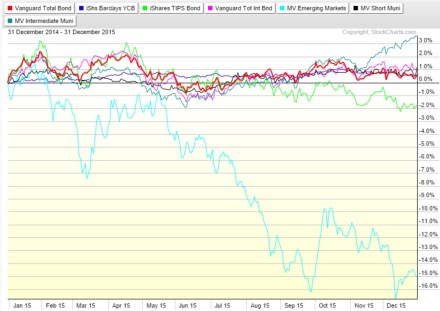
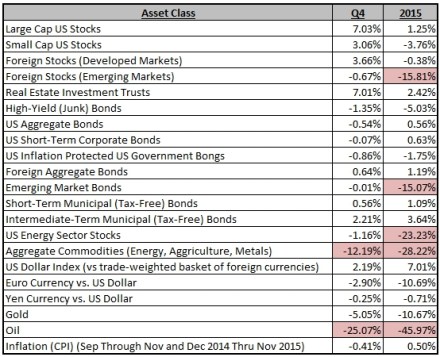
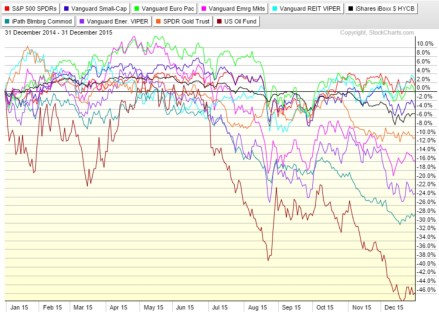
Just a quick snapshot of Q4 and 2015’s selected returns by segment of the market (returns are those of the segment’s representative ETF). It was a mostly flat to slightly down year with US Large Company stocks up slightly, but US Small down slightly more. Foreign Developed areas were up over 7%, but Foreign Emerging was down more (~15%). REITs were up a bit, but high-yield down a bit more. The noted exception area to the mostly flat to slightly down market was in Commodities. Led by oil (-46%), commodities in aggregate were down 28%, following their almost 19% drop in 2014

On the bright side, Q4 was mostly positive (again with the exception of Commodities). And inflation (as measured by the CPI) remains very low thanks mostly to the fall in commodity prices. The high correlation between your spending and commodity prices (esp. energy) is why we include commodities in investment portfolios. It’s ok if that portion of your portfolio falls in value if inflation is substantially lower than the 3% expectation we incorporate into most financial plans. The reverse is also true… If commodity prices rise sharply, your spending has a tendency to increase more than planned and the commodity portion of your portfolio is likely to rise along with it.

2015Q4-1

Stocks / REITs / High Yield / Commodities over the course of the year:2015Q4-2

Bonds over the course of the year:2015Q4-3

As a reminder, while it might not feel good, unless you are retired and no longer saving money, you are far better off with flat to down markets that rise later in life than you are with a market that moves steadily upward. It allows more investing at lower prices which results in a higher amount of total wealth assuming the same endpoint (see The Value Of Volatility). If you are retired and no longer saving, you’re likely to be in a much more conservative portfolio with lower expected returns factored into your financial plan so that the occasional down year in stocks doesn’t have a big impact on the plan overall.

Who Pays Federal Income Taxes

Per the Tax Foundation, the IRS released updated federal tax burden numbers for tax year 2013. In case anyone is interested, some numbers below that show the progressivity of the federal tax system and help you figure out where you fit in. No political intentions with this post… I leave that to the politicians. I’m sure there are about as many readers who feel there’s too much progressivity as there are those who feel there’s not enough.

· The top 1% of filers had adjusted gross income (AGI) of at least $429k, earned 19% of the total AGI for all filers, and paid 38% of all Federal income tax.

· The top 5% of filers had AGI of at least of at least $180k, earned 34% of total AGI, and paid 59% of all Federal income tax.

· The top 10% of filers had AGI of at least $128k, earned 46% of total AGI, and paid 70% of all Federal income tax.

· The top 25% of filers had AGI of at least $75k, earned 68% of total AGI, and paid 86% of all Federal income tax.

· The top 50% of filers had AGI of at least $37k, earned 89% of total AGI, and paid 97% of all Federal income tax.

· The bottom 50% of filers had AGI less than $37k, earned 11% of total AGI, and paid 3% of all Federal income tax.

Note that in most cases, AGI is all sources of income (wages, self-employment, investments, rents, etc.) minus items that are excluded from income (401k contributions, health insurance premiums, FSAs, etc.) and certain “above-the-line” deductions (HSA contributions, IRA contributions, etc.). It does not subtract out itemized deductions, the standard deduction, or personal exemptions. Those come out of AGI to determine taxable income, to which the tax rates are then applied. The taxes paid above also excludes social security and medicare taxes since they’re not part of the federal income tax.

Full analysis and historical date back to 1980 are available on The Tax Foundation website.