Recent Executive Actions On Unemployment Benefits, Payroll Taxes, Student Loans, & Housing Assistance

On August 8, President Trump issued executive orders related to the extension of expanded unemployment benefits, the deferral of employee payroll taxes, an extension to the waiver of student loan payments and interest, and a directive to various cabinet members to take action to prevent residential evictions and foreclosures resulting from financial hardships caused by COVID-19. These orders were an attempt to circumvent the need for congressional action on additional COVID-19 assistance, which seems to have at least temporarily, resulted in a standoff in the Senate. The provisions in these orders are complicated and may result in legal challenges. There has been some additional guidance issued by the Dept. of Labor and FEMA, both of whom are involved in implementation. Below is a quick summary of what I understand so far related to these orders.

Unemployment – the CARES Act provided $600 per week of federally funded unemployment insurance benefits, in additional to standard state funded unemployment benefits. The additional $600 per week benefit expired on July 31, 2020.  This executive order and supplemental guidance authorizes states to voluntarily apply for aid from FEMA to fund an additional $300 per week benefit from August 1 through December 27, not to exceed $44 billion (which would only last about 5 weeks given the number of currently unemployed people). While the original order called for a $400 per week benefit, only 75% was to be Federally funded, with states picking up the additional 25%. Given fiscal issues at the state level, additional guidance was provided that states could treat their $100 per week as additional unemployment compensation or as a portion of their existing unemployment compensation paid (i.e. make the additional benefit $400 by taking the FEMA $300 and adding $100 to the current amount they pay OR make the benefit $300 by taking the FEMA $300 and treating $100 of the current unemployment benefit calculation as part of the program). Participation is up to the states and many seemed to be waiting for the supplemental guidance on their $100 per week portion before applying. To date, SD has announced it will not participate and AZ, CO, IA, LA, MO, NM, and UT have applied and been approved. It is unclear when payments will be able to begin for participating states due to administrative delays in changing unemployment systems to comply. Some states may begin in late August, with others starting payments in September. Some states, like SD, may choose not to participate at all. In order to receive the $300 or $400 supplement, individuals need to be collecting unemployment at a rate of at least $100 per week and must certify that they are unemployed or partially unemployed due to the disruptions caused by COVID-19.

Payroll Taxes – this order directs the Treasury Secretary to defer the collection of the employee portion of social security taxes (currently 6.2% of the first $137,700 of wages earned in 2020), for Sepember 1 – December 31 without interest or penalties. It also directs him to “explore avenues, including legislation, to eliminate the obligation to pay the taxes deferred” (i.e. forgive the taxes, rather than just defer them). This would apply for workers earning less than $4000 per bi-weekly period (adjusted equivalently for other payroll periods). Additional guidance is required from the Treasury Secretary as to how this program will work. In practice, employers collect Social Security taxes as the FICA portion of payroll taxes. If they fail to collect these taxes, they are generally responsible for paying them on behalf of the employee. That means that if an employer allows an employee to defer the tax to post-12/31 and the employee cannot pay, the employer could be on the hook for these taxes. From an employee perspective, deferral of the tax for a few months isn’t a big help if the bill then comes due in January for the whole deferral period. However, if the deferred taxes are forgiven, that would be a huge help. Payroll taxes can’t really be forgiven without Congressional action though, so forgiveness seems uncertain. Without additional guidance, it would be difficult for an employer to stop collecting the social security taxes. Even if they did participate and offer it to employees, it may cause financial stress in early 2021 for those employees that participate and need to pay the deferred taxes. Of course if there is any chance of forgiveness that is dependent on deferring the taxes to 2021, then employees have a strong incentive to participate as much as their employers allow them to. We’ll have to wait for further guidance to understand how (if) this order will ultimately work.

Student Loans – the CARES Act provided for deferral of student loan interest and payments through September 30, 2020. This order effectively extends that (voluntary) deferral period through December 31, 2020.

Housing Assistance – the CARES Act issued a moratorium on evictions that expired on July 24, 2020. This order does not extend that moratorium. Instead, it directs various cabinet member to take action to find ways to minimize residential evictions and foreclosures during the ongoing COVID-19 national emergency, to review existing authorities that can be used to prevent evictions, to identify funds that could be used to help renters and homeowners, and to consider whether any further halting of evictions are reasonably necessary to prevent further spread of the virus.

Congress has adjourned through Labor Day, so barring any emergency callbacks, which look to be a very low probability at this point, guidance on the programs above is all we’re likely to get from now till then. I suspect there will be another stimulus act passed in September/October, but these executive orders are likely to be it until then.
Housing Market Progress

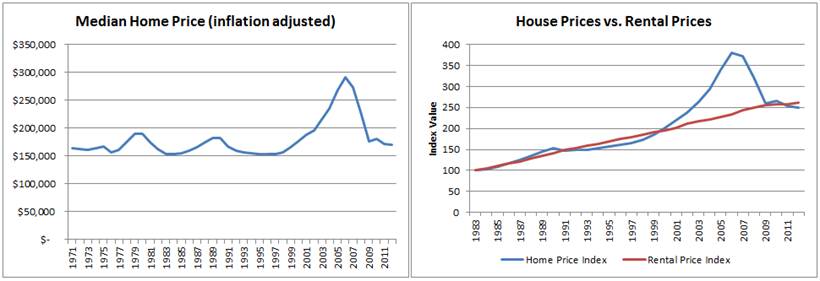
I wanted to quickly update two of the housing charts that I originally posted in the PWA Newsletter back in Q4 2009 (I’ve posted that article in the blog archives for reference). The first shoes the inflation-adjusted median price of a home in the U.S over time. The second shows a comparison of a national house price index (proxy for cost to buy) with a national rent index (proxy for cost to rent).

A few key takeaways (all from a national level of course):

1) House prices generally do not outpace inflation by very much on average. While there are repeated boom and bust cycles, and the 2000-today cycle is very fresh in memory, looking at the first chart above, you can see that on an inflation-adjusted basis (as measured by CPI), house prices have remained fairly steady over the past 40 years.

2) House prices, on average, are strongly correlated with rents.

3) The 2007-2012 bust in housing prices has not depressed the market as a whole to absurdly low levels. Real estate is not at a bargain price today as compared with rents or inflation-adjusted historical prices. Rather, the boom of 2001-2007 created prices that were absurdly high. These prices are now back to reasonable levels on a national level (local pockets of under/over valuation can obviously occur).

4) With mortgage rates at historical lows and prices at reasonable levels, affordability is near all-time highs. Buyers with a 20% downpayment and the median income level are able to afford a monthly payment that is very low as a proportion of their income, as measured by historical standards.

5) It’s tempting to say that prices are about as low as they can go, but it is a bit dangerous to make that assumption because:

a. If mortgage rates were at a more normal level by historical standards, buyers would be able to afford much less. What happens when rates eventually move back up?

b. The mortgage interest tax deduction is in question for the future. While we strongly doubt the deduction will be taken away in full, it is possible that it will be capped at a level much lower than the $1M of mortgage as it is today, and probable that the deduction for 2nd residences may be taken away completely. This would make the playing field between renting and buying much more equal, all other things being equal.

c. There is nothing to say that prices can’t overcompensate to the low side just like they did to the high side in 2001-2007.

6) Conclusion: no crystal ball, but the future of house prices looks considerably better than it did a few years ago.

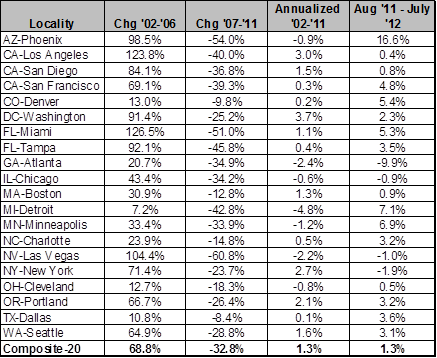
On a more local level, I did some slicing and dicing of the Case-Shiller home price index data. As you might expect, the localities that had the largest price increases in 2002-2006 had some of the sharpest falls in 2007-2011. I also included a column for change over the past year so you can tell what’s currently going on in your area (or an area near you). Sad story for the Atlantans who are reading this, but Phoenix, wow. Many cities definitely starting to see a (at least temporary) turnaround. Amazingly, the annualized increase in prices from 2002-2011 for the Composite of all 20 localities in the index (weighted by number of units) was still positive 1.3% per year even after the traumatic drops over the last few years. The last 12 months have shown an increase at that same 1.3% pace nationwide.

Re-Re-Refinancing

Mortgage rates are back at historical lows with last week’s national average on a 30-year fixed rate loan (per Freddie Mac’s mortgage survey) at 3.53%.  Even if you just refinanced in the last year, it may be worth your while to explore re-financing again.  In very simplified terms, you can estimate whether refinancing makes sense for you by dividing the closing costs by the amount you’d save on your payment each month and comparing that number, which is frequently called the “payback”, with the amount of time you plan to stay in the home.  I like to call this “broker math” or “refi 101”.  The calculation is quick, easy, and gives a decent first indication of whether the refinance could be worthwhile.  In reality though, there are some additional considerations: 

1)     What are the real closing costs for the loan?  Some lenders quote their origination fee, but leave out third party fees in their initial estimates.  Others quote origination fee, third party fees, and “pre-paids”, which are partial month’s interest and/or an initial deposit to an escrow account of a few month’s property tax and hazard (homeowners) insurance.  Others still will quote “no out-of-pocket closing costs” because they will allow you finance the costs into the loan.  This doesn’t mean you’re not still paying them!  The true costs of the loan include the lender’s fees (origination, application, underwriting, and points) + all third party fees (appraisal, title insurance, taxes, recording, processing, legal, document).  Prepaid items (partial month’s mortgage interest and escrow) are not true costs and should not be factored into the analysis because they are not costs in connection with the loan.  The mortgage interest portion is the interest for the partial month if you close in the middle of the month, but you’ll get to skip one month’s mortgage payment so there’s an offset.  The escrow deposit isn’t a true cost because you’re just pre-paying something you’d have to pay at a later date anyway, and if you have an existing escrow account on your current loan, you’ll receive a refund from that shortly after closing.

2)     What is the real benefit of the lower monthly payment?  Simply looking at the lower payment as a complete benefit to you is not the correct way to view a refinance.  That’s because only a portion of the payment reduction is due to a reduction in interest.  In fact, there are four components to watch out for:

  • (+)True interest reduction – this is your real benefit
  • (-)Tax impact of the true interest reduction – if you itemize, a portion of the lower interest payment means that you’ll have a lower mortgage interest deduction which means you’ll pay higher tax.
  • (-)Principal reduction from extending the term of your loan – not a real benefit because your mortgage is going to last for extra months on the end of the loan to account for this
  • (-)Principal reduction from amortization schedule – not a real benefit because more of each payment will be going toward interest after the refinance, so if you sell the home a few years after the refinance, the principal balance will be higher than it would have been without the refinance.

Calculating all of these impacts is somewhat challenging.  We’ve developed excel models to do the calculations.  Contact your PWA financial advisor if you need help.

3)     Do you have enough equity in the home to avoid needing private mortgage insurance (“PMI”)?  To qualify for a traditional loan with no insurance (assuming good credit), you’ll need a loan-to-value (“LTV”) ratio of no more than 80%.  To calculate your LTV, simply divide your mortgage amount by your estimated home value.  If the result is < .8, you probably won’t need mortgage insurance.  If it’s > .8, you probably will and if you do, there could be other up-front costs in the loan or there will be an ongoing PMI payment which typically equates to an interest rate that’s about 1% higher than the one quoted on the loan.  Be careful.  You probably won’t want to refinance a loan that doesn’t have PMI to a loan that does have PMI unless your interest rate is falling by ~2% or more.

4)     Once you’ve compared the true up-front costs of the loan with the real monthly benefits of the lower payment, you can calculate your payback by dividing the benefits into the cost.  If you plan to remain not only in the home, but also in the loan, for longer than the payback, then the refinance makes sense.  But do you really know for certain that you’re going to be in the home AND in the loan at a certain point in time?  Probably not (especially if you might refinance again).  For this reason, I advise clients to double the payback period and if they’re still confident they’ll be in the home and the loan for that amount of time, then do the refinance.  If the confidence is not there, then refinancing could add cost without enough payback before you exit the loan through a sale or another refinance.

5)     Do you have enough equity to qualify for traditional financing?  There is a chance that you’ll go through the loan process, pay an appraisal and potentially an application fee, and find out that your home is worth less than you thought and your LTV is higher than 80%.  In that case, adding mortgage insurance may be the only way to continue with the refinance.  Doing so will add to the costs and likely will extend the payback period to the point where the loan no longer makes sense.  In this case, you won’t proceed with the refinance, but will still be out the appraisal and application fee.  So, you need to have a fairly good idea in the value of your home and that you’ll have enough equity before you refinance.

6)     Many lenders will quote a standard rate and closing cost combination when you ask for a quote.  But, there are other options in most cases.  For a refinance, especially in the case where you don’t know how long you’ll be in your home or whether rates will fall sharply and you’ll want to refinance again, the best option may be a slightly higher than market rate and a credit that offsets most or all of your closing costs.  In this case, you remove all of the cost by giving up a little of the benefit and make the payback zero (or close to zero) months.  Explore that with your broker/lender before making a decision based on an initial quote.

Determining whether or not to refinance is really an intricate cost / benefit analysis.  Many borrowers look only at the payment reduction and the amount of money they need out-of-pocket to close and may put themselves in a worse position by doing so.  Make sure you think through this decision and talk to your PWA advisor before and during the process.  Once you get this right, and you’re certain you’ll benefit, refinancing really can be a free lunch.  And, there’s no better tasting lunch than a free one.

Has The Housing Market Bottomed Yet?

***This post was originally published in PWA’s Newsletter: The Pretirement Press in Q4 2009 and it’s publish date has been edited here to reflect the approximate initial publish date***

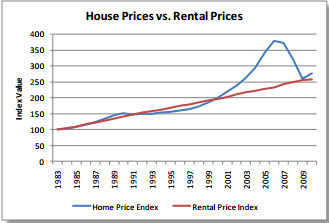
By now we all know we were in the midst of a housing bubble earlier this decade, which peaked in 2006-2007 in most areas. While it’s easy to say in hindsight, one of the clearest depictions of just how dislocated prices were compared to the fundamental value of a home is a comparison of housing prices to rental prices. A house’s value can always be tied back to the cash flows that an owner of that house could earn if she rented the house to a tenant. In other words, a good way of determining if a house is too expensive compared to renting is to determine if you can cover the costs of ownership (mortgage interest, insurance, property taxes, association fees if applicable, maintenance, potential vacancy, management, etc.) with the rental income. If you’re planning to buy a rental property, contact your advisor who can help you project the long-term return on your investment taking all of these factors into account.

The U.S. government tracks average rental prices across the country in an index which is a component into inflation measurements. Industry organizations track median house prices over time and so it’s easy to compare how each trends in relation to the other. Not surprisingly, as the chart below shows, the house price index and the rental price index track each other quite closely in most cases. What can also be seen is the huge spike in the home price index with no accompanying spike in rental prices from 2000 to about 2006-2007. As is usually the case in a bubble, prices have returned to a level that coincides with their fundamental value (measured by rental prices). So, does this mean the market has bottomed? Not necessarily, because there’s nothing to say that prices can’t fall to an extreme on the other side of the rental price index just like they peaked above it, but it does look like market is reasonably priced when compared to historical rents.

Additionally, there have been strong signs of life in the housing market in recent months with existing home sales gaining ground in four consecutive months (Aug-Nov). Not only have sales been increasing month over month, November’s sales are up 44% over November of 2008, showing the people are definitely out there buying. The number of homes for sale has also come down in the past four months, from just over 4 million, to just over 3.5 million. If the pace of sales from November could continue and no additional houses were put on the market, the current inventory of homes for sale would be depleted in 6.5 months. That compares to about 4-5 months of supply in a steady housing market, and a peak of 10-11 months around this time last year during the worst of the downturn.

What about prices? There are two different nationally recognized sources for home prices, the National Association of Realtors (NAR) and the Case-Shiller (CS) Index. CS always runs a month behind NAR, so we only have CS data through October where both sources show about an 7-8% drop in median home price year-over-year, but CS shows no change in month-over-month price vs. a decrease of about 2% from NAR. NAR’s November report shows virtually no change in price compared to October. Both reports show a trough in prices in April of 2009, at a level approximately 5% lower than today. It’s a mish-mosh of data, but it appears there has been some stabilization in prices, and when compared with the increase in sales data, it looks as though a recovery is in progress.

Before concluding that the housing crisis is over however, we have to look at the extraordinary circumstances that are currently affecting buyers as well as the impact of potentially increasing foreclosures. First, the First-Time Homebuyer Tax Credit of $8,000 was set to expire in November which could have

influenced buyers who were planning to buy soon to accelerate their purchase into the last few months. Congress has since extended (to April) and expanded (to include some existing homeowners) the credit, but at some point it will have to end. The extended credit could cause a lull in sales in December/January before spiking again to beat the April deadline.

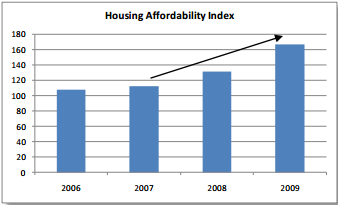
Second, the housing market is still being stimulated by the Federal Reserve as they purchase mortgage backed securities on the open market to keep mortgage rates low. With prices down significantly and historically low interest rates at the same time, home affordability is extremely good. NAR calculates

a housing affordability index based on median income vs. the principal and interest owed monthly on the average mortgage for a home with the median home price. This index has soared as prices and rates have come down, but incomes have remained fairly steady in the past few years. The Fed has indicated that it plans to end its mortgage purchase program in March 2010 which could allow rates to start increasing. Combined with the credit ending in April 2010, this could put pressure on the housing market for a second wave down in prices.

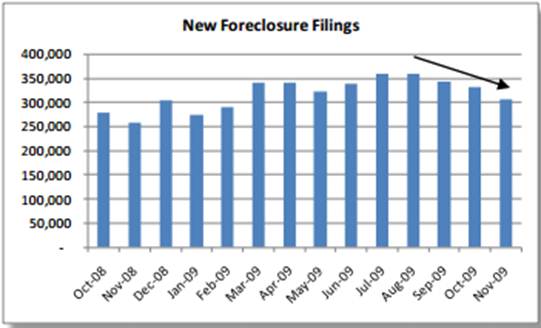
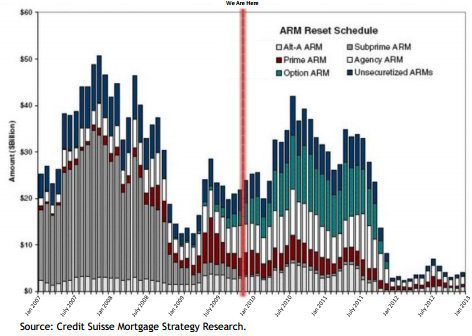
Also potentially impacting prices going forward is the rate of foreclosures. Again, a bit of improvement in recent months as new foreclosure filings have decreased. This is in part due to the moratorium on foreclosures in some states as well as the ramp down in subprime, adjustable rate mortgage (ARM) resets. But, while we’re almost out of the woods on subprime, there is a new wave of ARM resets coming, in the form of option-ARMs. These are adjustable rate mortgages that allow the borrower to choose his monthly payment, sometimes even less than the interest amount, which can result in increasing rather than decreasing mortgage balances. As those rates reset from extremely low teaser rates, more homeowners could find themselves unable to make their payments, just like the subprime situation that peaked in 2008.

Another factor that could restart another wave of foreclosures is the increasing number of homes that have negative equity. As prices continue to fall, more owners find themselves upside-down on their mortgage, owing more than the house is worth. The Wall Street Journal recently published an article with some staggering statistics in it on this point.

· 23 % of homes that have a mortgage are worth less than the mortgage balance

· 50% of under-water homes are more than 20% under-water

· 40% of mortgages started in 2006 are underwater

· 10% of mortgages started this year are already underwater (so much for bargain hunting!)

The lack of equity in many homes contributes to the growing number of foreclosures which in turn puts more pressure on neighboring home values. So, while we have definitely seen recent signs of life in the housing market in terms of sales and prices, there is good reason to suspect another tick up in foreclosures, mortgage rates likely increasing after March, and the homebuyer tax credit expiration slowing down the pace of sales again. For those reasons, it’s too early to feel like the housing market and housing prices have bottomed on a national level. Temporary stability, yes. Recovery, not quite yet.